
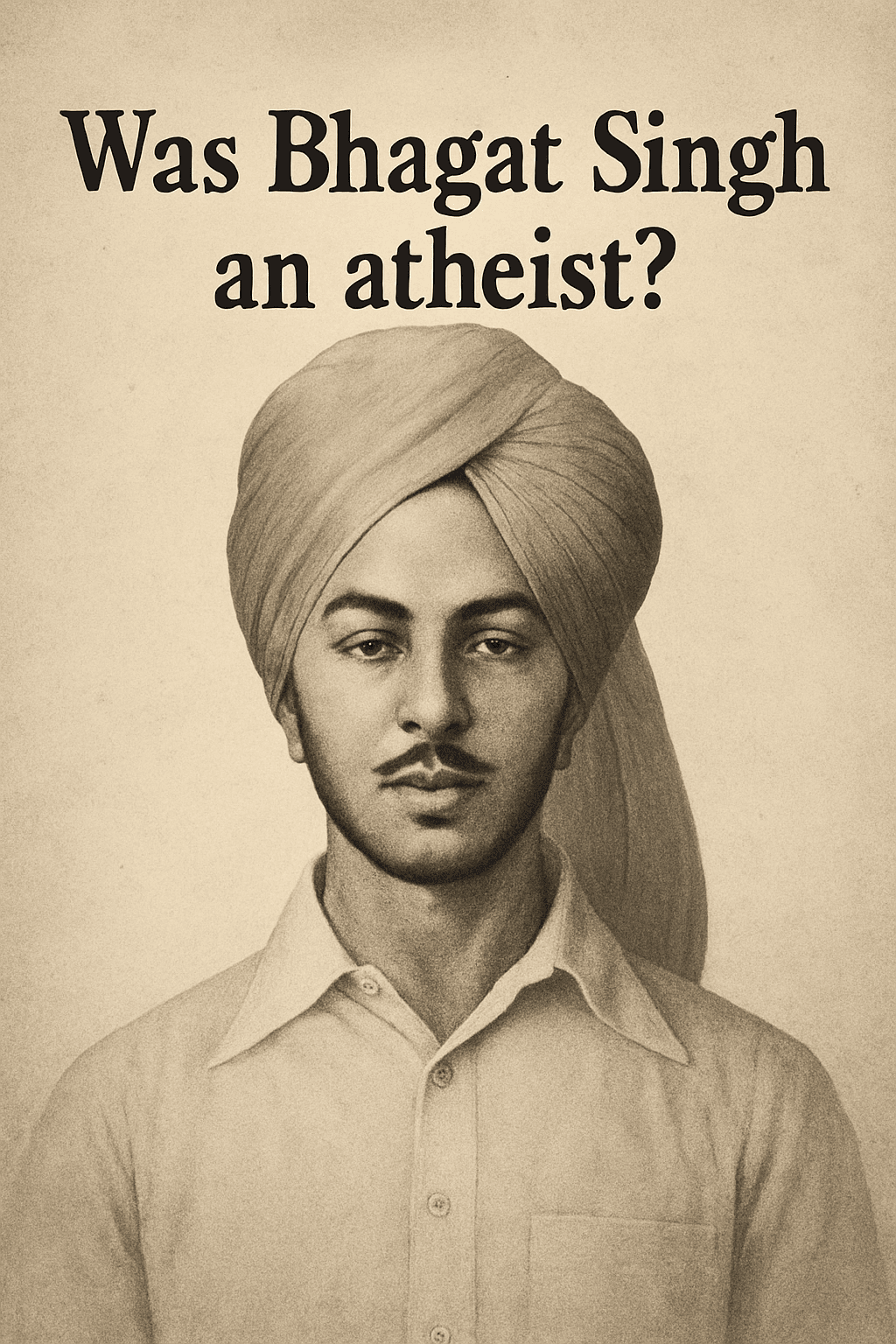
For years, people have debated whether Shaheed Bhagat Singh was truly an atheist or if his beliefs evolved before his martyrdom. One of the most significant accounts in this discussion comes from Bhai Sahib Randhir Singh Ji, a saint-soldier and fearless patriot whose life in prison left a deep mark on countless freedom fighters. Their historic meeting inside Lahore Central Jail, recorded in Bhai Sahib’s own words, reveals a side of Bhagat Singh’s spiritual journey and sheds light on a side of him that many have overlooked.
Bhai Sahib Randhir Singh Ji rebelled against the British government, and because of that, he was arrested in the Lahore Conspiracy Case. At the time when he was arrested, Sikh prisoners in jail did not have any freedom to practice their religious principles. Bhai Sahib Ji was a fully committed Rehitwan Gursikh (one who strictly follows the Sikh code of conduct), and because of this, even in jail, he remained fully dedicated to strictly following the Guru Sahib’s Rehat (code of conduct).
By following the Khalsa Rehat and obeying the Guru Sahib’s will, he endured many harsh and cruel conditions given by the jail authorities, but he did not give up his faith. In the end, by standing firm on his principles, he succeeded, and because of him, Sikh prisoners were granted the freedom to practice their religion.
Because of Bhai Sahib Ji’s life full of struggle, he was held in very high respect in the Sikh Panth. All patriots and political prisoners respected him greatly. During his prison journey, Bhai Sahib Ji was transferred to many jails across India. Wherever he went, political prisoners were very eager and keen to meet him because of Bhai Sahib’s unwavering love for Sikhi and his fearless qualities of standing firmly against oppressors. All the patriots were deeply influenced by Bhai Sahib’s personality.
Among these prisoners was Sardar Bhagat Singh as well. The meeting between Bhai Sahib Randhir Singh Ji and Sardar Bhagat Singh can be read in Bhai Sahib’s book Jail Chithian, which he wrote later. In this, Bhai Sahib revealed how much they met and what conversations took place between them.
When Bhai Sahib Randhir Singh Ji came to Lahore Central Jail, Bhagat Singh wanted to meet him. At that time, Bhagat Singh’s hair had been cut. Even after having his hair cut once, he kept cutting his hair repeatedly. Because of this, Bhai Sahib initially refused to meet him.
After many repeated requests from Bhagat Singh, Bhai Sahib finally agreed to meet him. When Bhagat Singh met Bhai Sahib Randhir Singh Ji, he was an atheist. Some Sikhs who had forgotten the ideology of Gurmat, passed down by our ancestors, became greatly influenced by these Western ideas. Atheism among Sikhs began after the Russian Soviet Revolution of 1917. Many educated individuals from Sikh backgrounds started studying Marxist philosophy, and this sparked an atheistic wave among Sikhs.
This atheistic wave initially began as the Kirti movement and later developed into the Communist movement. At that time, many Sikhs fell victim to this wave, including talented young men like Sardar Bhagat Singh. However, Sardar Bhagat Singh should have understood that Western atheistic ideology was as foreign to our country and culture as British imperialism, against which he was fighting.
In the Jail Chithian, Bhai Sahib Randhir Singh Ji wrote that when Bhagat Singh first saw Bhai Sahib, his happiness knew no bounds. He met Bhai Sahib with great love and respect. With great humility, he told Bhai Sahib how, out of compulsion, he had his hair cut and how his comrades advised him to change his appearance by cutting his hair.
Seeing Bhagat Singh’s humility and respectful demeanor, Bhai Sahib was deeply moved. He lovingly explained to Bhagat Singh that, although he admired his spirit of patriotism, his companions had not given him good advice in the decision to cut his hair.
After hearing the criticism about cutting his hair, Bhagat Singh told Bhai Sahib Ji that he would keep his hair for Bhai Sahib’s happiness. But Bhai Sahib replied that there was no need to keep hair unless it is kept for the sake of Waheguru.
Hearing this, Bhagat Singh said that although he felt proud to call himself a Sikh, inwardly he had become an atheist who no longer believed in the existence of God.
Bhai Sahib was happy to hear the truth about Bhagat Singh’s inner condition because now Bhai Sahib could treat the root of this problem. Bhai Sahib told him that he would never die because he had a soul, and the soul never dies. He also said that he would definitely return to this earth again because the soul is immortal.
These words spoken by Bhai Sahib, who was in a very high spiritual state at that time, had a deep impact on Bhagat Singh. Bhagat Singh was silent for a few minutes after hearing Bhai Sahib Ji’s words. In the end, Bhagat Singh himself admitted that now he believed that Waheguru exists and that his soul would never die.
Based on the above information, after meeting Bhai Sahib Randhir Singh Ji, Bhagat Singh began to have faith in Waheguru and Sikhi. From the start, he was deeply influenced by the Sikh tradition of martyrdom, and now he also came to believe in Sikhi. Faith and belief come in many levels; perhaps he did not have the same level of faith as Bhai Sahib Randhir Singh Ji, but he began to believe in the existence of Waheguru. That is why, after that, he did not cut his hair and was martyred as a Sikh.
Sardar Kapoor Singh Ji wrote in his book Sachi Sakhi that at one time Bhagat Singh even expressed a desire to take Amrit from the Panj Pyare, among whom Bhai Sahib Randhir Singh Ji was serving. But the British did not allow Bhagat Singh’s wish to be fulfilled.
Bhagat Singh’s cremation was performed according to Sikh Maryada, while Sukhdev and Rajguru’s cremations were done according to Hindu rites. For this ceremony, the government brought a Sikh priest and a Hindu priest. Bhagat Singh’s Antim Ardas (prayer) was done by Granthi Bhai Natha Singh Ji from Kasur.
Later, Bhai Natha Singh’s statement appeared in newspapers describing that at the time of cremation, Bhagat Singh’s hair was six inches long and he had a beard on his face.
If Bhagat Singh had remained an atheist after meeting Bhai Sahib, then why would he have kept his hair like a believer Sikh? If he did not believe in Sikhi, then why didn’t he get his hair cut in jail?
What Bhai Sahib wrote about Bhagat Singh in his Book Jail Chithian is a respected Sikh perspective based on Bhai Sahib’s own truthful and honest testimony as a devout Sikh. Bhai Sahib mentioned that Bhagat Singh had agreed that he would never die, that is, Bhagat Singh expressed belief in the existence of the soul and faith in Waheguru.
While there are different narratives about Bhagat Singh’s beliefs, instead of giving preference to false narratives by non-Sikhs and atheists, many within the Sikh community give preference to this Sikh perspective. Without any hesitation, we can say that Sardar Bhagat Singh truly left this world as a Sikh, and he is worthy of respect for us all.