
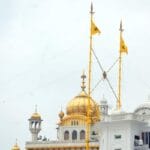
 Nishan Sahib was first raised by the third Sikh Guru, Dhan Guru Amar Das Patshah Ji, at Goindwal Sahib. In Gurbani, it is clearly mentioned that the religious flag, the Nishan, of Dhan Guru Amar Das Patshah Ji was white in colour. The white colour is a symbol of devotion, peace, and love. This shows that the house of Guru Nanak Patshah Ji is a treasure of devotion, and that this path of devotion is unique and different from all others.
Because of this, raising a white Nishan Sahib meant that the Sikh faith was distinct from all other religions and had its own independent identity and separate recognition.
After the martyrdom of Dhan Guru Arjan Dev Patshah Ji, Sikhi took a new turn. Guru Arjan Dev Patshah Ji gave his martyrdom for the principles of faith and taught the Sikh community that while walking on the path of devotion, one must also be ready to give one’s life for righteousness. A true devotee, a true Sikh, is one who is always ready to sacrifice their life for the principles of Sikhi. With this, Sikhi took the form of a nation.
When the teaching of devotion was joined with the readiness for martyrdom, the master of Miri Piri (spiritual and temporal authority), Dhan Guru Hargobind Patshah Ji, changed the colour of the Nishan Sahib to Xanthic (basanti). This colour and this Nishan Sahib became a symbol of sacrifice and martyrdom.
Later, the tenth Guru, Dhan Sri Guru Gobind Singh Ji, raised the Nishan Sahib in blue. The blue colour is a symbol of royalty, leadership, and sovereignty.
The blue Nishan Sahib means that the Sikh community is a distinct and independent nation. It is a symbol of the political strength of the Sikhs, meaning that the Sikh community is a sovereign and leading community to whom Guru Sahib has granted authority and sovereignty. This Nishan Sahib represents that the Sikh community has its own independent existence. The Sikh community is not dependent on anyone, nor is it under the control of any state.
Because of this, during wars and battles, the Nishan Sahib was always raised at the front, and the Khalsa (the collective body of initiated Sikhs) armies would march behind it.
Raising the Nishan Sahib on top of Gurdwaras means that it represents the special principles and ideals of Sikhi. This raises the question: what are these principles and ideals? There are four reasons behind this, which we will share today.
The first reason is that it is a sign of both spiritual and worldly life. First of all, let us clearly understand that the Nishan Sahib is not an ordinary flag that can be raised anywhere. It is raised only at Gurdwara Sahib and Takhat Sahib (the highest Sikh seats of authority), because the Nishan Sahib is a sacred symbol.
It tells us that wherever this flag is flying, both spiritual and worldly support is available. This is because the Gurdwara Sahib is a place where Guru Sahib’s presence is felt. There, the gift of Naam is shared, which purifies the soul. Through Kirtan (devotional singing) and Katha (spiritual discourse), the mind is cleansed, and guidance is given that shows the correct path in life.
The Langar (community kitchen) at every Gurdwara is open to everyone, where the rich, poor, needy, and hungry all receive Prashad (blessed food). This practice brings the principles of equality and selfless service in Sikhi to life. In the gathering (Sangat) and while sitting together in rows (Pangat), all distinctions between people disappear, and everyone sits in the loving embrace of the Guru, connecting with their Akal Purakh (Timeless Being). This contributes to the welfare of all (Sarbat da Bhala).
Gurdwaras also provide shelter and support, where the needy, homeless, and travelers can rest. When the Nishan Sahib is raised at a high place, flying at the top, it directly signifies that this is the house of the Guru, where anyone can come to seek a spiritual path. It is a place for everyone, like a spiritual college, a center that awakens those who are spiritually asleep or unaware, helping humans elevate their spiritual state. Here, true guidance for living a meaningful life is taught.
The Nishan Sahib is a symbol of all these values. It represents the Sikh way of life, emphasizing selfless service (Seva), remembrance of Waheguru (Simran), peace, charity, and the welfare of all. Raising it high also reminds us to live a life of higher purpose and inspires us to always strive for excellence in our spiritual and worldly lives.
This is why the Nishan Sahib cannot be raised over a private home, because a personal home is not equal to a Gurdwara Sahib and does not have the same facilities. When the Nishan Sahib is raised on a building, like when the Khalsa raised it at Lal Qila under Baba Baghel Singh’s leadership, it signifies authority. It means that the Khalsa Panth (the Sikh community) rules here, a place where no one sleeps hungry, no one is homeless, and people live in peace, free from oppression. Education, medical care, and other facilities are available for everyone, just as they are provided at a Gurdwara Sahib.
The second reason for raising the Nishan Sahib is to show the uniqueness of the Sikh community. The Nishan Sahib represents the distinct identity of the Sikhs. It shows that the Sikh community is a separate and unique nation in the world, just as every country has its own flag. For example, Spain, Italy, England, France, Germany, and the USA all have their own flags, showing that their people have their own way of life, language, clothing, and traditions.
Similarly, the Nishan Sahib represents the unique identity of the Sikh community and the Sikh faith. It signifies that Sikhs are not part of any other religion or nation. The Sikh community has its own distinct identity, independent of anyone else. The Nishan Sahib tells the world that the Sikh community has its own history, culture, clothing, Gurmukhi script, religious scriptures, traditions, ceremonies, and way of life, all of which are different from others.
Sikhs are unique, and this is a matter of pride, but it does not mean that others are inferior in any way. Just as people take pride in their own religion, history, and language, the Sikh community is proud of its distinct identity. The Nishan Sahib is a symbol that the principles of Sikhi are upheld here. From Guru Nanak Dev Ji to Dhan Guru Gobind Singh Ji Patshah, the divine light of all the Gurus resides in Dhan Sri Guru Granth Sahib Ji.
The third reason for raising the Nishan Sahib is to make it clear to the world whose place this is and whose authority prevails here. This is not an ordinary flag; it is the Guru’s flag. No human rule operates here; only the will and command of the Guru are followed. Wherever Dhan Sri Guru Granth Sahib Ji is present, that place becomes the Guru’s, and only the Guru’s instructions are followed. Personal whims, the desires of any individual, or interference from any government are never allowed in Sikhi.
Just as the national flag of a country, like India’s Tiranga or the American flag, signifies that the government rules there and its laws apply, the Nishan Sahib flying over a Gurudwara or Takhat Sahib shows that only the Guru’s authority is recognized here. The management, actions, respect, and honor at that place must all be according to the Guru’s will and in line with the Rehit Maryada (Sikh code of conduct). Everything is carried out under the guidance of Dhan Sri Guru Granth Sahib Ji and the principles of Gurmat.
So, the Nishan Sahib is a symbol of Patshahi (sovereignty), meaning that the true ruler here is the Guru Sahib Ji themselves. Sikhs have been referring to the Gurus as the true Patshah since the time of Guru Ram Das Patshah Ji. As Gurbani says, “Baitha sodhi Patshah Ramdas Satguru kahavai,” from then on, the Guru’s court became the court of the true Patshah.
Guru Sahib sits on the Singhasan (throne), the Chaur Sahib is waved, and Chandoa Sahib is raised above. These are all symbols of sovereignty, showing that the Guru Sahib is the true Patshah, the ruler of both the spiritual and worldly realms. They help and protect Sikhs in this life and the next. Such a Patshah is never under any government of the time; their authority is eternal, representing spiritual sovereignty. This is why Dhan Sri Guru Granth Sahib Ji is also placed in a regal manner. The rumalas (special cloths) and Chaur Sahib are all symbols of the royal dignity of the Gurus.
Wherever the true Patshah is present and their authority is recognized, their symbol, the Nishan Sahib, must be raised. The Nishan Sahib tells us that here, the rule of the true Patshah, Guru Sahib, and the Khalsa Panth prevails. No government, law, or politics of any country can interfere with this rule.
The fourth important meaning of the Nishan Sahib is something not commonly known and is understood only by those who have upheld the Guru’s sovereignty. Only Amritdhari Sikhs (initiated Sikhs) can carry weapons to the place where the Nishan Sahib is raised. No one else is allowed, not the police, soldiers, government officers, or even the Prime Minister of a country.
This is why the Guru’s presence is placed at the highest point, and all others are positioned below, showing the primacy of the Guru in all matters.
To explain this, let us take an example of a country’s embassy, such as the American Embassy in New Delhi. There, the American flag flies, and only American law applies inside the embassy. Only the American security personnel are allowed to carry weapons inside. The Indian police or army cannot carry weapons there. If they need to enter, they must first deposit their weapons outside. This means that only the authority that rules a place can allow its own forces to be armed.
The same principle applies to Gurdwaras where the Nishan Sahib is raised. Here, the Guru Sahib rules. That is why only the Guru’s devoted armies, the Khalsa, who are fully prepared and initiated, can carry weapons into the Darbar. It does not matter whether the weapons are spears, swords, shields, or modern arms; everything is permitted under the Guru’s instruction. The Guru Sahib themselves commanded the Sikhs to come fully prepared when visiting the Darbar, with weapons ready for presence in proper form.
No police officer, soldier, or government official can enter a Gurdwara in their official uniform with weapons. If they wish to come, they must join the congregation as an ordinary Sikh. Their rank, position, or post is never recognized in the Darbar. Only the Guru’s authority is acknowledged, and only the Guru’s command is followed.
The Gurus themselves taught this. For example, when King Humayun came to Guru Angad Dev Ji to reclaim his kingdom, Dhan Guru Angad Dev Ji did not give him any special authority above others, nor did they consider his rank or position. Similarly, when Akbar or Jahangir Bahadur Shah met the Gurus, they were never given any special honor above the congregation. They came, sat with the Sangat, took Prashad, and left along with the congregation.
Even today, the same rule applies. Wherever Dhan Sri Guru Granth Sahib Ji or the light of the ten Gurus resides, that place becomes the Guru’s authority. If any official or government person wishes to visit, they must leave their identity behind and come only as part of the Sangat (congregation).
If a soldier or police officer enters a Gurdwara in uniform or carrying weapons, it is considered disrespectful, because their uniform or weapons are seen as a challenge to the Guru’s house, as if they have come to attack. That is why Sant Jarnail Singh Ji Bhindranwale used to say in his speeches that no government official can enter the Darbar Sahib in uniform.
When government forces attacked Darbar Sahib, Sant Ji gave special instructions to all Sikhs that no retaliatory firing should be done until the army entered the perimeter. As explained earlier, when armed forces entered the sacred precincts in uniform, it was considered an attack. In response, the Sikhs fired to protect their holy place, Darbar Sahib.
This was not a new policy. It follows the same principle applied in embassies around the world. Just as no foreign government or police can enter another country’s embassy carrying weapons, similarly, in the Guru’s Darbar, only the Guru’s prepared Sikhs, fully trained and armed, are allowed to enter with weapons.
For this reason, the Nishan Sahib is not an ordinary flag. It represents the principles of Sikhi and the identity of the Sikh faith.
Nishan Sahib is a symbol of the glory of living and dying for Dharam (righteousness). It is a place of refuge for the humble, honor for the lowly, and protection for every oppressed person. Every cry for help is heard here. Every humble person, every helpless individual, and every oppressed soul is protected from tyranny and injustice. Whoever comes under the Guru Sahib’s protection is safeguarded by the fully prepared Khalsa armies.
This is the true meaning of the Nishan Sahib. Whenever the Sikh community went to war to defend the faith, the Nishanchis (flag bearers) were always at the front. This shows that the Khalsa armies stood firmly behind the principles of Sikhi, ready and determined. As long as the Nishan Sahib flew, Sikhs fought and gave their lives. When a Sikh carrying the Nishan Sahib was martyred, another Sikh would take the flag and continue. This demonstrates that the Khalsa forces were never defeated; they never gave up.
If the Nishan Sahib fell or was lowered, it would have meant that the principles of Sikhi had been compromised. But the Sikhs never allowed this to happen. That is why national flags may change, and kingdoms may rise and fall, but the Nishan Sahib of the Guru will always fly high. It will continue to wave, unshaken, for generations to come.