Whenever we think about Sri Harmandir Sahib, the values of shared belonging and equality naturally come to mind. This sacred place reflects Guru Sahib’s teachings, where people from every background sit together in sangat and pangat without distinction.
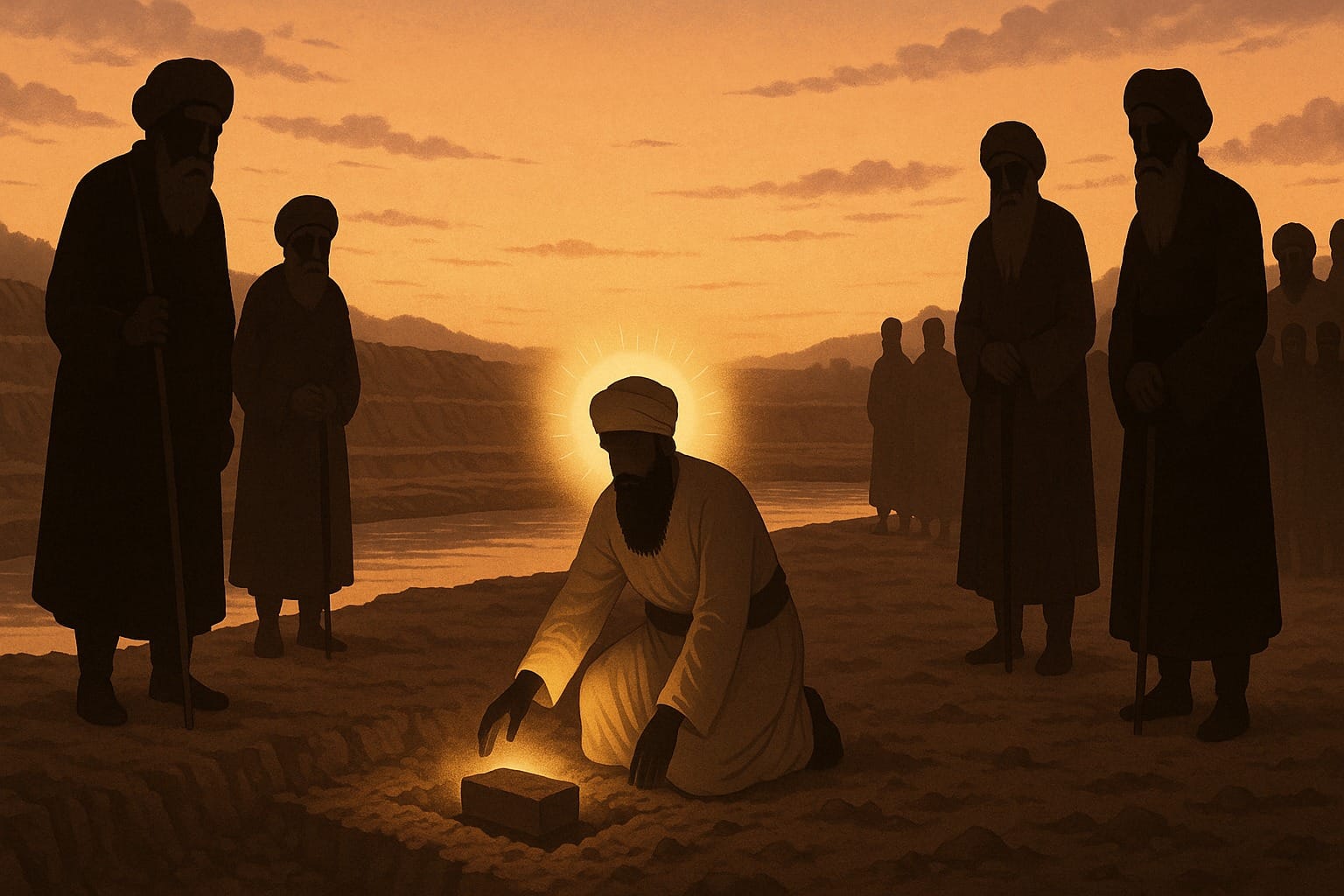
Over time, a particular sakhi has become widely known among Sikhs. Many have heard that Guru Arjan Dev Patshah Ji invited the Sufi saint Sai Mian Mir to lay the foundation stone of Sri Harmandir Sahib Ji. Because this story is often linked with ideas of openness and equality, it has been widely accepted.
However, when Sikh history is examined carefully, a serious question arises. Popularity alone does not make a sakhi historically true unless it is supported by reliable sources.
This leads to an honest question:
Is this sakhi supported by historical writings, or did it appear at a later stage?
To answer this, we must examine early Sikh sources and the manner in which historical accounts have been recorded and passed down.
Why was Sri Harmandir Sahib Ji established
When Guru Nanak Dev appeared in this world, society was deeply divided. People were separated by caste, social class, and religion. Discrimination was everywhere. Some were treated as high, others as low.
Guru Sahib rejected this completely. Guru Sahib taught that Akaal Purakh is both mother and father of all. Humanity is one family. This teaching of equality was not meant to remain only in words. It had to be lived.
Later, Guru Amar Das envisioned a physical place where these teachings could be practiced in real life. A place where anyone could come without fear or hesitation. A place where people of every background could sit together in sangat and pangat, listen to Bani, remember Naam, and eat together as equals.
This vision required a visible model. That model became Sri Harmandir Sahib Ji.
Guru Amar Das Patshah Ji selected the location, Guru Ram Das Patshah Ji began the work and founded the city of Amritsar, and Guru Arjan Dev Patshah Ji completed the sarovar and planned the Gurdwara Sahib in the center.
According to Sikh history, the foundation of Sri Harmandir Sahib Ji was laid in Magh, Samvat 1645 Bikrami, corresponding to 1588 CE.
The main problem with the “Mian Mir laid the foundation” sakhi
From 1588 to 1888, around 300 years, many Sikh historical works were written, yet not even one Sikh writer mentions that Sai Mian Mir Ji laid the foundation stone.
Well-known Sikh sources that do not record this sakhi, including works like:
This long silence is the biggest reason people raise doubts. If something this significant happened, we would normally expect it to appear in Sikh historical tradition much earlier.
What about Muslim sources and Mian Mir’s biographies?
One might assume that Muslim writers would proudly record such an event. After all, if a revered Sufi saint laid the foundation of the Sikhi’s holiest shrine, it would be a matter of great honor.
Yet even Muslim sources are silent.
The earliest biography of Sai Mian Mir Ji, Sakinatul Auliya, written in 1635 by Dara Shikoh, makes no mention of this event.
So neither Sikh sources nor early Muslim sources record this sakhi.
What Sikh history does record
Sikh history does record the foundation of Sri Harmandir Sahib Ji. The key text here is Sri Gur Pratap Suraj Prakash, completed in 1843 by Kavi Santokh Singh.
Kavi Santokh Singh Ji describes the event in detail:
So, according to this, the foundation stone was laid by Guru Arjan Dev Patshah Ji himself.
The established Maryada of Guru Sahiban
When we look at Sikh history as a whole, a clear pattern appears. When Guru Sahiban founded cities and established major places, the foundation was laid by Guru Sahib themselves:
In every case, the Guru Sahib laid the foundation.
After Guru Gobind Singh Patshah Ji, this responsibility passed to the Panj Pyare, who represent Guru Sahib.
There is no exception to this tradition. It would be strange that, leaving aside every other Guru-established place, only Sri Harmandir Sahib Ji would be treated differently.
Where the Sai Mian Mir Sakhi came from
The first time this claim appears is in 1848, in a book called Tarikh-e-Punjab, written by Boote Shah, a Muslim writer working under British supervision.
Later, Sohan Lal Suri copied this claim in Umdat-ut-Tawarikh. The story then appears in the Amritsar municipal committee report.
None of these writers gave any source or evidence.
Worse, their versions contradict each other. One says Guru Sahib sent a letter. Another says Guru Sahib traveled to Lahore. Details change completely.
This inconsistency itself exposes the weakness of the claim.
How it became popular among Sikhs
A respected Sikh scholar, Giani Gian Singh, unintentionally helped spread this story.
In the first two editions of his work, he does not mention Sai Mian Mir Ji at all. Only in the third edition did he include this claim, likely influenced by British-era writings.
Later writers copied his work without rechecking earlier sources, and the story slowly became accepted.
What do modern scholars say
Many respected modern scholars accept that Guru Arjan Dev Patshah Ji laid the foundation, such as:
The established truth
History, tradition, and evidence all point to one truth:
Guru Arjan Dev Patshah Ji laid the foundation of Sri Harmandir Sahib Ji with his own hands.
This truth does not diminish Sai Mian Mir Ji’s respect. But it restores historical accuracy and upholds the long-standing tradition of the Guru Sahiban.
We’re here to help. Whether you’re curious about Gurbani, Sikh history, Rehat Maryada or anything else, ask freely. Your questions will be received with respect and answered with care.
Ask Question