
Did Guru Nanak Dev Ji ever actually eat meat?
Did he ever give Sikhs permission to eat meat?
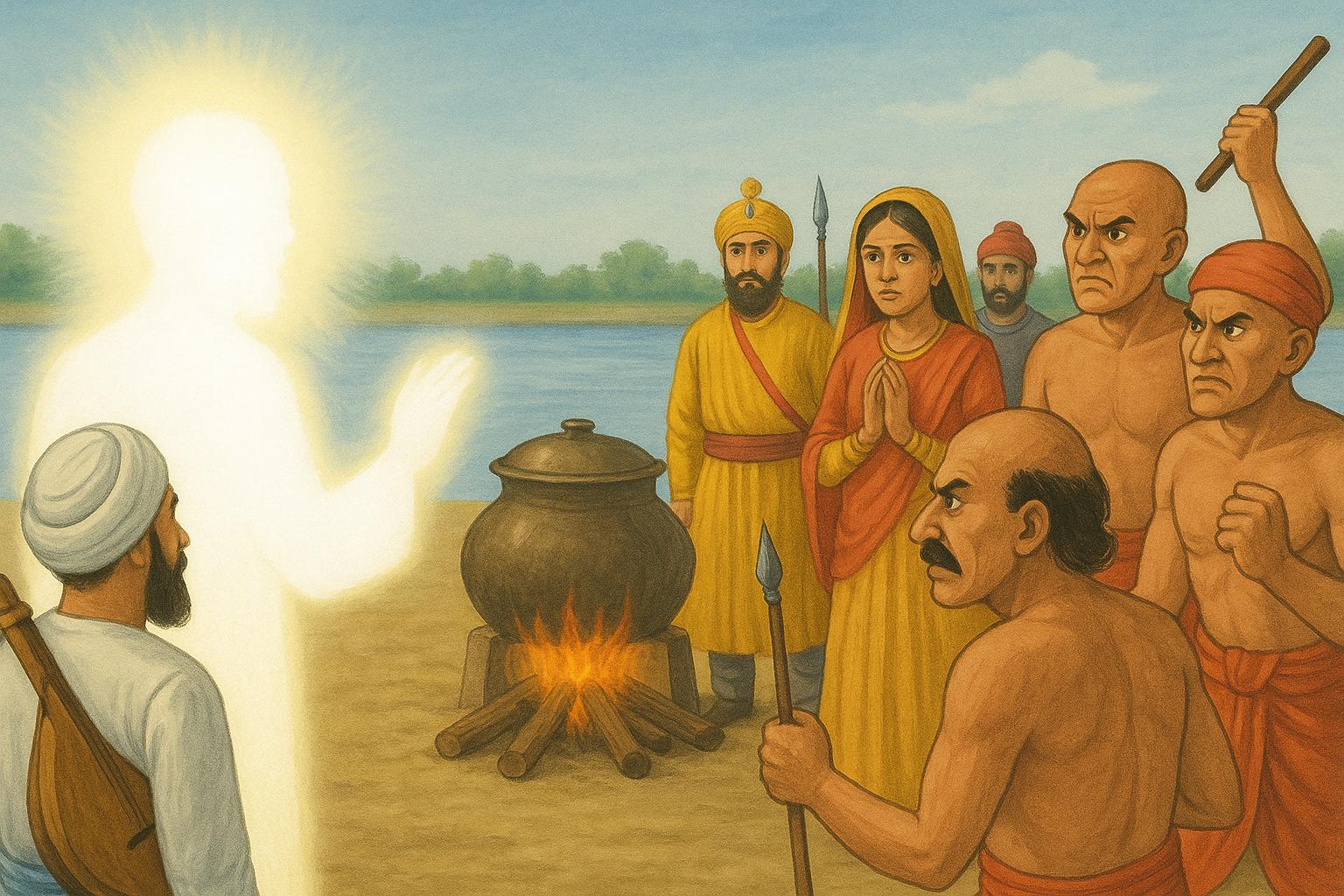
In the Janam Sakhis (traditional accounts of Guru Nanak Dev Ji’s life), there are some references, such as the sakhi of the Kurukshetra fair. In this sakhi, it is said that Guru Sahib went to the Kurukshetra fair and cooked deer meat there.
This raises several questions. Did Guru Sahib himself eat this deer meat, or did he allow Sikhs to eat it? Where did this deer meat come from, and why was it cooked? Was meat ever prepared in Guru Sahib’s langar (community kitchen), or not?
Does this mean that Guru Sahib personally consumed meat and permitted Sikhs to eat meat as well? Or is there a deeper and more complex meaning behind this incident, pointing toward something else altogether?
What is the background of this sakhi, and what is the real teaching hidden behind it?
In this article, we will openly and clearly examine these questions.
If there is any issue that causes the most debate within the Sikh Panth, it is the question of eating meat or not eating meat. Arguments in favor of it and against it are presented by both sides in many different ways.
When it comes to the meat issue, the most controversial sakhi (traditional account) is the Kurukshetra sakhi. During Guru Sahib’s time, a very large fair was taking place at Kurukshetra.
So first, we should understand what the Kurukshetra fair is and why it is held. At Kurukshetra, Hindus organize a very large fair during a solar eclipse. According to Hindu history and Hindu mythology, it is believed that a solar eclipse occurs because two celestial beings named Rahu and Ketu attempt to consume the sun. As a result, the nourishing rays of the sun are believed to be blocked, and food and water are considered unfit for consumption.
In an effort to protect the sun from being consumed, Hindus observe fasts. They also perform religious bathing and give charity at Brahm Sarovar, which they consider to be a sacred pond belonging to God.
To remove ignorance and show people the true and correct path, Dhan Sri Guru Nanak Dev Ji decided to go to the Kurukshetra fair so that people could be saved from darkness (spiritual ignorance).
During one of his Udasis (spiritual journeys), Sri Guru Nanak Dev Ji arrived at the Kurukshetra fair at the time of a solar eclipse. Now the question arises: where did this deer meat come from, and why was it cooked? Let us try to understand the information given in the Janam Sakhis and share what is written there.
According to the Janam Sakhis, when Guru Sahib and Bhai Mardana Ji reached the Kurukshetra fair, they sat under a tree on one side of the Brahm Sarovar, where a very large fair was taking place. After some time, Bhai Mardana Ji began to play the rabab (a stringed musical instrument) and started singing kirtan (devotional singing). Sri Guru Nanak Dev Ji sat beside him, listening attentively to the kirtan.
Absorbed in divine love and immersed in a spiritual state, Guru Sahib became deeply focused as the Shabad kirtan continued. While the kirtan was ongoing, Raja Jagat Rai, who was fleeing, arrived on horseback along with his mother and royal attendants, and came to Guru Sahib.
Some enemies of Raja Jagat Rai had overthrown his rule, expelled him from his kingdom, and forcefully taken control of his state. Because of this, Raja Jagat Rai intended to find a perfect saint so that, through the saint’s blessing or grace, he could regain his royal throne. During his journey, Raja Jagat Rai had hunted a deer and brought the dead deer’s body with him to the fair.
He was completely unaware of the rituals and customs of the fair. He did not know that eating and drinking were prohibited at the Kurukshetra fair, and especially that Hindu Vaishnav pandits strictly followed a vegetarian diet. Eating meat there was strictly forbidden. According to these customs, even lighting a fire during a solar eclipse was considered sinful. For the Vaishnav pandits, meat was regarded as something extremely impure, and they strongly despised it.
The Janam Sakhis state that as soon as the Raja and his mother came near Guru Sahib, they saw him and felt drawn toward him. They were so deeply impressed by Guru Sahib’s radiant presence and face, illuminated by the Naam, that they immediately went before him. As soon as they arrived, they bowed before Guru Sahib with deep reverence.
Jagat Rai told Guru Sahib his painful story and made an ardas (humble prayer) before him, asking for his grace so that he could regain his kingdom and return to power.
Guru Sahib replied that if someone uses kingship for personal gain or selfish interests, it becomes nothing more than a place of suffering. However, if a ruler wishes to work for the welfare of the people, serve the public impartially, remember Akal Purakh (the Timeless One), and rule with justice, then this is true and righteous work. If he desired such a form of rule, Guru Sahib could bestow his grace.
Addressing the Raja further, Guru Sahib said, “O young king, if you live this way, remain in remembrance, serve your people with dedication, and give them comfort, then your kingdom can be returned to you.”
The Raja bowed before Guru Sahib in acceptance of this guidance and promised that he would keep his people content and cared for. After this, the Raja placed the body of the hunted deer before Guru Sahib as an offering.
Guru Sahib instructed him to place the carcass in a large cauldron and begin cooking it. The Raja’s servants started doing exactly that.
When the devotees and Hindus who were bathing in the Brahm Sarovar saw the fire and smoke, they quickly gathered together, carrying sticks, stones, and other weapons, and came before Guru Sahib. The pandits and the other people were extremely angry, because they believed that cooking anything during a solar eclipse was sinful. They wanted to know who had committed such a sin.
When they learned that deer meat was being cooked in a cauldron, their anger knew no bounds. The strict vegetarian Vaishnav pandits became even more enraged. From the furious crowd, someone shouted angrily at Guru Sahib, “Who are you to cook food during a solar eclipse?”
Another person in the crowd said that to please the deities and to stop Rahu and Ketu, a human sacrifice was required. Therefore, they wanted Guru Sahib to be presented before the deities as a sacrifice, as a punishment.
Guru Sahib calmly replied, “If killing an animal during a solar eclipse is considered a sin, then how can killing a human being be regarded as a virtuous act?”
Hearing Guru Ji’s calm and logical response, the angry crowd became somewhat quieter and more thoughtful. However, this had no effect on the pandits. Their ego was very strong, and their anger was intense. They were so deeply entangled in empty rituals and so proud of their own learning that they were not willing to listen to anything Guru Sahib said.
They challenged Guru Sahib to debate this issue and demanded that he engage in a discussion with them. Among the Vaishnav pandits, Pandit Nanu was their leader. Many pandits gathered behind Pandit Nanu, supporting him and sitting together so that he could debate with Guru Sahib and, through this discussion, defeat him.
Pandit Nanu was quite clever and highly educated. He began debating with Guru Sahib. As the debate started, Pandit Nanu claimed that if the pandits did not perform charity and ritual bathing, there would be no hope of saving the sun from the attack of the demons Rahu and Ketu during a solar eclipse.
Guru Sahib replied that all the practices they followed – rituals, fasts, ceremonial bathing, worship, and recitations were merely physical rituals. They had no connection with spiritual life and were performed only for the sake of ritual itself. Guru Sahib explained that such practices cannot purify the mind.
Guru Sahib further explained that a solar eclipse is a natural phenomenon. During it, the movements of the Earth, the Moon, and the Sun align in such a way that the Sun and its rays become hidden behind the Moon. The Sun is extremely far away, so how could any demon possibly attack or consume it? There are no such demons that can eat or swallow the Sun. All of this, Guru Sahib said, is based on false belief.
After this, Pandit Nanu raised the issue of eating meat. He argued that according to Hindu scriptures, eating and serving meat is forbidden, and that all people of Hindu lineage are strictly vegetarian.
Guru Sahib responded very boldly, saying that this claim was completely false. Guru Sahib cited references from the Vedas and Puranas to show that for thousands of years, during Hindu yajna rituals, animal meat was offered, cooked in fire, and used as sacrifice. Guru Sahib further explained that in earlier times, Khatri Hindu kings regularly went hunting and ate meat.
Guru Sahib pointed out that these were the same Khatris from whom the pandits gladly accepted donations. He asked how they could remain pure while accepting charity stained with blood and killing.
Guru Sahib then said to them, “O pandits, you are skilled only in making arguments and debates. Your mind and actions are not pure, and your character is not righteous.”
During this debate with Nanu at Kurukshetra, Guru Ji composed two Shabads (hymns) about meat. These Shabads directly address the pandit’s arguments and questions about meat. They have become very popular within the Panth (Sikh community).
The first Shabad is: “ਪਹਿਲਾਂ ਮਾਸਹੁ ਨਿੰਮਿਆ ਮਾਸੈ ਅੰਦਰਿ ਵਾਸੁ ॥”
The second Shabad is: “ਮਾਸੁ ਮਾਸੁ ਕਰਿ ਮੂਰਖੁ ਝਗੜੇ ਗਿਆਨੁ ਧਿਆਨੁ ਨਹੀ ਜਾਣੈ”
Some Sikhs who support eating meat try to use these Shabads to argue that, according to Gurbani, eating meat is not a sin. They attempt to justify meat consumption by claiming that Gurbani permits it. However, this is completely incorrect.
It is important to note that these two Shabads do not advocate eating meat. The first Shabad contains eight lines. The opening line, “ਪਹਿਲਾਂ ਮਾਸਹੁ ਨਿੰਮਿਆ ਮਾਸੈ ਅੰਦਰਿ ਵਾਸੁ ”, exposes the hypocrisy of the pandits who despised even seeing meat and believed that by staying away from it, they could attain liberation.
Generally, this Shabad applies to all those who believe that simply staying away from meat and despising it can lead them to a state of spiritual knowledge or liberation.
For Sikhs, it is not about being distant from meat, but about abstaining from eating it. A Sikh never hates meat, because a Gursikh cannot hate anything created by God. Sikhs also do not believe that merely avoiding meat will grant them liberation. True liberation is possible only by following the Guru’s Rehat (code of conduct) and practicing Naam and Bani.
Being vegetarian or avoiding meat is just one part of Sikh discipline. By itself, it does not lead to liberation. Similarly, daily bathing, reciting Simran, following Nitnem, earning honestly through righteous work, and speaking the truth are all part of Sikh discipline. In the same way, being vegetarian is only one aspect of it.
A Sikh never believes that simply being vegetarian will grant them liberation. Nowhere in these Shabads is permission given to eat meat.
In the first six lines, Guru Sahib explains that a human cannot separate themselves from meat. Guru Sahib clarifies that humans themselves are made from flesh, and come from flesh – that is, their parents are made of flesh. Their relationships – with a spouse, children, and other relatives, are also made of flesh.
If someone argues that, according to this Shabad, one can eat meat, then by that logic, it would mean eating one’s parents, spouse, children, and other relatives would also be acceptable. Clearly, this is not the case. Moreover, the Shabad does not even mention animal meat. Therefore, it is unclear how this argument is made that the Shabad permits eating animal meat.
According to this Shabad, eating meat is not permissible at all, and it cannot be justified. In the last two lines of the Shabad, Guru Sahib explains that liberation is attained only by following the command of the true Satguru. The essence of the final couplet is that abstaining from meat, or in other words, achieving freedom from the cycle of birth and death, is possible only through union with Waheguru.
From this, it is clear that the Shabad is not about whether one should eat meat or not. Hatred toward meat is merely a form of ignorance found in Hindu beliefs. For Sikhs, being vegetarian is not about hating meat but is part of following the Satguru’s instructions. According to these guidelines, the body, mind, and soul require a simple, balanced diet, which keeps a person healthy and supports spiritual progress.
Scholars of the Sikh Panth and interpreters of Gurbani agree that meat is considered tamasic food, meaning it increases lust, anger, and other negative tendencies in the body.
So, Guru Sahib has explained in Gurbani that if a Sikh wants to achieve spiritual progress, unite with Waheguru, and attain liberation, then abstaining from meat is good and necessary. This is because, in the process of spiritual growth, a person must stay away from base tendencies and vices, and practice restraint from them.
Now, let us consider the second Shabad, which begins with “ਮਾਸੁ ਮਾਸੁ ਕਰਿ ਮੂਰਖੁ ਝਗੜੇ ਗਿਆਨੁ ਧਿਆਨੁ ਨਹੀ ਜਾਣੈ” In this Shabad, Guru Sahib explains that the Vaishnav pandits, or those people, are foolish and deprived of true knowledge and meditation. This means their minds are distant from the wisdom given by the Guru.
Foolishness does not come from discussing meat. It comes from being deprived of true knowledge and Naam. Those who are distant from the wisdom and Naam given by the Satguru are the truly foolish. Here, Guru Sahib is not promoting eating meat in any way.
Guru Sahib further explains that sin is neither in meat nor in vegetables. Neither of them is inherently bad, because everything is created by Akal Purakh (the Timeless One). Nothing created by Akal Purakh is sinful. Hindus pandits hate meat because they believe it is full of sin, but Guru Sahib clarified that nothing created by Waheguru contains sin. Sin and virtue come from our own actions. If someone does a bad deed, that act becomes sinful; if someone does a good deed, it becomes virtuous.
Just as a human body is not sinful, sin exists only in wrongful actions. Similarly, sin is not in meat itself, but in the act of eating meat. Therefore, if someone commits the act of eating meat, that act is sinful. This Shabad does not mean that meat and vegetables are the same, or that someone can eat meat thinking it is like vegetables. Guru Sahib would never make such a foolish statement. If that were the case, then humans themselves are made of flesh, and by that logic, human flesh could also be treated like vegetables and eaten, which is absurd.
Guru Sahib is not making such statements. Here we can clarify that Guru Sahib is not equating meat with vegetables. Rather, He is explaining that neither meat nor vegetables contain sin in themselves. Being good or bad applies only to actions, not to the food itself. Eating meat, however, leads to sin. Humans cannot avoid being made of flesh, but consuming meat is considered a sinful act.
The rest of the Shabad exposes the hypocrisy of hating meat. Nowhere does it give permission to eat meat. Those who eat meat are simply misinterpreting the meaning of the Shabads.
Guru Sahib teaches that simply pronouncing the word “meat,” saying it, seeing it, or even touching it does not make one sinful. Likewise, simply being vegetarian does not make one virtuous, nor does hating meat make one a saint. Hating meat is considered a wrong action, and eating meat is also a wrong action.
The two Shabads composed by Guru Sahib at the Kurukshetra fair never give permission to eat meat. Instead, they were a teaching to expose the hypocrisy of the Vaishnav pandits.
Pandit Nanu, after listening to Guru Sahib’s arguments and teachings of truth, fell at Guru Sahib’s feet and said that his beliefs and thoughts were wrong and false. Hearing Guru Sahib’s words, he felt a deep sense of humility in both mind and body. After this, he became a disciple of Guru Sahib. This account is as recorded in the Janam Sakhis.
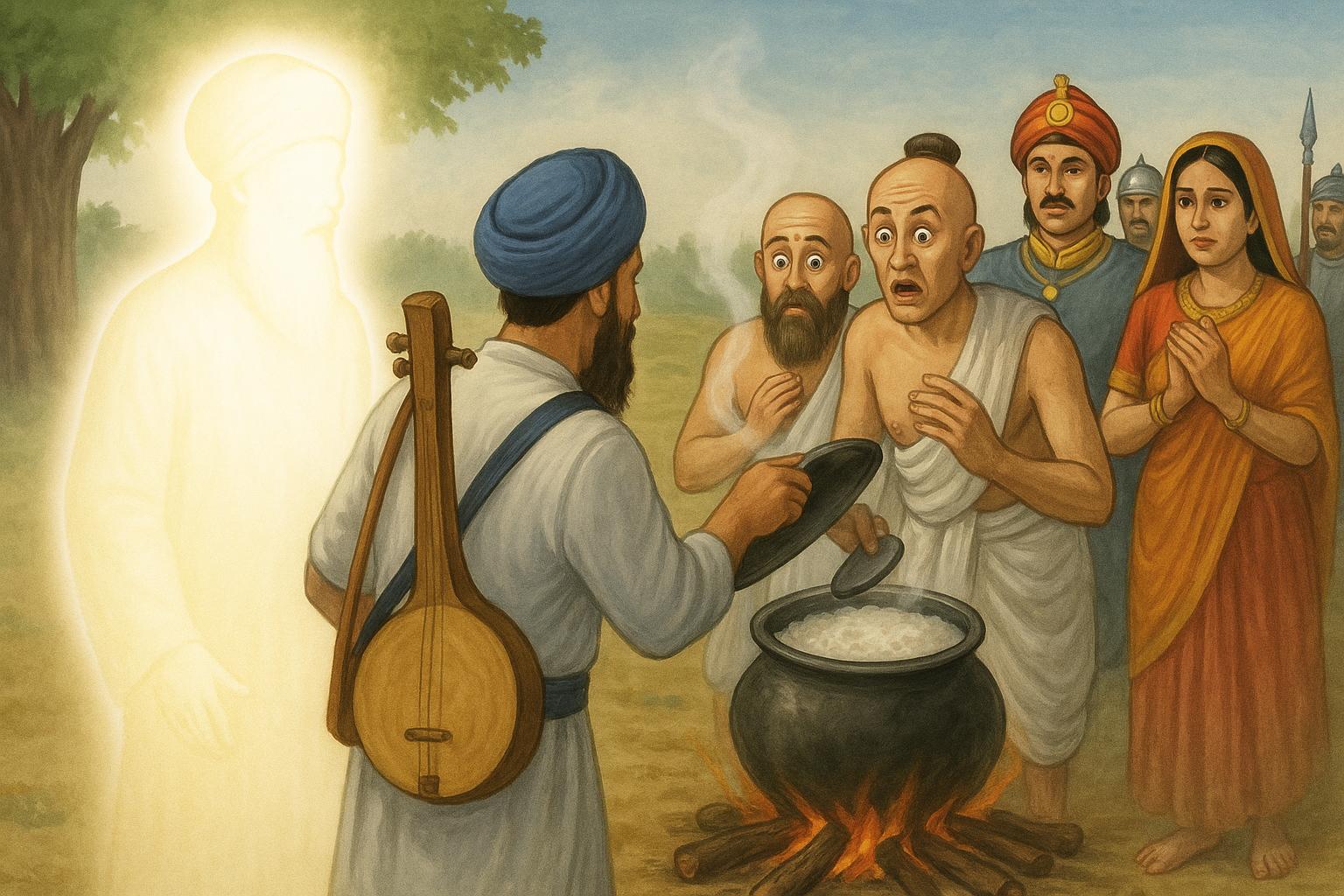
Then the question arises: did Guru Sahib eat the deer meat, or did He give it to someone else to eat? Historically, the Janam Sakhis state that after giving the teaching, the pot in which the deer meat had been placed was covered. When the lid was lifted, it was found that the pot actually contained kheer (a sweet rice pudding) instead. Guru Sahib then distributed this kheer among the people. People took it as prasad (blessed food) from Guru Sahib and became His disciples.
If Guru Sahib had been in favor of eating meat, He would have certainly distributed the deer meat among the Sangat and clearly permitted eating it. But that never happened. Instead, Guru Sahib, using His divine power, miraculously transformed the deer meat in the pot into kheer before distributing it.
Those who try to justify eating Jhatka meat cannot use this Sakhi as an example, because the event was never about permitting meat consumption. According to their own definition, Jhatka is when a Sikh kills an animal with a single swift blow, usually decapitating it in one motion. Raja Jagat Rai, who had offered the deer to Guru Sahib, was neither a Sikh at that time nor did he perform a Jhatka. He had only hunted the deer. Therefore, this Shabad or Sakhi cannot be used to justify Jhatka or meat consumption in any way.
Moreover, Guru Sahib never cooked meat Himself, nor did He distribute it. Historical Janam Sakhis do not record any instance of Guru Sahib supporting meat consumption. Some people who advocate eating meat claim that Guru Sahib must have distributed the meat to the Pandits so they could eat it and thus accept His teaching. However, this is purely their imagination and a fabricated assumption. There is no historical evidence to prove that this actually happened.
This Sakhi is found in the Janam Sakhis of Bhai Bale and Bhai Mani Singh, but neither of these sources mentions that the meat was distributed or that Guru Sahib allowed anyone to eat it.
According to both Janam Sakhis, it was kheer that was served and everyone ate only kheer. There is also the Janam Sakhi of Sodhi Mehrban, but it does not mention meat at all. In other Janam Sakhis, this Sakhi is not even recorded.
So tell now, on what basis is meat eating or justifying meat consumption being claimed, when there is no evidence that Guru Sahib ever allowed meat? This claim is completely false.
Moreover, there was no need to “test” anyone, because everyone’s mind had already changed after hearing Guru Sahib’s teachings and seeing the kheer. Besides, Guru Sahib Himself is the embodiment of Akal Purakh and the supreme knower of hearts, so He already knew that everyone’s mind had turned.
And tell me, is there a single historical example where someone’s life did not change after following Guru Sahib’s teachings? There is not a single instance of this in history.
Guru Sahib’s words were never ordinary or trivial; they were divine teachings. They were completely united with Akal Purakh, and anyone whose heart was burning with confusion or suffering would naturally be drawn to Guru Sahib and become His Sikh.
Secondly, when we compare this Sakhi with other Sakhis, the claim about testing people falls apart. For example, when Guru Sahib went to Haridwar and threw water in the opposite direction, He was breaking people’s misconceptions and guiding them to the true path. Yet, He never “tested” anyone or forced anyone to throw water the other way.
Similarly, when Guru Sahib went to Mecca and placed His foot towards the Kaaba, He did not compel any Muslim to do the same to prove their faith. A test is only conducted when there is doubt or uncertainty, but this does not apply to Guru Sahib. His intention was always to spread the truth and enlighten those walking the path of falsehood, illuminating their hearts with His divine light.
This is why the claim that meat was distributed is completely false and has no proof. The lesson we learn from this Sakhi is not to hate meat, because we ourselves and all human beings are made of flesh. A Gursikh can never hate anything created by Akal Purakh.
However, this does not mean that eating meat is permissible. Loving something does not mean you can consume it. Therefore, Guru Sahib never gave permission to eat meat. Gurbani clearly states that for spiritual life, simple food is best and most suitable, not the flesh of animals. From history, there is no Sakhi that proves meat was ever served in Guru Nanak Dev Patshah Ji’s langar.
Let us, like Pandit Nanu, become true Sikhs of Guru Sahib by leaving meat, alcohol, and other intoxicants behind, taking Amrit, and following the path of Guru Sahib to make our lives successful.
May Waheguru shower His endless blessings on us. May we always walk on the path of Gurmat and make our lives successful through the practice of Naam Simran.