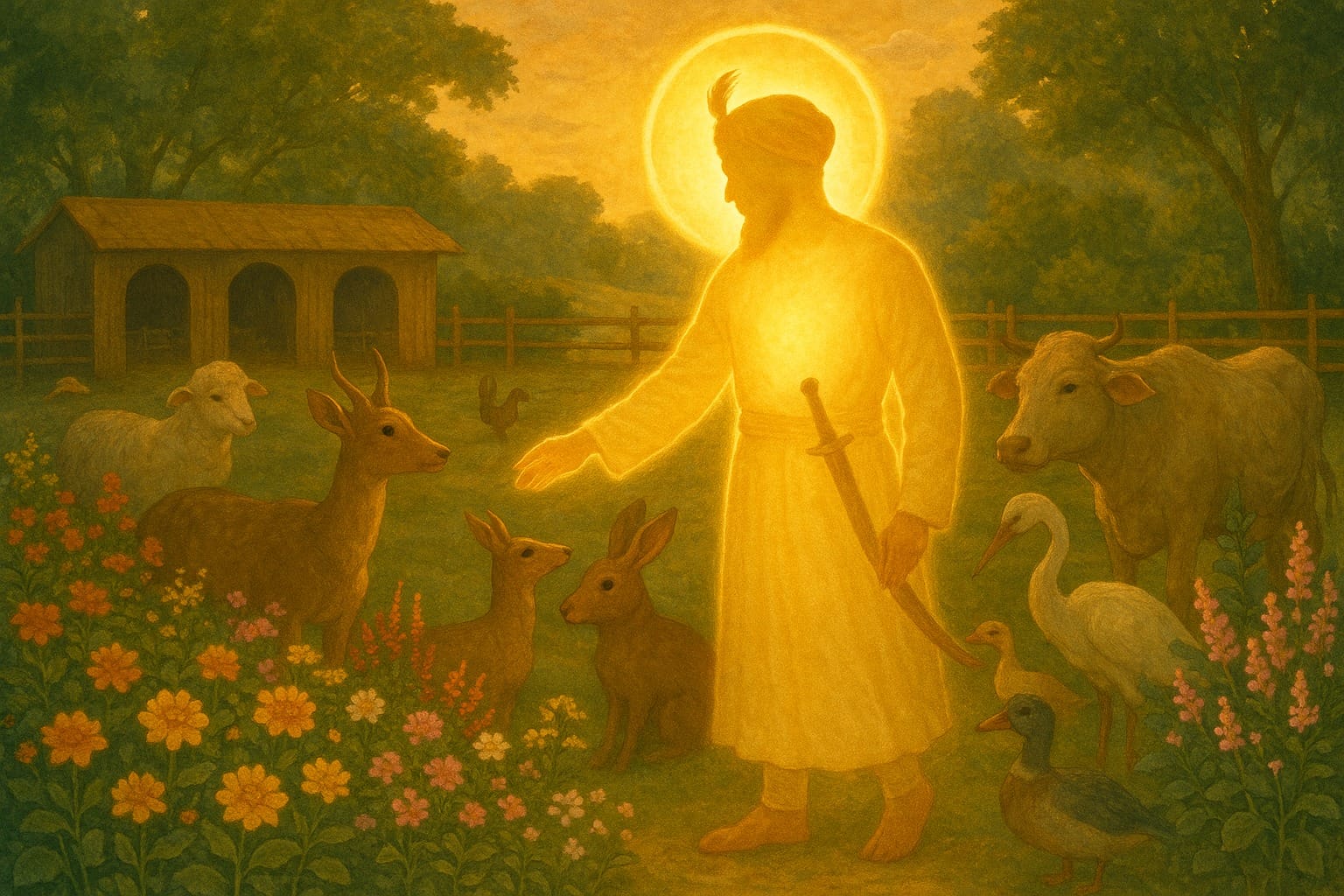
In many Sikh historical books, it is written at several places that Guru Har Rai Patshah Ji had eight marriages. This raises an important question: did Guru Sahib Ji truly have eight marriages? In this article, we will remove the misunderstandings surrounding Guru Sahib Ji’s marriage and present the actual historical account.
Guru Har Rai Patshah Ji was born in Samvat 1686, which corresponds to 1629 CE. The name of Guru Sahib Ji’s father was Baba Gurditta Ji, who was the eldest son of Guru Hargobind Sahib Ji. Guru Sahib Ji’s mother was Mata Raj Kaur Ji. Some writers have also mentioned her name as Mata Nihal, but in reality, Nihali was her nickname or secondary name.
Guru Har Rai Ji became Guru at the age of 14. Regarding his marriage, two different types of references are found. In several books, only one marriage is mentioned, while in others, more than one marriage is recorded. Therefore, we will first examine those books that mention more than one marriage.
First, we will discuss the claim that Guru Sahib Ji had more than one marriage and examine where this idea originated. Bansavali Nama is an early eighteenth-century historical work in which it is written that Guru Sahib Ji had two marriages. This book was written by Bhai Kesar Singh Chhibbar. From here, the incorrect belief about multiple marriages gradually began and later expanded into claims of even more marriages.
Bhai Kesar Singh Chhibbar writes that a Sikh named Bhai Dayaram came from Anupshahr in present-day Uttar Pradesh to have the darshan of Guru Hargobind Patshah Ji. After having Guru Sahib Ji’s darshan, he was greatly pleased. At that time, he also had the darshan of Guru Har Rai Patshah Ji. He then made a request to Guru Hargobind Patshah Ji that his daughter, Kot Kalyani, be married to Guru Har Rai Ji. According to Bansavali Nama, when this proposal was presented, Guru Hargobind Patshah Ji accepted the marriage alliance.
The author of Bansavali Nama, Kesar Singh, further writes that Guru Sahib Ji was married to Kot Kalyani Ji. He then states that along with Kot Kalyani Ji, a beautiful maid named Punjab Kaur also came with her. Kesar Singh goes on to write that because Punjab Kaur was wiser than Mata Kot Kalyani Ji, Guru Har Rai Ji married her as well.
According to Kesar Singh, Baba Ram Rai Ji was born to Punjab Kaur, while Guru Har Krishan Patshah Ji was born from the womb of Mata Kot Kalyani Ji.
Now, we will examine how Bhai Kesar Singh’s account is incorrect and why he came to such a mistaken conclusion. The first reason is that the marriages of all Guru Sahiban were arranged by their parents.
Even when a Sikh came to request the marriage of his daughter, he would seek consent from Guru Sahib Ji’s mother or father. In other words, such proposals were made to Guru Sahib Ji’s parents, not directly to Guru Sahib Ji. Therefore, while his mother and Guru Hargobind Patshah Ji were alive, Guru Har Rai Ji could never have married a maid of his own will.
The second reason is that the mother from whose womb Guru Sahib Ji was born is described in Gurbani as worthy of the highest honor. No one could be more refined or wiser than such a mother. As stated in Gurbani: ਧਨੁ ਧੰਨੁ ਪਿਤਾ ਧਨੁ ਧੰਨੁ ਕੁਲੁ ਧਨੁ ਧਨੁ ਸੁ ਜਨਨੀ ਜਿਨਿ ਗੁਰੂ ਜਣਿਆ ਮਾਇ ॥ meaning blessed is the father, blessed is the family, and blessed is the mother who gave birth to the Guru.
Along with this, if Guru Hargobind Ji himself arranged a marriage, how could it be possible that it was not with a wise and noble woman, and that her maid was considered wiser than her?
In fact, the truth is that any woman whose marriage proposal was accepted by Guru Sahib Ji was wiser and virtuous than others. It was never possible that Mata Kot Kalyani Ji lacked wisdom, making it necessary for Guru Sahib Ji to marry a maid instead. Therefore, describing a maid as wiser than Mata Kot Kalyani Ji is the personal mistake of the writer Kesar Singh Chhibbar.
The third reason is that Bhai Dayaram of Anupshahr was not a wealthy man who could afford to employ a maid on a salary. Even if we assume that Bhai Dayaram did have a maid or a helper in his household, she was not his personal property or private possession that he could simply send along with his daughter’s wedding procession to Punjab. After all, Bibi Punjab Kaur also had her own family in Uttar Pradesh. How could her family have agreed to send their daughter away to Punjab with the wedding procession?
Along with this, Guru Sahib Ji could never have agreed to such a custom or practice. He would never have given permission for a Sikh to treat a maid as personal property and send her away with his daughter’s wedding procession. This was something Guru Sahib Ji would never have accepted or allowed.
The fourth reason is that Guru Har Rai Sahib Ji was not married to Mata Kot Kalyani Ji at all. Authentic and reliable historical sources clearly show that Mata Kot Kalyani Ji was not married to Guru Har Rai Patshah Ji. Therefore, this is another error made by the writer Bhai Kesar Singh Chhibbar.
In reality, Bhai Kesar Singh Chhibbar developed this misunderstanding because the Sikh history he heard in his childhood was later written down from memory. He knew that Baba Ram Rai Ji had a relationship of some kind with Bibi Punjab Kaur, but he forgot the exact nature of that relationship. In fact, Bibi Punjab Kaur was not the mother of Baba Ram Rai Ji, but his wife. This means that Bibi Punjab Kaur was married to Baba Ram Rai Ji.
All historical books and historical texts agree on this point, but Bhai Kesar Singh mistakenly wrote Bibi Punjab Kaur as the mother of Baba Ram Rai Ji. Because of this misunderstanding, he ended up writing about the second marriage of Guru Har Rai Patshah Ji. It was his confusion, and in an attempt to explain it, he recorded a second marriage for Guru Sahib Ji. From here, the error continued to spread further and further.
Later writers of the nineteenth century copied this same mistake into their Gur Pranalis (genealogical records of the Gurus). Not only was the error repeated, but the number of marriages was increased as well. Poet Kesar Singh, writing a Gur Pranali in the nineteenth century, stated that Guru Har Rai Sahib Ji had six marriages and again mentioned Punjab Kaur as having come as a maid. Bhai Gulab Singh wrote another Gur Pranali and expanded this error even further by writing that Guru Sahib Ji had eight marriages.
One important point to note here is that in these Gur Pranalis, neither the number of marriages is the same, nor do the names of the wives match with one another.
In other words, the names of Guru Sahib Ji’s wives mentioned in these sources are all different from one another. Because of this, the claim of multiple marriages is not acceptable, as no two books agree with each other or record the same details.
Another claim found in these Gur Pranalis is that the seven or eight marriages of Guru Har Rai Ji were with women who were all real sisters. It is written that they were all married to Guru Har Rai Patshah Ji at the same time, and that Guru Sahib Ji was eight years old at the time of marriage. Now, even if we assume that the eldest wife was eight years old at the time of marriage, then according to this claim, the youngest sister could not have been more than one year old. Even in those times, no one would marry off such a young child and send her to her in-laws’ home.
Moreover, Bhai Dayaram did not have seven or eight daughters. According to history, he had only one daughter, whose marriage proposal he presented to Guru Sahib Ji.
Later writers continued to copy the same mistake, and from there this claim kept being repeated again and again. Those who did not study history carefully or reflect on it properly repeated the same error and wrote that Guru Sahib Ji had seven or eight marriages.
Now we will present the references and proofs that mention only one marriage. All authentic sources state clearly that Guru Sahib Ji had only one wife, that he had only one marriage, and that the name of his wife was Mata Sulakhni Ji.
Saroop Das Bhalla writes in his book Mehima Prakash that Baba Gurditta Ji was the father of Guru Har Rai Patshah Ji and Mata Raj Kaur Ji was his mother. He further writes that Sulakhni was the wife of Guru Har Rai Ji, meaning Mata Sulakhni Ji was Guru Har Rai Patshah Ji’s wife. He also records that Guru Sahib Ji had two sons, Guru Har Krishan Ji and Baba Ram Rai Ji.
In Guru Kian Sakhian (also known as Bhatwahi), only one marriage is mentioned, and the name of Guru Ji’s wife is again written as Mata Sulakhni Ji. Similarly, Giani Gian Singh, in his nineteenth-century work Twarikh Guru Khalsa, also mentions only one marriage.
During the time of the Khalsa Raj, a Gur Pranali was written by poet Saudh Singh. In this work as well, only one wife is mentioned, and her name is recorded as Mata Sulakhni Ji. There is no mention of multiple marriages at all.
An important point to note is that all sources mentioning only one marriage agree that Guru Sahib Ji had a single wife and that her name was always the same – Mata Sulakhni Ji. In contrast, where multiple marriages are mentioned, nothing matches; neither the number of marriages nor the names of the wives are consistent. From this, it becomes clear that Guru Sahib Ji was married only once.
One final proof comes from the work Suraj Prakash, written by poet Santokh Singh. This work was completed in 1843 CE, at a time when the poet himself was alive. He wrote extensively about Sikh history and provided very detailed information about it. Some have claimed that Santokh Singh Ji also recorded multiple marriages of Guru Sahib Ji. However, this is not correct. Bhai Vir Singh Ji, after extensive research, clarified this matter and presented the truth.
In all copies of the Suraj Prakash Granth, only one marriage is recorded. Bhai Vir Singh Ji explains that he came across a copy which was written 19 years after the death of poet Santokh Singh Ji. In other words, this copy was produced 19 years after Santokh Singh Ji had passed away.
Bhai Vir Singh Ji notes that in this copy, four blank pages had been added at the end. On the fifth page, the story written by Bhai Kesar Singh Chhibbar was copied. This means that the claim Kesar Singh Chhibbar made in Bansavali Nama, that Guru Sahib Ji had two marriages, was reproduced on this fifth page.
These five pages were added later, and the ink and handwriting on them were entirely different from the rest of the Granth, clearly showing that they were not part of the original work.
This is conclusive proof that the additions in the Suraj Prakash were made later. What poet Santokh Singh Ji himself originally wrote is that Guru Sahib Ji had only one marriage and only one wife.
From all of this, it becomes clear that the idea of multiple marriages of Guru Sahib Ji was a mistaken belief started by Bhai Kesar Singh Chhibbar. He misunderstood the facts, and later writers of Gur Pranalis copied his work. These writers, without consulting authentic and reliable sources, increased the number of marriages in their records.
In reality, Guru Har Rai Sahib Ji had only one wife, and he was married only once. The name of his wife was Mata Sulakhni Ji. We have shared the evidence for this with you from sources such as Mehima Prakash, Guru Kian Sakhian, Suraj Prakash, the Gur Pranali by poet Saudh Singh, and Twarikh Guru Khalsa. All these are authentic sources, and all of them mention only one wife of Guru Sahib Ji.
We will now share a little-known fact about Guru Sahib Ji. The truth is that Guru Sahib Ji had not two, but three children. It is commonly known that Guru Sahib Ji had two sons, Baba Ram Rai Ji, the eldest, and Guru Har Krishan Patshah Ji, the youngest. However, the reality is that Guru Sahib Ji also had a daughter who was younger than Baba Ram Rai Ji.
This daughter, four years younger than Baba Ram Rai Ji, was named Bibi Sarup Kaur. Five years after her birth, Guru Har Krishan Patshah Ji was born. Bibi Sarup Kaur was married to Bhai Khem Chand, who was from Pasrur in the Sialkot district. Bibi Sarup Kaur, along with her in-laws, came to live in Kiratpur with Guru Sahib Ji and spent the rest of her life there.
We hope that this article has enhanced your understanding of Sikh history and provided you with new knowledge.
We’re here to help. Whether you’re curious about Gurbani, Sikh history, Rehat Maryada or anything else, ask freely. Your questions will be received with respect and answered with care.
Ask Question