
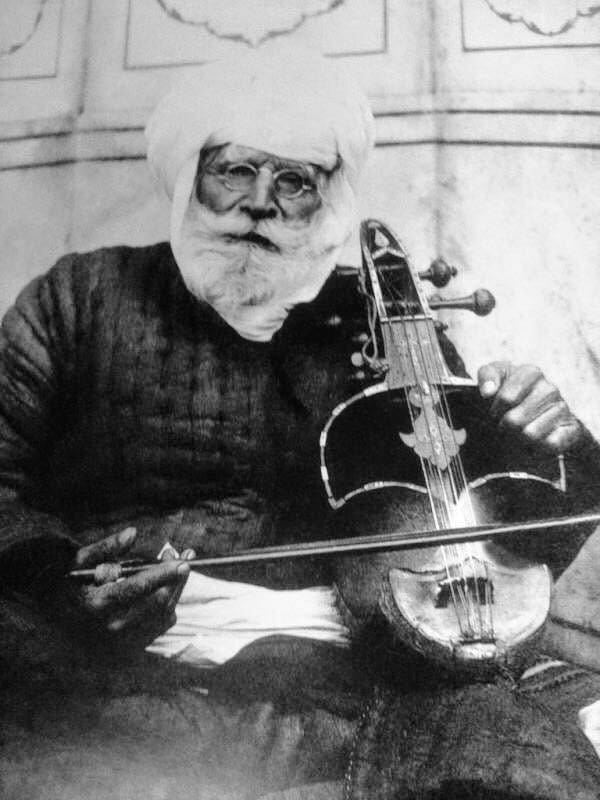
Baba Sham Singh jee lived till the first quarter of the 20th century and went to Sachkhand at the age of 125 years. He has the distinction of doing Kirtan Sewa at Siri Harmandir Sahib for more than 80 years. He saw the rise and fall of Khalsa Raj, the rise of Singh Sabha, and the formation of the Shiromini Committee in the 1920s. Baba jee was accepted as Brahmgyani Gurmukh by the whole Panth. Sant Attar Singh Mastuanewale, Bhai Sahib Randhir Singh jee, and Bhai Vir Singh jee recognized him as great Gurmukh.
Bhai Sahib Randhir Singh jee, in one of his books, has written a Saakhi about Baba Sham Singh jee. Once Baba jee had a vision of the next world. He saw that a number of individuals were tied on camels and were being beaten mercilessly by Jammdoots. Baba jee asked someone why these individuals were being beaten up. He got the reply that these people allowed gullible devotees to Matha-Tek to them in the Maat-Lok (this world), and now they were being punished for this crime.
Even before having this vision, Baba Sham Singh jee did not allow anyone to Matha-Tek to him, but now, with this supernatural experience, he became very strict in not allowing anyone to Matha-Tek or touch his Charan. If anyone did touch his feet, he would never rest till he too touched that person’s feet.
Baba jee was an ocean of divine knowledge and was a master of mystical powers (Ridhi Sidhis), but he kept himself hidden in his humility so well that very few realized the extent of his great spiritual state.
Once, he, along with other Gursikhs, was going for Darshan of Siri Harmandir Sahib. At this time, his age was about 120 years. As he approached Darshani Deodhi, he went on his knees and did Matha-Tek to Siri Darbar Sahib. A 16-year-old sewadaar of his Jatha got his chance and touched Baba jee’s feet from the back. Baba jee realized it, and before he could say anything, that boy ran away towards Dukhbhanjani Beri. Sant jee ordered his Sewadaars to catch the boy and bring him over to him.
The boy was pretty fast, and it took half an hour for them to catch him and bring him to Baba jee. Baba jee caught hold of both his feet, placed them on his forehead, and humbly said, “ਕੀ ਫਿਰ ਤੂੰ ਗੁਲਾਮ ਦੇ ਪੈਰਾਂ ਨੂੰ ਹੱਥ ਲਾਏਂਗਾ?” (Will you ever touch this slave’s feet again?).
Noteworthy thing is that Baba jee always addressed himself as Ghulaam and never used the pronoun “Mai” (I or we) for himself.
You can imagine what would have been the condition of the poor boy when he saw such a great Mahapurakh placing his head on his feet. He was greatly vexed and, holding his ears with his hands, apologized and promised never to do so again.
Bhai Vir Singh has written that he was blessed with Sikhi through Baba Sham Singh jee. When Bhai Vir Singh took Amrit from Siri Akal Takhat Sahib, Baba Sham Singh was the Jathedar of Punj Pyare. He writes that Sant Jee used to love him greatly but never allowed him to touch his Charan.
Presented below is a Kautak relating to Ardaas and Kirtan, from Baba jee’s life.
Rainfall as a result of Baba jee’s Kirtan and Ardaas
Around the end of the 19th century (1800s), no rainfall occurred starting from Poh (around December) up until Saavan-Bhadon (July-August). When even the month of Saavan, which is famous for the monsoon season in India, passed without rainfall, there was an outcry in public. Famine-like conditions were forming in Punjab at that time.
Sensing the dire situation that the area of Punjab in general and Siri Amritsar Sahib in particular was facing, some Gursikhs with Shardha (faith) decided to approach Baba Sham Singh jee, who was a humble servant of Siri Guru Raamdaas jee, for help. It was decided that 5 Gurmukhs would approach Baba jee to request him to perform an Ardaas for rainfall.
Baba jee received the Gurmukhs with respect and love. He heard their requests and said, “Kirtan Diwaans are done every day in the Darbar of Sache Paatsha, Sodhi Sultan, Siri Guru Raamdaas Sahib jee. You all are also Gurmukhs. You all come to the Darbar of Srii Guru Raamdaas jee, and this Ghulaam (Baba jee always used to call himself Ghulaam) too would accompany you. Let’s all humbly do Ardaas before Satguru jee.”
Every day at a set time, at Amritvela, Baba jee used to do a Kirtan Chaukee. The next day, the five Gurmukhs and a lot of Sangat arrived at the time of Baba jee’s Kirtan. Before beginning Kirtan, Baba jee placed his head on his Saranda (Tantee Saaj used for Kirtan) and did a fully-concentrated Benti to Satguru jee, “O Sodhi Sultan, Sache Paatshah, Karo Kirpa.”
After completing a short Benti, Baba jee started doing Kirtan in Raag Malhaar. Within moments, clouds arrived on the skies of Siri Amritsar Sahib and rainfall started. For hour and a half, Baba jee did Kirtan and all this time heavy rainfall continued.
ਮੇਘੁ ਵਰਸੈ ਦਇਆ ਕਰਿ ਗੂੜੀ ਛਹਬਰ ਲਾਇ ॥
ਮੇਘੈ ਨੋ ਫੁਰਮਾਨੁ ਹੋਆ ਵਰਸਹੁ ਕਿਰਪਾ ਧਾਰਿ ॥
It is said that when Baba jee stopped Kirtan, the rainfall also stopped.
Baba Sham Singh was very kind-hearted and merciful. He could never bear anyone’s sorrow. Presented below are some Saakhis from his life that show his compassionate nature that covered even the speechless animals.
Helping an Ox in distress
One day Baba jee was coming back from Siri Harmandir Sahib that near the Chhabeel of Bhai Savaiya Singh, he noticed an ox that was in great pain. It seemed that its end was near. Baba jee was moved seeing the pain of the ox. He asked Bhai Satt Singh (his PA) to quickly get water from the Sarovar of Darbar Sahib near Dukhbhanjani Sahib. In the meantime, he sat near the ox and started doing Siri Jap jee Sahib.
The ox was quite receptive to the Siri Jap jee Sahib Paath from the mouth of a Mahapurakh and responded to the Paath by getting peaceful. When Bhai Satt Singh arrived with Amritmai water, Baba put some water in the ox’s mouth and sprinkled the rest on its body. Now the ox became totally free of pain and became very peaceful. In a few moments, the ox passed away peacefully. Baba jee came back to his Dera and organized a Paath and performed an Ardaas at the end of the Paath for the Atma (soul) of the ox.
A Wounded Horse
Once Baba jee was travelling from Siri Tarn Taran Sahib to Siri Amritsar Sahib on a tonga (chariot). Midway towards Siri Amritsar Sahib, Baba jee found out that the horse had a wound on its back, and that blood was flowing out of it. Baba jee asked the chariot driver to stop the chariot and immediately off the chariot. He asked the charioteer why he was putting the horse through so much pain and suffering.
Hearing this, the driver started crying and said that with great difficulty, he is able to earn just enough food for his family and the horse, and that if he did not run his chariot, he and his family would be deprived of food that day.
Baba jee was visibly moved and ordered the charioteer to immediately take the horse off the chariot and then come to his Dera. Saying this, Baba jee started walking towards his Dera. Later, when the charioteer came to Baba jee’s Dera, Baba jee arranged for complete treatment of the horse, and all the time when the horse was under treatment, he took up all the house expenses of the charioteer.
Nowadays, there are many societies that work for the welfare of the animals, but their Jeev-Daya (compassion for creatures) is flawed since they only worry about the animals and do not understand the problems of the people who own these animals. Baba jee’s concept of Jeev-Daya was perfect since it covered not only animals but also people. Baba jee went to the root of the problem and did not just look at resolving the problem on the surface.
Whipping the horse
Once Baba jee was travelling towards Siri Tarn Taran Sahib and Siri Govindwal Sahib on a chariot. On the way, the chariot driver whipped the horse to make it run fast. It was as if the pain of this whipping was felt by Baba jee. Baba jee cried out and ordered the driver not to whip the animal. Baba jee said that the horse would run fine on its own, through love.
Baba jee travelled in this chariot many times again, and the driver never whipped the horse again. It seemed that the horse ran fast with love as opposed to through whipped.
Such was the compassionate nature of Baba Sham Singh jee.
Rupinder Kaur
September 12, 2026First time I could listen to about Babaji. Goosebumps came out. I read all about him from this post. Thanks a lot. ਵਾਹਿਗੁਰੂ !