Religious rituals are meant to inspire equality, morality, and spiritual connection. Yet, in Islam, women are treated as inherently impure, even in the most sacred acts of worship.
One striking example comes from Sahih al‑Bukhari, Volume 1, Book 9, Hadith 490, narrated by Aisha, one of Muhammad’s wives:
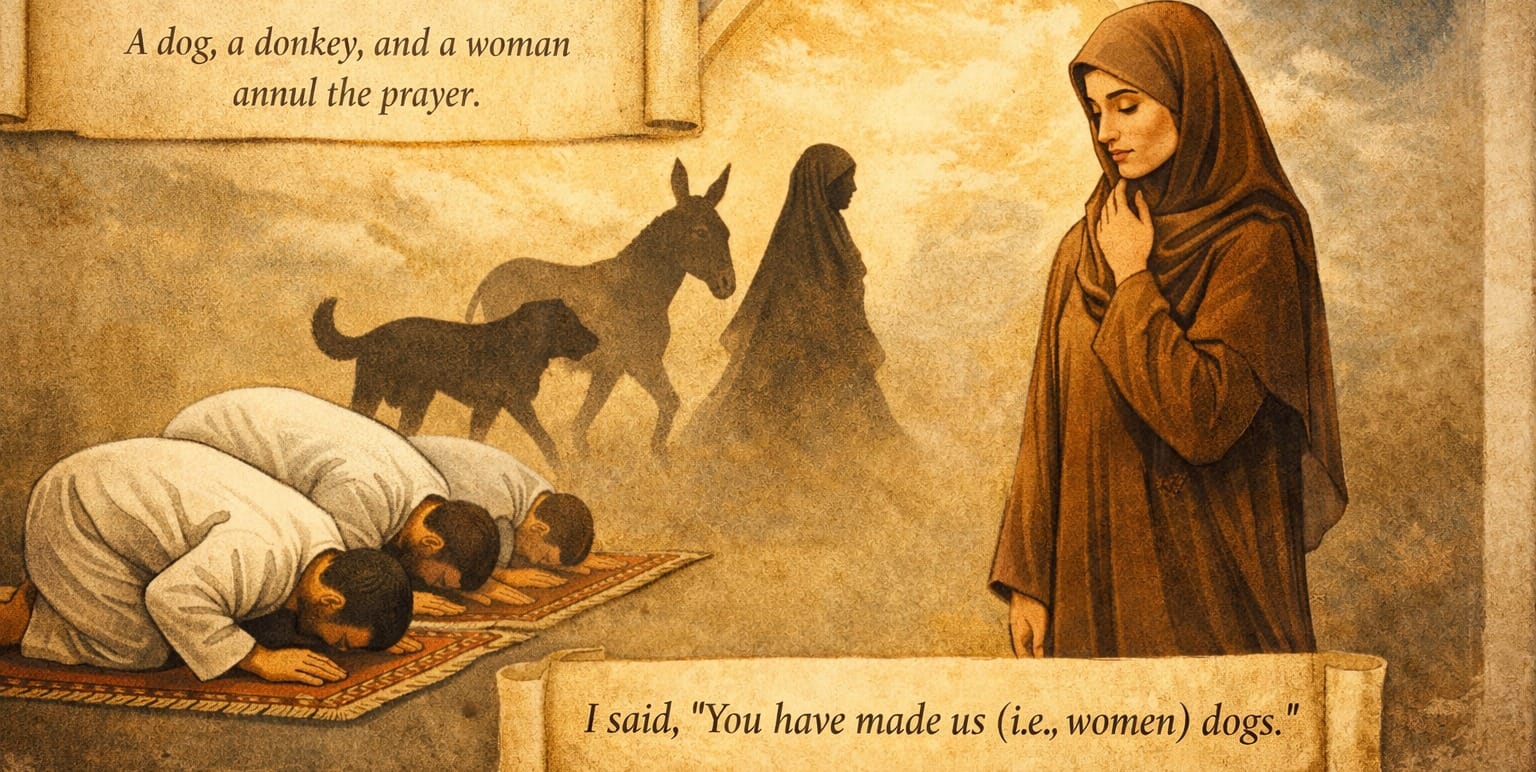
“The things which annul the prayers were mentioned before me. They said, ‘Prayer is annulled by a dog, a donkey, and a woman (if they pass in front of the praying people).’ I said, ‘You have made us (i.e., women) dogs.’”
The Hadith equates women with animals, implying that their presence is so impure it can disrupt a man’s communion with God. The reaction of Aisha herself, expressing shock and indignation at being compared to dogs, highlights the degrading and offensive nature of the teaching. Yet, despite this clear expression of misogyny, the instruction has been preserved in some of the most widely referenced collections of Islamic tradition.
Modern-Day Impact
The influence of such Hadiths is not purely academic. They have tangible effects on women’s experiences in Muslim communities:
Mosque segregation – Women are often placed in separate areas or prohibited from entering mosques entirely.
Cultural inequality – Viewing women as spiritually impure normalizes their inferiority in broader social, educational, and leadership contexts.
Internalized stigma – Women often internalize these norms, accepting limited roles in religious and public life, reinforcing cycles of inequality.
Why It’s Inhumane
Comparing women to dogs and donkeys is not only offensive but also institutionalizes the idea that women are inherently inferior. It encourages a mindset where women are seen as obstacles to worship rather than equal participants in faith. Such teachings erode dignity, reinforce inequality, and seriously damage Islam’s claim to uphold moral values.
We’re here to help. Whether you’re curious about Gurbani, Sikh history, Rehat Maryada or anything else, ask freely. Your questions will be received with respect and answered with care.
Ask Question