(THE OFFICIAL SIKH CODE OF CONDUCT DOCUMENT)
The Sikh Rehat Maryada is the guiding document that establishes the foundational code for both personal conduct and community life among Sikhs. The standards set forth in this document are observed at Sri Akal Takht Sahib, the supreme Sikh authority, and upheld by the Shiromani Gurdwara Parbandhak Committee (SGPC), the principal representative body of Sikhs in Punjab and worldwide. The SGPC manages major historical Gurdwaras and serves as the authoritative voice on Sikh matters. The Sikh Rehat Maryada document is also recognized and widely referenced by Sikh institutions and Gurdwaras across the globe.
It should be understood that the Sikh Rehat Maryada offers a foundational framework rather than a comprehensive account of Sikh discipline. The lived discipline of many Sikhs, rooted in the Guru’s guidance, extends beyond this written code. Additional practices arise from the conduct imparted to initiates during the Amrit ceremony, as well as from the unwritten Gurmat-based disciplines that remain vibrant within Sikh tradition. For any code or practice to be regarded as Gurmat, or in accordance with the Guru’s teachings, it must rest upon the principles enshrined in Sri Guru Granth Sahib Ji and never contradict them. This ensures continuity between the written code and the living tradition.
The Sikh Rehat Maryada was first published and implemented at Sri Akal Takht Sahib, and in all Gurdwaras managed by the SGPC, in 1936. It has since been refined through subsequent amendments. Today, it continues to be implemented at Sri Akal Takht Sahib and propagated by its custodians. Whenever matters of Sikh conduct arise, this document, together with rulings issued from time to time by Sri Akal Takht Sahib, serves as a central point of reference for Sikhs internationally, alongside the eternal teachings of Sri Guru Granth Sahib Ji.
Click on the tiles to view contents
A Sikh is any man or woman who:
A Sikh should wake up during Amrit Vela (the last quarter of the night before sunrise), take a bath (ishnaan), and focus their mind on the One Eternal Supreme Being (Akaal Purakh), while repeating the Divine-Name “Vaheguru”.
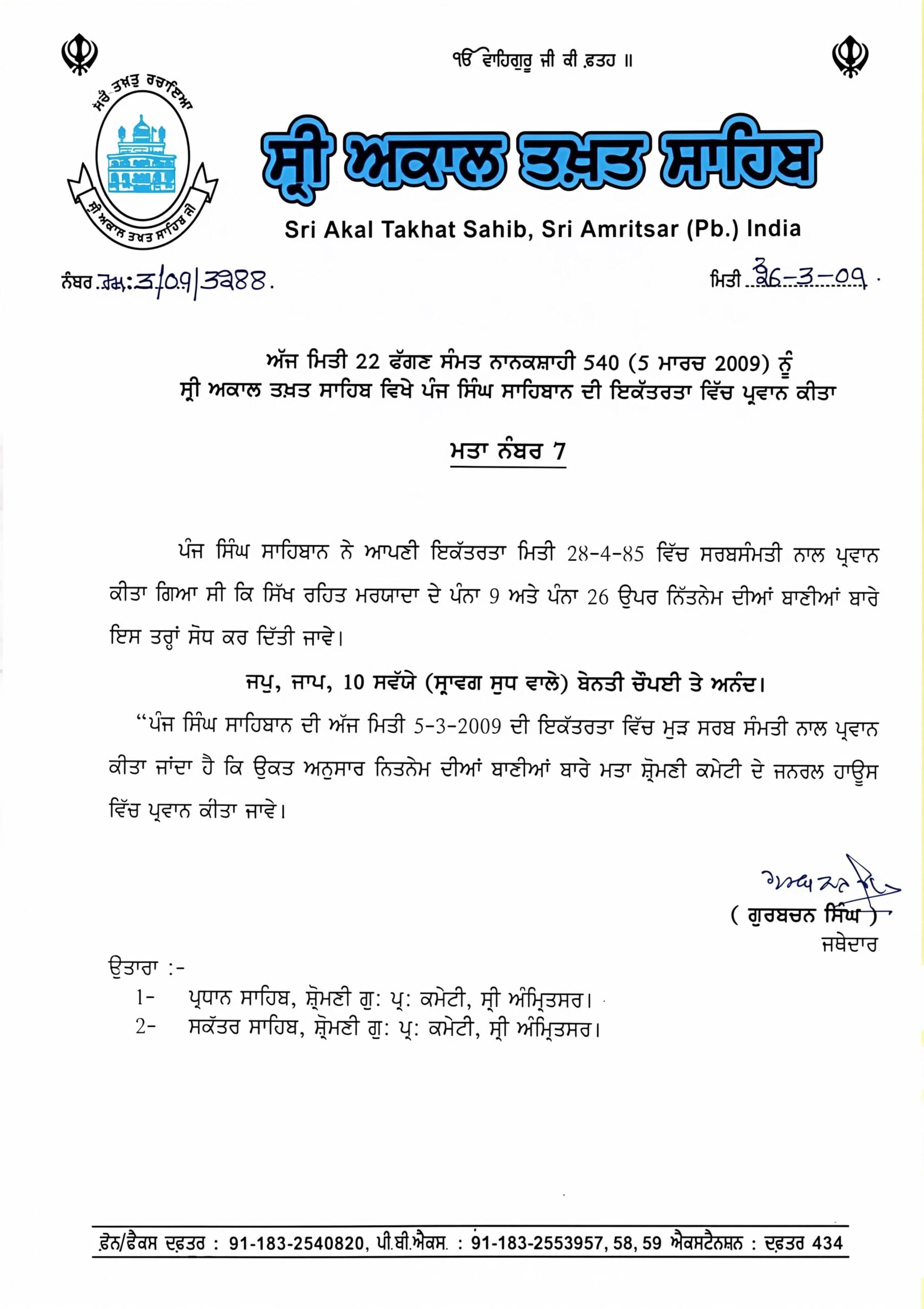
They should then recite the daily set of prayers, known as Nitnem. Nitnem consists of the following scriptural prayers (Banis):
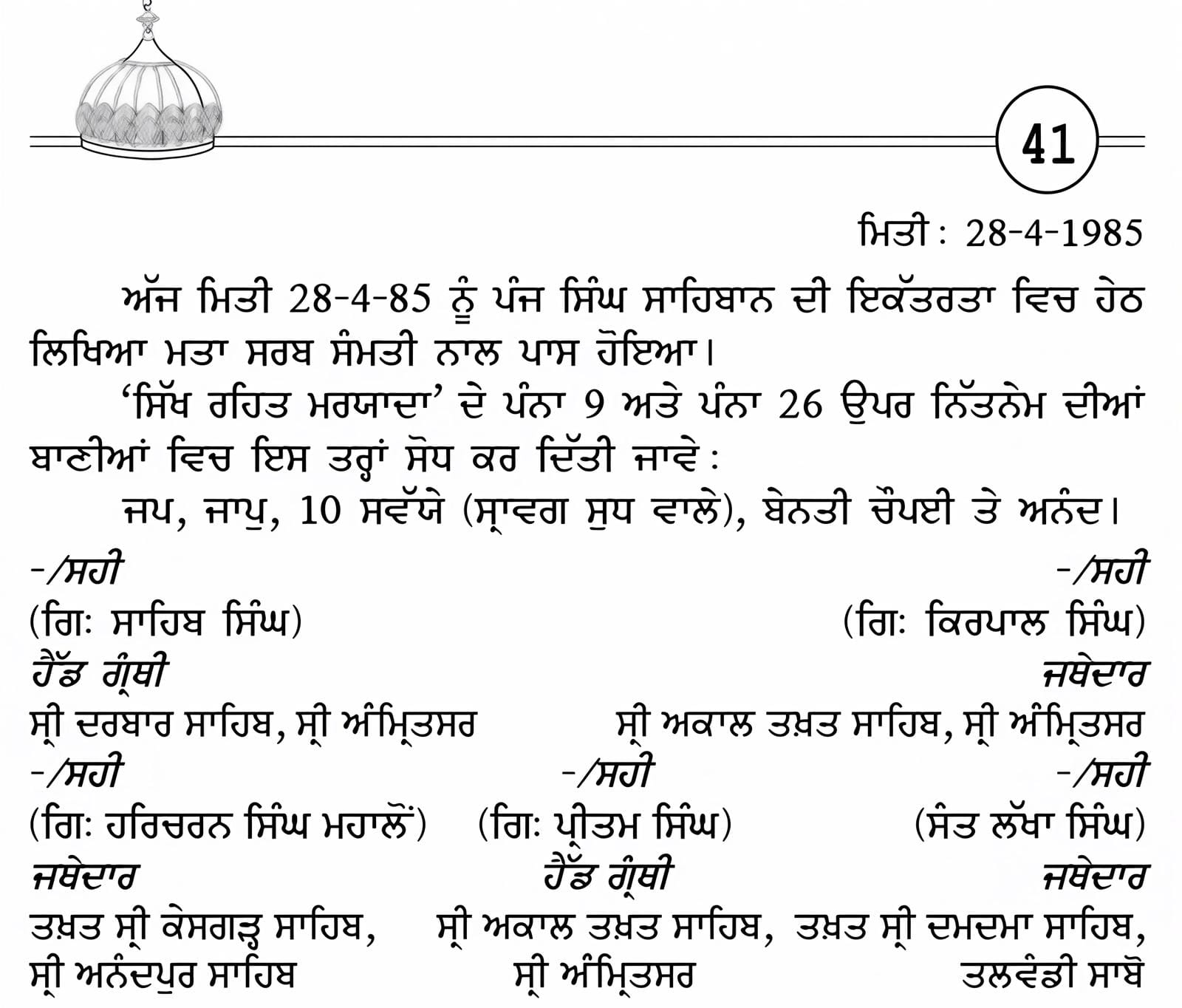
a. Morning Prayers: Japji Sahib, Jaap Sahib, Ten Svaiyye (starting at “sraavag sudh”), Benti Chaupai and Anand Sahib.
b. Evening Prayers (After sunset): Sodar Rehraas. The core text consists of:
c. Night Prayer (Before going to bed): Sohila.
After completing the morning and evening Nitnem, it is important to perform a formal standing Ardaas (a prayer asking Vaheguru for guidance, protection, and blessings).
The text of the Ardaas is as follows:
ik o'ann-kaar, vaahe'guroo jee kee fateh.
siree bhagautee jee sahaa'e.
vaar siree bhagautee jee kee. paat'shaahee dasveeⁿ.
There is One Supreme Being, through whose Sound all creation flows. All victory belongs to Vaheguru. May the Supreme Power help us! The Tenth Master’s heroic divine poem.
pritham bhagautee simar kai, gur naa'nak leyeeⁿ dhiyaa'e. fir angad gur, te amar'daas, raam'daasai ho'eeⁿ sahaa'e. arjan hargobind noo, sim'rau siree har-raa'e. siree har-krishan dhiyaaee'yai, jis ditth'ai sabh dukh jaa'e. teg bahaadar simree'yai, ghar nau nidh aavai dhaa'e. sabh thaaeeⁿ ho'e sahaa'e.
First, I meditate on the Supreme Divine Power (Vaheguru), then I focus my thoughts on Guru Nanak Ji. I then seek the blessings of Guru Angad Ji, Guru Amar Das Ji, and Guru Ram Das Ji. I meditate on Guru Arjan Ji, Guru Hargobind Ji, and Guru Har Rai Ji. I remember Guru Har Krishan Ji, whose graceful sight removes all suffering. I remember Guru Tegh Bahadar Ji, whose remembrance brings divine treasures. May their power assist us everywhere.
dasvaaⁿ paat'shaah, siree guroo gobind singh saahib jee! sabh thaa'eeⁿ ho'e sahaa'e. dasaaⁿ paatshaahee'aaⁿ dee jot, siree guroo granth saahib jee de paatth dee'daar daa dhiyaan dhar key, bolo jee vaahe'guroo!
Tenth Master, Sri Guru Gobind Singh Ji, may your power assist us everywhere. Focusing on Sacred reading and blessed sight of the Guru’s Word of Sri Guru Granth Sahib Ji— the eternal Divine Light of all Ten embodiments of the Guru, say: Vaheguru!
panjaaⁿ piyaariaaⁿ, chau'haaⁿ saahib'zaadiyaaⁿ, chaalee'yaaⁿ muk'tiyaaⁿ, hatthee'aaⁿ - japee'aaⁿ - tapee'aaⁿ, jin'haaⁿ naam japiyaa - vand chhakiyaa, degh chalaa'ee - teg vaahee, dekh key an'ditth keetaa, tin'haaⁿ piyaariaaⁿ, sachiyaariaaⁿ dee kamaaee daa dhiyaan dhar key, bolo jee, vaahe'guroo!
Seeking inspiration and strength from the Panj Piaare (Five Beloved Ones), the four Sahibzaade (sons of the Tenth Guru), the Forty Mukte (Liberated Ones), those who had enduring devotion that they put their bodies in discomfort & remained chanting, those who repeated the Holy Name and shared their blessings with others, those who provided food and protection of righteousness for all, those who overlooked other’s faults in service to humanity, O Khalsa spirit, chant: “Vaheguru!”
jin'haaⁿ singhaaⁿ singhnee'aaⁿ ney dharam hey't sees dittey, bann'd bann'd kattaa'e, khopree'aaⁿ luhaaee'aaⁿ, charkee'aaⁿ tey charr'hey, aariyaaⁿ naal chiraa'e gaye, gur'duaariyaaⁿ dee sevaa leyee kurbaanee'aaⁿ keetee'aaⁿ, dharam nehee haariyaa, sikhee su'aaasaaⁿ naal nibhaa'ee, tin'haaⁿ dee kamaa'ee daa dhiyaan dhar key bolo jee, vaahe'guroo!
Seeking inspiration and strength from the acts of devotion of Sikh men & women who gave their lives for their faith; those who were hacked to pieces (but refused to give in); those who had their scalps removed (but refused to cut their holy hair); those who were tortured in wheels (but never let their love for Sikhi be crushed); those who were sawn alive (but refused to part with the Guru); those who gave up their lives in the service of Gurdwaras; those who never gave up the Path of the Guru; and upheld Sikh values with each hair and breath, O Khalsa spirit, chant: “Vaheguru!”
panjaaⁿ takh'taaⁿ, sarbat gur'duaariyaaⁿ daa dhiyaan dhar key, bolo jee, vaahe'guroo!
Seeking inspiration from thinking of all the five Takhats (the symbols of our bestowed kingship) and all Gurdwaras, say: “Vaheguru!”
prith'mey sarbat khaalsaa jee kee ardaas hai jee, sarbat khaalsaa jee ko vaahe'guroo - vaahe'guroo - vaahe'guroo - chit aa'vai, chit aa'van ka sad'kaa sarab sukh hovey. jahaaⁿ jahaaⁿ khaalsaa jee saahib, taa'haaⁿ taa'haaⁿ rachhiyaa riyaa'et, degh - teg - fateh, panth kee jeet, siree saahib jee sahaa'e, khaalsaa jee key bol baaley, bolo jee vaahe'guroo!!
Now the prayer of the entire Khalsa is that may it first always remember “Vaheguru” (in thought), “Vaheguru” (in word), “Vaheguru” (in deed) that brings peace & happiness to all. Wherever the Khalsa goes, may its honour be protected; may it be successful in providing food and protecting justice for all; may its loving nature be honoured; may the Panth (the Path) be glorious; may the holy sword of peace always be of assistance; and may the Khalsa’s reach & influence be universal. Chant: “Vaheguru!”
sikhaaⁿ noo sikhee daan, kes daan, rehat daan, bibek daan, visaah daan, bharosaa daan, daanaaⁿ sir daan - naam daan, siree amritsar jee de ish'naan, chaunkee'aaⁿ - jhann'ddey - bunn'gey - jugo jug attal, dharam kaa jai'kaar, bolo jee vaahe'guroo!!!
Grant Sikhs with the gift of Sikhi, gift of Kes (hair – divine form), Rehat (divine discipline), the gift of Bibek (divine wisdom); the gift of Bharosa (divine faith); the gift of Visaah (divine trust) & the greatest gift of Naam. May they be blessed with bathing in the holy waters of Sri Amritsar. May the Sikh traditions, flags & spiritual learning centres stand strong forever; and righteousness remain victorious. Say: “Vaheguru!”
sikhaaⁿ daa man nee'vaaⁿ, mat uchee, mat daa raa'khaa aap vaahe'guroo!
May the minds of Sikhs remain humble, and their wisdom rise. O Vaheguru, protector of wisdom, guide us!
hey a'kaal purakh, aap'ney panth dey sadaa sahaa'ee daa'taar jee'o! siree nan'kaanaa saahib tey hor gur'duaariyaaⁿ gur'dhaamaaⁿ dey, jin'haaⁿ toh panth noo vichhoriyaaⁿ gayaa hai, khul'hey darshan dee'daar tey sevaa samm'bhaal daa daan khaalsaa jee noo bakh'sho!
O Akaal Purakh! Constant Helper of Your Panth! Bless the Khalsa with the gift of freely visiting and managing Sri Nankana Sahib and all the other Gurdwaras and Sikh shrines that have become separated from the Sikh Panth (nation).
hey nimaaniyaaⁿ dey maan, nitaaniyaaⁿ dey taan, ni'ottiyaaⁿ dee oh'tt, sachey pitaa, vaahe'guroo! aap dey hazoor ................................. dee ardaas hai jee!
O True Father, Vaheguru! Honour of the honourless, Power of the helpless ones, Shelter of the shelterless! Before you the humble prayer is....................................
akhar vaadhaa ghaattaa bhul chuk maaf karnee. sarbat dey kaaraj raas karney.
Forgive our mistakes & shortcomings. Kindly help everyone to fulfill their divine assigned tasks.
seyee piyaare mey'l, jin'haaⁿ miliyaa teraa naam chit aavey. naa'nak naam charh'dee kalaa, tere bhaaney sarbat da bhallaa.
May we be blessed with the company of those by meeting whom, we remember Your Holy Name. O Guru Nanak! May Naam lead to rising spirits, and may all humanity prosper in Your Will.
At the conclusion of the Ardaas, the entire Sangat (congregation) participating should respectfully matha tek (bow by touching the forehead to the floor) before Sri Guru Granth Sahib Ji, then stand up and say, “Vaheguru Ji Ka Khalsa, Vaheguru Ji Ki Fateh” (“The Khalsa belongs to Vaheguru, and all victories/achievements belong to Vaheguru”). The Sangat should then raise the spirited chant of “Sat Siree Akaal” (“Vaheguru is Eternal and True”).
b. During the Ardaas, all men and women present should stand with folded hands (palms of their hands pressed together). The person sitting behind Sri Guru Granth Sahib Ji should also stand and respectfully wave the Chaur Sahib (the royal whisk).
c. The person leading the Ardaas should stand in front of Sri Guru Granth Sahib Ji, with folded hands (palms of their hands pressed together). If Sri Guru Granth Sahib Ji is not present, it is acceptable for them to face any suitable direction and offer the Ardaas.
d. When a personal Ardaas is offered for a specific individual or group, it is not required for the rest of the Sangat (congregation) to stand.
a. The influence of Gurbani (the Guru’s Word) is most effectively experienced in the presence of the Saadh Sangat (the holy congregation). For this reason, it is considered appropriate and beneficial for Sikhs to attend Gurdwaras—places where the Sikh community gathers—and to engage with Gurbani by sitting among the Saadh Sangat.
b. Sri Guru Granth Sahib Ji should be respectfully enthroned (Parkash) in the Gurdwara daily. Unless there is a specific reason requiring otherwise, Guru Sahib should not remain in Parkash during the night. As per tradition, after the evening recitation of Rehraas Sahib, Guru Sahib is respectfully retired (Sukh Aasan). However, Parkash may be maintained for longer if a Granthi (scripture reader), Sevadaar (volunteer), or members of the Sangat are present, or if there is a concern regarding the potential for disrespect. Following this, it is proper to respectfully perform Sukh Aasan, in order to prevent any possibility of disrespect toward Guru Sahib.
c. Sri Guru Granth Sahib Ji must always be enthroned (Parkash), read, and cared for with deep respect. The area should be clean, and a cloth-canopy (Chandowa Sahib) should be respectfully suspended above Sri Guru Granth Sahib Ji as a mark of royal honour. Parkash (enthronement) of Sri Guru Granth Sahib Ji should be performed on the Manji Sahib (the special raised platform or throne for the Guru) after clean and tidy cloths have been respectfully laid out. Soft supports such as cushions should be used to carefully position the physical form of Guru Sahib during Parkash, and a Rumala Sahib (decorative cloth covering of appropriate size) should be placed over the top. When Sri Guru Granth Sahib Ji is not being read, Guru Sahib should remain covered with a Rumala Sahib. A Chaur Sahib (ceremonial whisk-fan) should also be present during Parkash.
d. Apart from the respectful items mentioned above, practices such as burning incense or lamps (deevey) to perform Aarti (worship involving the waving of lighted lamps), ritualistically offering food items to Sri Guru Granth Sahib Ji (in the false belief that Guru Sahib gets hungry for food), lighting symbolic flames (jotaan) for the purpose of worship, ringing bells (tal) as a means of invoking or awakening the Divine, and other similar acts are not in accordance with Gurmat (the Guru’s teachings). However, the use of flowers, incense, or other natural fragrances to keep the space pleasant is not prohibited. For lighting within the room, appropriate sources such as oil lamps, ghee lamps, candles, electric lights, or other practical lighting should be used.
e. No book (pustak) should ever be placed at the same level or in the position of Sri Guru Granth Sahib Ji. There should be no idol worship or any other practice or ceremony that goes against Gurmat (the Guru’s teachings) in the Gurdwara, nor should any festivals of another faith be celebrated. It is, however, not inappropriate to use an occasion or gathering to share and teach Gurmat (the Guru’s teachings).
f. Actions such as pressing the legs of the cot that Sri Guru Granth Sahib Ji lays rest as an act of flattery, rubbing one’s nose on walls or platforms that mark a sacred place to seek blessings, placing water underneath the Manji Sahib (the platform where Guru Sahib is seated), making or keeping idols or statues (murtis) in Gurdwaras, or bowing before pictures depecting any of the Sikh Gurus or respected Sikh elders — all these practices are considered manmat, meaning they go against the Guru’s teachings.
g. When Sri Guru Granth Sahib Ji is being taken from one place to another, an Ardaas should be performed. The person carrying Sri Guru Granth Sahib Ji on their head should walk barefoot. However, if it necessary to wear shoes due to a situation, there is no need to have any doubts or reservations.
h. Parkash of Sri Guru Granth Sahib Ji should be done after performing Ardaas. After Parkash, a Vaak (holy command) of a Shabad should be read from Sri Guru Granth Sahib Ji.
i. Whenever Sri Guru Granth Sahib Ji is being carried into a place, every Sikh present should stand up out of respect, even if a saroop of Sri Guru Granth Sahib Ji is already parkash (enthroned) there.
j. When entering a Gurdwara, shoes, including socks, must be removed outside, and ensure they are clean. If the feet are dirty, they should be washed with water. While walking around (performing Parkarmaa of) Sri Guru Granth Sahib Ji or the Gurdwara, one should keep them on their right side as a sign of respect.
k. No one is forbidden from entering a Gurdwara for darshan (viewing or paying respects), regardless of their country, religion, or caste — but they should not bring anything that goes against Sikh principles, such as tobacco.
l. Upon entering the Gurdwara, a Sikh’s first act should be to humbly bow before Sri Guru Granth Sahib Ji. Afterward, they should respectfully greet the Guru-roop Sangat (the congregation that embodies the Guru’s presence) by saying ‘Vaheguru Ji Ka Khalsa, Vaheguru Ji Ki Fateh’ in a discreet and quiet manner (so as not to disturb or draw attention from others).
m. There should be no discrimination or prejudice when it comes to sitting in the Sangat (congregation) — whether someone is Sikh or non-Sikh, or based on caste, social status, or Brahminical beliefs that classify people as high or low, touchable or untouchable by birth.
n. It is manmat (contrary to the Guru’s teachings) for anyone to sit in the sangat (congregation) or in the presence of Sri Guru Granth Sahib Ji, when Parkash (enthroned), on a cushion, elevated seat, chair, stool, or in any manner that suggests special distinction, status, or pride.
o. No Sikh should sit bare-headed in the presence of Sri Guru Granth Sahib Ji or the Sangat. It is against Gurmat (the Guru’s teachings) for Sikh women to practice veiling (pardah) or cover their faces (ghund or jhund) in the Sangat.
p. There are five Takhats (recognised places of authority):
q. Only an Amritdhari (fully initiated) Sikh man or woman, who strictly observes the Rehat (code of conduct), is permitted to enter the designated sacred areas within the Takhts. Ardaas (prayer) may be offered at the Takhts for any individual, Sikh or non-Sikh, except for those who are Patit (apostates) or Tankhaiya (those guilty of religious misconduct or under religious penalty).
r. Every Gurdwara must have a Nishan Sahib (Sikh flag) installed at a prominent and elevated location. The cloth covering the Nishan Sahib should be either Basanti (bright spring-yellow) or Surmaee (dark blue), and the top of the flagpole should be adorned with either a Sarbloh (pure-iron) spearhead (bhaalaa) or a Sarbloh Khanda (double-edged sword made of pure-iron).
s. A Nagaara (traditional large ceremionial royal victory drum) should be present in the Gurdwara and played at appropriate times, representing Sikh sovereignty and awakening the spirit warrior within.
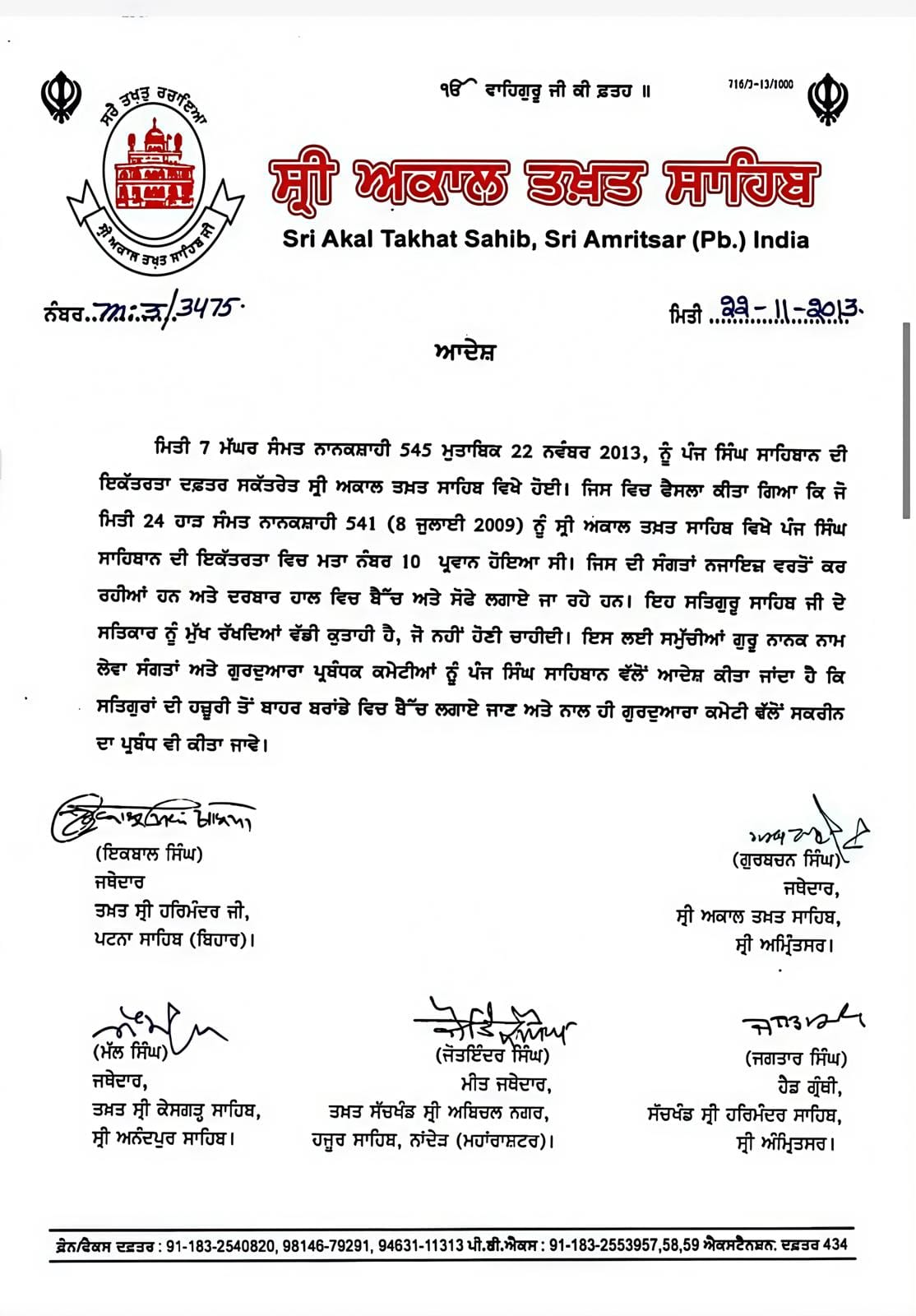
a. Only a Sikh is permitted to lead or formally perform Kirtan in the presence of the Sangat (congregation).
b. Kirtan refers to the singing of Gurbani to melodic frameworks (Raags).
c. In the Sangat (congregational setting), Kirtan must consist solely of Gurbani or the acknowledged writings of Bhai Gurdas Ji and Bhai Nand Lal Ji, which are recognised as interpretive extensions of Gurbani.
d. It is not permissible to add made-up words or lines to Shabads when singing Gurbani, whether it is performed as collective group singing (jotteeaan) in simple folk tunes (dhaarna) or in traditional Raag. Only the original lines of the Shabad may be repeated during the singing.
a. Matha tekna (bowing by touching the forehead to the floor) before Sri Guru Granth Sahib Ji, respectfully taking darshan (the holy glimpse) of the Guru-roop Sangat and taking a Vaak (holy edict): these together constitute having darshan (a glimpse) of Satguru (the True Guru). Raising the Rumala Sahib (drapery) covering Sri Guru Granth Sahib Ji and merely taking a look or making others take a look in this manner without taking a Vaak is Manmat, against the Guru’s Way.
b. In the Sangat, at any one given time, only one thing should be done, whether it is performing of Kirtan, delivering Katha (discourse), interpreting Gurbani or reading Gurbani.
c. Only a Sikh (man or woman) is entitled to be in attendance of Sri Guru Granth Sahib Ji during a Divaan (congregational session).
d. Only a Sikh may read out Gurbani for the Sangat. However, a non-Sikh may read Gurbani for themselves.
e. When taking the Hukam (holy edict), the on-going Shabad on the top left-hand ang (sacred page) must be read from the beginning. If the Shabad begins on the previous Ang, turn over the Ang and read the whole Shabad from the beginning to the end. If the on-going scriptural composition on the top left-hand ang (sacred page) is a vaar (ode), then start from the first of the saloks that comes before the pauri and read up to the end of the pauri. Conclude the reading at the last line of the Shabad, where the name ‘Nanak’ for example occurs.
f. Hukam must be taken at the end of the Divaan (congregational session) or after the Ardaas for Bhog (completion).
a. Every Sikh should as far as possible, maintain a separate and exclusive place for the prakaash (installation) of Sri Guru Granth Sahib Ji in their home.
b. Every Sikh man, woman, boy or girl, should learn Gurmukhi to be able to read Sri Guru Granth Sahib Ji.
c. Every Sikh should take a Hukam from Sri Guru Granth Sahib Ji at Amrit Vela, the early hours of the morning before dawn, before taking a meal. If there are any difficulties in doing this, then one should read or listen to a reading from Sri Guru Granth Sahib Ji sometime during the day. If one cannot do that either, during travel etc., or owing to any other difficulty, one should not feel guilty.
d. It would be good for every Sikh to continue a personal Sadhaaran Paath (non-continuous complete reading of Sri Guru Granth Sahib Ji) and complete the full reading in one or two months (or however long it takes).
e. When undertaking a full reading of Sri Guru Granth Sahib Ji, one should recite Anand Sahib (the first five and the last pauris), followed by an Ardaas. One should, thereafter, read Japji Sahib.
a. An Akhand Paath (a non-stop reading of Sri Guru Granth Sahib Ji) is carried out during times of hardship or encouragement. It usually takes around 48 hours. The reading is done non-stop without interruption. The reading must be clear and correct. It is disrespectful to Gurbani if the reading is done too fast, so that the person listening to it cannot understand the reading. The reading should be correct and clear, with due care given to the letters and sounds, even if it takes a little longer to complete.
b. Whichever family or Sangat undertakes an Akhand Paath, they should complete it through its members, relatives, friends, etc., all together. The number of Paathis (reciters) is not prescribed. If a person cannot read themselves, then they should listen to the reading by any competent Paathi (reader). However, it should never be allowed to happen that the reader carries on the reading all by themselves and no member of the Sangat or the family are listening to the reading. The Paathi should be served with food and clothing to the best of the host’s means.
c. It is Manmat, a self-created belief contrary to the Guru’s Way, to place a Kumb (a ritualistic pot), Jyot (a venerated ritualistic flame), (a ritual) coconut etc. during an Akhand Paath, or to read another Paath (scriptural reading) side by side or during the Akhand Paath.
When a Sadhaaran Paath is to be started, Prashad should be presented and then Anand Sahib (six pauris) should be recited. This should be followed by offering an Ardaas and then taking a Hukam. During an Akhand Paath, Karah Prashad should be present, and then after reciting Anand Sahib (six pauris) Ardaas should be offered. After taking a Hukam the reading of the Akhand Paath should begin.
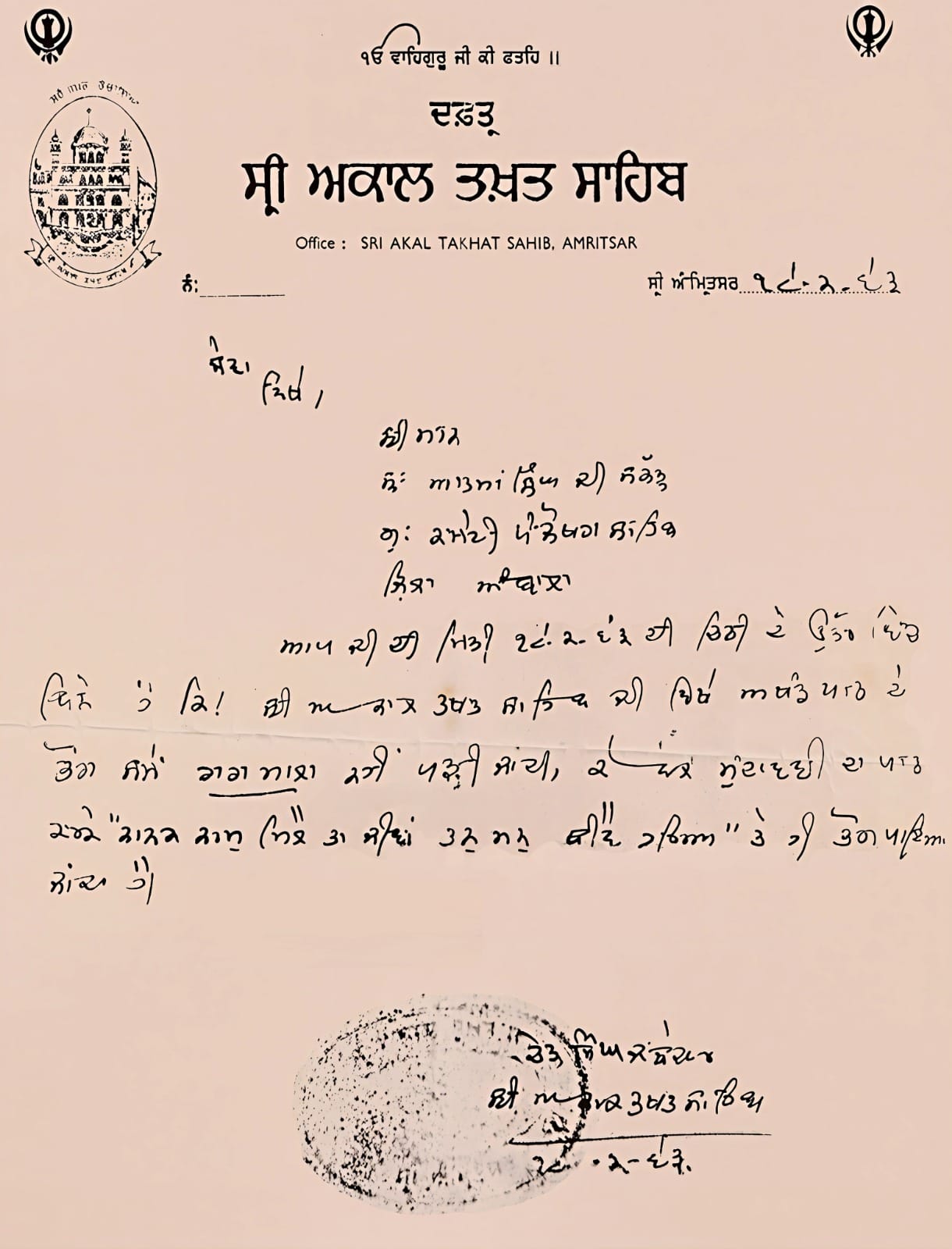
a. The complete reading of Sri Guru Granth Sahib Ji (Sadhaaran or Akhand) should be followed by the reading of ‘Mundaavani.’ ‘Raagmala’ may or may not be recited according to the local custom or according to the wishes of the person(s) who arranged the reading (Paath).
b. Anand Sahib should then be read, followed by the final Ardaas and Hukam reading. At the end, Karah Prashad should be distributed to the congregation.
c. At the time of Akhand Paath it is usual to give donations for the upkeep of the gurdwara, for example, a Rumala Sahib (draperies), Chaur Sahib (royal whisk), Chandowa Sahib (royal awning), or anything else for the furtherance of the Sikh Panth. This should be given in accordance with one’s means.
a. Only the Karah Prashad (sacred blessed pudding) prepared as per the prescribed method is acceptable in the Sangat.
b. The method of preparing Karah Prashad is this: Equal quantities of wheat flour, pure sugar and clarified butter should be cooked in a clean pure-iron vessel whilst reciting Gurbani. Then covered with a clean piece of cloth, it should be placed on a clean stool in front of Sri Guru Granth Sahib Ji, the first five and the last pauris (stanzas) of Anand Sahib should be recited aloud (so that the Sangat can hear). Ardaas should be done and for the acceptance of the Karah Prashad it should be touched with a Kirpan.
c. After this, before Karah Prashad is distributed to the Sangat, the share of the Panj Piaare (Five Beloved Ones) should be set apart and given away. The person(s) distributing the Prashad should ‘tyaar-bar-tyaar’ (adhering to full Rehat). When distributing the Karah Prashad to the Five representing the Khalsa, the Sevadaar should not ask when giving to the Five whether or not they observe full Rehat. Instead the Sevadaar should use their own personal judgement on who is tyaar-bar-tyaar (fully observes Rehat) in the Sangat.
If there are less than five (which can include the Amrit-dhari sitting in attendance of Sri Guru Granth Sahib Ji) then the Karah Prashad (of the Five Singhs) should be distributed to however many they are and then mix the remaining Karah Prashad back into the baatta (bowl) for distributing to the rest of the Sangat.
Thereafter, when distributing amongst the Sangat, first Karah Prashad should be put in a small bowl or vessel and given to the person sitting in attendance of Sri Guru Granth Sahib Ji and then continue to distribute amongst the rest of the Sangat. The person who gives out the Karah Prashad to the Sangat should do so without any discrimination based on personal regard or spite. Karah Prashad should be given equally irrespective of one being a Sikh, non-Sikh or a person of so-called high or low caste. While giving out Karah Prashad to the Sangat, no discrimination should be made on considerations of caste, ancestry, or being regarded, by some, as untouchable.
d. When Karah Prashad is being presented for an Ardaas, it should be accompanied by at least a small sum cash offering (for the betterment of Panthic or humanitarian causes).
a. Katha of Gurbani (discourse of the Guru’s Word) within the Sangat can only be done by a Sikh.
b. The objective of Katha should only be to promote the understanding of Gurmat (the Guru’s teachings).
c. Katha can only be done of the Ten Gurus writings or utterances, Bhai Gurdas Ji’s writings, Bhai Nand Lal Ji’s writings or of any generally accepted Panthic book, or of books of history (which are in agreement with Gurmat), and not of a book of any other faith. However, for illustration, references to a holy person’s teachings or those contained in a book may be made.
d. No lecture contrary to Gurmat should be delivered inside a Gurdwara.
e. The usual schedule of the Sangat in the Gurdwara is generally the following: Prakaash of Sri Guru Granth Sahib Ji, Kirtan, Katha, lecture, reciting of Anand Sahib, Ardaas, the raising of the Fateh slogan and then the slogan Sat Siree Akaal followed by the ‘Hukam’.
A Sikh’s everyday lifestyle, work, and social behaviour should be in accordance with Gurmat. Gurmat is the following:
a. Only worshipping the One Supreme Timeless Being (Akaal Purakh) and not following or worshipping any other deity.
b. Accepting as one’s sole spiritual Saviour and Guide: the One Guru revealed in all ten human forms, Sri Guru Granth Sahib Ji, and the sacred utterances of all the ten forms of the Guru.
c. Regarding the Ten Forms of the Guru as a single entity and the embodiment of the one Vaheguru on earth as the Divine-Guiding Light (Jyot).
d. Accepting no faith or belief in:
Study of the books of other faiths is acceptable only for general self‑education.
e. Although the Khalsa shines above all other religions, with truth no one can equal, one must never intentionally cause pain to the heart of any non‑believer.
f. A Sikh should always perform Ardaas (offer a prayer) to Vaheguru before beginning any task.
g. Learning Gurmukhi (Panjabi in the Gurmukhi script) is essential for a Sikh, while also pursuing other subjects of study.
h. It is the duty of parents to ensure their children are brought up and educated in the Guru’s Sikhi.
i. Do not wish harm upon your child’s hair (kesh). Their sacred hair must be kept intact—uncut and respectfully maintained. A son’s first name should be followed by “Singh,” and a daughter’s by “Kaur.” A Sikh is duty‑bound to preserve the hair of both sons and daughters as a sacred trust.
j. A Sikh must not consume intoxicants, whether cannabis (bhang), opium, alcohol, tobacco, or any other intoxicant. One should sustain themselves only through food.
k. Piercing of the nose, ears, etc., is forbidden for both Sikh men and women./p>
l. A Sikh of the Guru must never kill a daughter, nor commit abortion, nor associate with those who do. To intentionally destroy any unborn or newborn child is against Gurmat.
m. The true Sikh of the Guru shall earn an honest and righteous living.
n. A Sikh shall regard the mouth of a poor person as the Guru’s Golak (offerings box).
o. A Sikh must not commit theft, engage in immoral relationships, or gamble.
p. "par bey'ttee ko bey'ttee jaa'nai. par istree ko maat bakhaa'nai. ap'nee istree so rat ho'ee. rehat'vaan singh hai so'ee." - “He who regards another man’s daughter as his own daughter, regards another man’s wife as his mother, has an intimate relationship with his own wife alone — he alone is a truly disciplined Sikh of the Guru." (Rehat‑nama: Bhai Desa Singh Ji, pp. 128–129)
In the same spirit, women should regard those elder than them as their father, those of the same age as their brother, and those younger as their sons, while maintaining an intimate relationship only with their husband.
q. A Sikh should observe the Guru’s Maryada (code of conduct) from birth until the end of life.
r. When meeting another Sikh, one should greet them with “Vaheguru Jee Ka Khalsa, Vaheguru Jee Kee Fateh." This is ordained for both Sikh men and women.
s. It is not proper for a Sikh woman to keep her face hidden by a veil or cover.
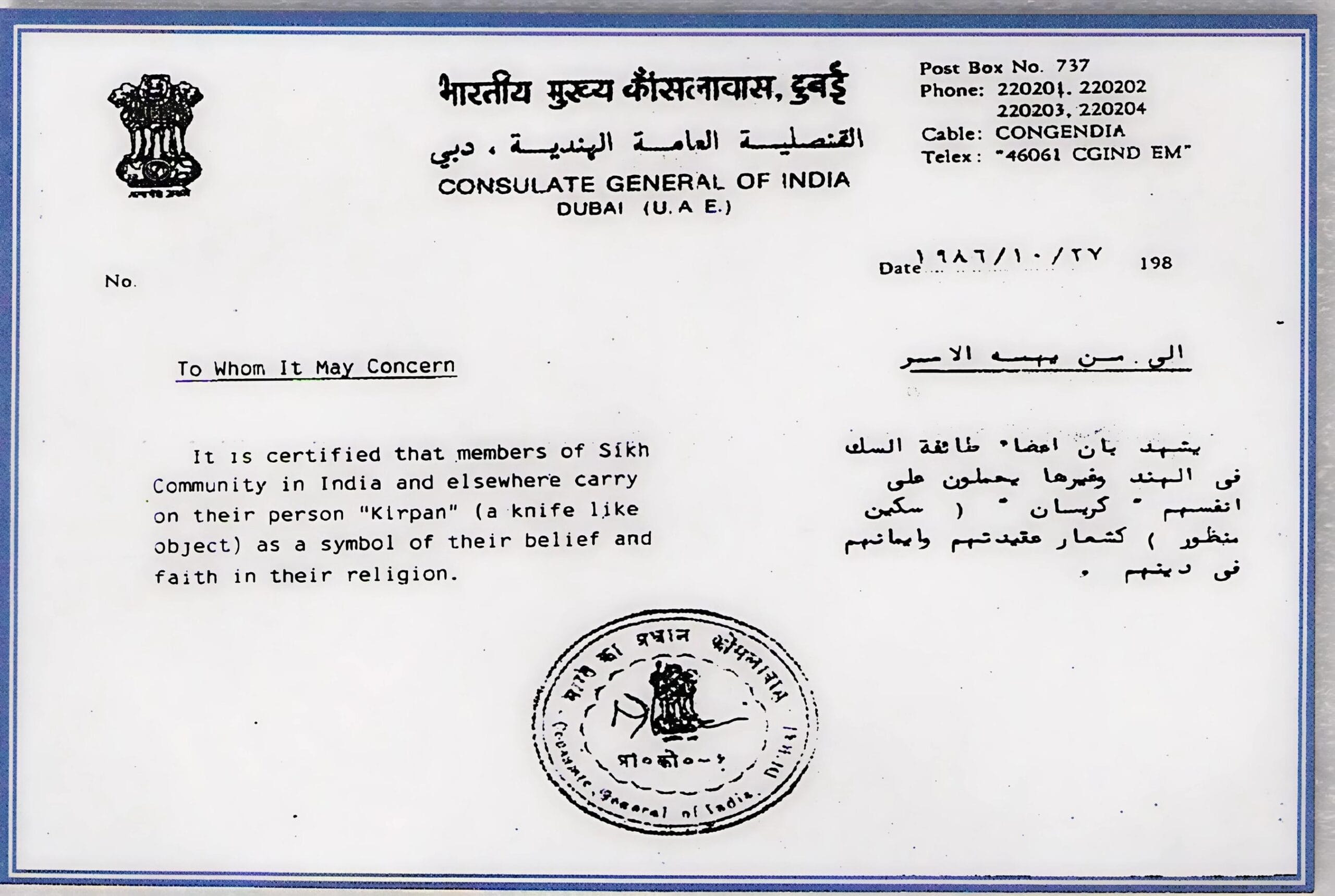
t. A Sikh is required to wear the Kachhera (the holy shorts of modesty) and Dastaar (the holy turban of responsibility); beyond these, there are no prescribed restrictions on dress, provided it remains modest and dignified. It is proper for Sikh women to wear the Dastaar, yet those who do not are also acknowledged.
a. When, by the grace of Vaheguru, a child is born into a Sikh family, the cultural Gurrtee ceremony (making the newborn taste something sweet) should be replaced with recitation of the Mool Mantar.
b. Once the mother is well enough to sit and bathe (no fixed number of days prescribed), the family should prepare Karah Prashad and take it to the Gurdwara, or have it prepared there.
c. Superstitious beliefs about ritual pollution of food and water after childbirth must not be followed. Gurbani teaches:
"jamman mar'naa hukam hai, bhaa'nai aa'vai jaa'e. khaanaa peenaa pavitr hai, de'ton rijjak samm'baaeh." - “Birth and death are subject to Hukam (the Divine Law); by the Divine Will, we come and leave. All food and water are pure, for these life‑sustaining substances are provided by Vaheguru.” (Raag Aasa M:1, Ang 472)
d. Using the Rumala Sahib (the special clothing used to drape Sri Guru Granth Sahib Ji) to make clothing for a child as part of a ritual or superstition is considered Manmat (a self‑created belief, contrary to Guru’s Way).
a. The marriage between a Sikh man and Sikh woman1 should take place without consideration of caste, clan, or lineage.
b. A Sikh must only marry a Sikh.
c. A Sikh’s marriage should be conducted through the Anand ceremony (Anand Kaaraj), the Sikh religious marriage ceremony.
d. The marriage of children, an underage boy or girl, is strictly prohibited.
e. When a girl is mature physically, mentally, and in character, she may be married through the Anand marriage ceremony to a suitable Sikh.
f. The Kurmaaee (engagement ceremony) is not required before the Anand marriage ceremony. However, if one chooses to do hold it, the bride’s family should arrange for the Sangat (congregation) to gather in the presence of Sri Guru Granth Sahib Ji, offer an Ardaas (prayer), and respectfully place a Kirpan (sword), a sarbloh Karha (bangle made of pure iron) and some sweets in the groom’s Pallaa (scarf) or hand.
g. It is against Sikh principles to consult astrology, horoscopes, or search for good luck dates when setting the wedding day. Instead, a date should be selected by mutual agreement between both families, based on practical convenience.
h. The following customs are strictly prohibited in a Sikh wedding as they are rooted in superstition or stem from non-Sikh traditions, and are therefore considered Manmat (contrary to Sikh teachings). These include:
All the above are considered Manmat (self-created practices contrary to Sikh teachings).
i. The groom should arrive with no more guests than the number invited by the bride’s side, keeping the gathering modest and considerate. Upon arrival, both sides should sing shabads (sacred hymns) from Gurbani and greet one another with the traditional Sikh greeting: “Vaheguru Ji Ka Khalsa, Vaheguru Ji Ki Fateh.”
j. During the wedding, a divaan (religious gathering) should take place in the presence of Sri Guru Granth Sahib Ji. Raagis (skilled Sikh devotional musicians) or the Sangat (congregation) should lead Keertan (the musical singing of Gurbani). The bride and groom should be seated before Sri Guru Granth Sahib Ji, with the bride seated to the groom’s left.
Afer seeking permission of the Sangat (congregtation), the person conducting the Anand ceremony (whether a man or woman) should invite the bride, groom, and their parents or guardians to stand, and offer an opening Ardaas (prayer) for the commencement of the marriage ceremony. Then the marriage ceremony facilitator should explain to both the bride and groom their duties and responsibilities relating to living a spiritual married life in accordance with Gurmat:
After this, the bride and groom are individually explained their duties of a husband and as a wife:
The bride and groom bow before Sri Guru Granth Sahib Ji to show their acceptance of the teachings and guidance that has just been shared. Then, the bride’s father or a senior relative should place the groom’s pallaa (wedding scarf) into the bride’s hand. The Granthi or appointed religious individual leading the religious service, seated behind Sri Guru Granth Sahib Ji, should then recite the Laavaan (marriage hymns), which begin with the title ‘Soohee Mahalla 4’.
After each Laav (marriage verse) is recited, the groom, followed by the bride who holds the groom’s Pallaa, should complete one Parkarmaa — that is, a reverential walk around Sri Guru Granth Sahib Ji to express devotion and acknowledge Guru Sahib as the spiritual centre of their union. In total, four Parkarmaas are performed, one after each Laav (marriage verse). During each Parkarmaa, the Raagis (skilled Sikh devotional musicians) or the Sangat (congregation) should sing the corresponding Laav in musical tune (sur), following the correct sequence of the sacred verses. After completing each Parkarmaa, the couple should bow before Sri Guru Granth Sahib Ji and then stand respectfully to listen to the next Laav being recited.
Afterwards, the bride and groom should bow before Sri Guru Granth Sahib Ji and then return to sit in their designated space on the floor. The Raagi Singh (skilled Sikh devotional musician), or the person appointed religious individual leading the Anand marriage ceremony, then recites the first five Pauris (stanzas) and the final Pauri of Anand Sahib. Following this, the concluding Ardaas (prayer) of the Anand marriage ceremony is offered, and Karah Prashad is distributed.
k. Individuals who do not accept or follow the Sikh faith, cannot be married through the Sikh marriage ceremony.
l. Ther marriage of a son or daughter should not be arranged in exchange for money or any form of dowry.
m. “If, there is any occasion or time, the daughter’s parents visit her marital home and are offered a meal, they should accept and partake without hesitation. To refuse food at the daughter’s home due to superstition is a false belief rooted in spiritual ignorance. The practice of feeding one another is a blessing upon the Khalsa by the Guru and Akaal Purakh. Those united through the marriage of their children should share meals together. Why? Because the Guru has joined both families as one.” (Rehat-nama: Bhai Chaupa Singh Ji)
n. If a woman’s husband passes away, she may, if she chooses, remarry a suitable partner. The same applies if a Sikh man’s wife passes away.
o. The ceremony for remarriage should follow the same Anand marriage ceremony already described.
p. Under normal circumstances, a Sikh should not remarry while their first spouse is still alive.
q. An Amrit‑dhari Sikh should ensure that their spouse is or becomes Amrit-dhari.
a. At the time of death, if the person is on a bed, they should not be taken off the bed and placed on the floor, as some traditions mistakenly believe this prevents the soul from remaining in the house. Rituals such as lighting a lamp in the belief it guides the soul in the afterlife (deeva vatti), donating a cow in the belief it aids the soul’s journey, or any other practices that are Manmat (self‑created, contrary to the Guru's Way) must not be performed. Instead, Gurbani should be recited or “Vaheguru, Vaheguru” repeated.
b. When someone passes away, no loud crying (dhaah maarnee), no beating of the body (pittnaa), and no ritualised mourning (siaapa) should be done. To accept Vaheguru’s Will (razzaa), Gurbani or “Vaheguru” repetition is recommended.
c. Regardless of age, even the youngest child must be given funeral rites (saskaar). Where cremation is not possible, immersion in flowing water (jal pravaah) or another respectful method should be used.
d. There should be no superstition about choosing day or night for cremation.
e. The body should be bathed, dressed in clean clothes, and the Kakkaars must not be removed. Then the body should be placed on a bier/coffin, Ardaas offered, and carried to the cremation ground while reciting shabads of bairaag (detachment).
At the cremation site:
After returning home or to the Gurdwara:
f. When the pyre has cooled, ashes and remains should be collected and immersed in flowing water or buried, with the ground levelled. No memorial should be constructed at the cremation site.
g. The undermentioned practices and similar customs are prohibited as they are Manmat (self-created beliefs, contrary to the Guru's Way):
Likewise, collecting burnt bones from the pyre and taking them to the Ganges, Patalpuri (at Kiratpur Sahib), Kartarpur Sahib, or any other such place, in the belief that the soul of the deceased will attain peace or salvation by doing so, is also Manmat (self‑created, contrary to Guru’s Way).
Beyond the prescribed rites of passage, on every occasion of joy or sorrow—such as moving into a new home, opening a business, or enrolling a child in school—a Sikh should offer Ardaas to seek Vaheguru’s guidance and blessing. In Sikhi, the essential element of all rites and ceremonies is the recitation of Gurbani and the offering of Ardaas.
Seva (voluntary selfless service) is a central principle of the Sikh faith. It is organised, practised, and taught in Gurdwaras. Common forms of Seva include sweeping and plastering the floors of the Gurdwara, serving water or fanning the Sangat, contributing provisions and performing any service in the Langar (Guru Nanak’s kitchen), and cleaning the shoes of those who visit the Gurdwara.
a. The institution of the Guru ka Langar (Guru’s Langar) rests on two purposes: first, to train Sikhs in the spirit of Seva; and second, to eliminate all distinctions of high and low, touchable and untouchable, within society.
b. Anyone may help provide the ingredients or funding for the Guru’s Langar. However, the actual cooking of the Langar is to be done only by a practising Sikh.
c. All human beings—regardless of caste, colour, or social status—may sit together and partake of the Guru’s Langar. No discrimination on the basis of nationality, colour, caste, or religion is permitted when arranging Pangat (the practice of sitting in rows on the floor). However, sharing food from a single plate is reserved for Amrit-dhari Sikhs.
The concept of Seva is not limited to fanning the Sangat or serving in the Langar. A Sikh’s entire life is meant to be one of 'par-upkaar', meaning selfless service and doing good for others. The most fruitful Seva is that which secures the greatest benefit with the least effort, and this is best achieved through organised collective action. For this reason, while fulfilling individual religious duties, every Sikh must also fulfil their Panthic responsibilities. This collective body is the Panth. Each Sikh is to recognise themselves as part of the Panth and discharge their obligations accordingly.
a. The Guru Panth refers to the entire body of committed tyaar-bar-tyaar (always ready and prepared) Amrit-dhari Sikhs. The Ten Guru-forms nurtured and shaped this Panth, with the Tenth Guru-form, Sri Guru Gobind Singh Ji, giving it its final form and investing it with Guruship.
b. Wherever even a small number of Sikhs gather, they form a Gur-Sangat. The larger the gathering, the better. Where at least five tyaar-bar-tyaar (fully disciplined) Amrit-dharis are present in the presence of Sri Guru Granth Sahib Ji, it is formally recognised as Gur-Sangat.
c. Apart from the Gur-Sangat, the Saadh Sangat (holy congregation) and other Sikh gatherings may include individuals who are not Amrit-dharis.
a. An exclusive place that is away from common human traffic should be arranged for administrating Amrit.
b. Sri Guru Granth Sahib Ji should be prakaash (present) there. There should be at least six committed tyaar-bar-tyaar Singhs, one of whom should sit in attendance of Sri Guru Granth Sahib Ji and the other five should be there to administer Amrit. Sikh women can participate in Seva roles that relate to the ceremony. All of them must have had a kesi-ishnaan (a full body bath that includes the hair).
c. To properly fulfil the duty of administering Amrit, none of the Panj Piaare should have physical disabilities, such as being blind in one or both eyes, crippled (i.e. walks with a limp), one have a broken or disabled limb, or be suffering from any chronic disease. None of them should be Tankhahiya (a religious offender who has committed a breach in Rehat). All of them should be Singhs who are committed (tyaar-bar-tyaar) and with spiritually appealing persona (darshani Singhs).
d. Any man or woman from any country, religion, or caste who embraces Sikhi and solemnly undertakes to abide by its principles is entitled to receive Amrit. The person should not be of very young age; he or she should possess sufficient maturity and awareness. Everyone should have taken a full body wash that includes the hair (kesi‑ishnaan) and be wearing the Panj Kakkaar (sacred unshorn hair covered with the holy turban, the holy sword secured in a Gatra-body strap, the knee-length holy white-colored shorts, the holy wooden comb, and the holy iron bangle). They must not have on them any symbol of another faith, must not have a bare head or wear a cap, and must not wear jewellery. All should stand respectfully before Sri Guru Granth Sahib Ji with folded hands.
e. If anyone seeks to re-take Amrit because they have committed a Kurehat, they should be singled out and the Panj Piaare should award them Tankhah in the presence of the Sangat.
f. One of the Panj Piaare should explain the principles of the Sikh religion to the Abhilaakhis (candidates for Amrit).
g. On receiving an affirmative response, one of the Panj Piaare should perform Ardaas for the preparation of Amrit and take the Hukam. The Panj Piaare should come close to the baatta.
h. The baatta (bowl vessel) should be of sarbloh (pure-iron) and placed on a clean sarbloh ring or other clean support.
i. Clean water and pataase (home-made organic hardened sugar candy discs) should be put in the baatta and the Panj Piaare should sit around it in bir-aasan posture.
j. The following Banis (prayers) should be recited for preparing the Amrit: Japji Sahib, Jaap Sahib, Ten Svaiyye, Benti Chaupai, and Anand Sahib.
k. Each of the Panj Piaare, when reciting, should hold the edge of the baatta with their left hand and stir the water with a sarbloh khanda (double-edged sword made of pure-iron) in their right hand, with full concentration. The rest should grip the baatta with both hands.
l. After the conclusion of the recitation, one of the Panj Piaare should perform Ardaas.
m. Only those initiation candidates (Abhilaakhis) who participated in the entire ceremony can receive Amrit. Anyone arriving mid-ceremony cannot receive Amrit.
n. Each person should sit in the traditional warrior‑sitting posture (bir‑aasan), with the left knee raised and the right knee lowered, cup their hands, and be given Amrit to drink five times while repeating “Vaheguru Jee Ka Khalsa, Vaheguru Jee Kee Fateh.” Five handfuls of Amrit should then be sprinkled into the eyes and five into the Kes, each time repeating the Fateh. Any remaining Amrit should be drunk together by all who have received Amrit.
o. The Panj Piaare should then collectively bestow the Divine‑Name “Vaheguru” and recite the Mool Mantar, having the candidates repeat it aloud:
p. After this, one of the Panj Piaare should explain the Rehat (code of discipline):
“Today you have joined the Khalsa Panth and have attained what Gurbani describes as "satgur kai jan'mey gavan mittaayaa" — "Being reborn in the House of the True Guru, you are freed from the cycle of reincarnation" (Raag Raamkalee M:1, Ang 939). Your spiritual father is now Guru Gobind Singh Ji and your spiritual mother is Mata Sahib Kaur Ji. Your place of birth is Kesgarh Sahib and your residence is Anandpur Sahib. As the children of one Father, you and all other Amrit-dharis are spiritual siblings. Having renounced your previous labels of lineage (kul), labels of occupation (kirat), karma/behaviour (karam), and religious beliefs (dharam)—that is, having set aside all consideration of previous caste, descent, birth, country, religion, etc.—you have now become pure Khalsa.
Except for the One Akaal Purakh, you are not to worship any gods, goddesses, avtaars (incarnations), or prophets. You are not to consider anyone other than one Eternal True Guru revealed as Ten human forms of the Guru and their Bani (revealed Word) as your sole saviour and redeemer.
You are expected to know Gurmukhi script, and if you do not, you should take steps to learn it. You are to read or listen daily to the Nitnem Banis:
You should read from, or listen to, the recitation of Sri Guru Granth Sahib Ji.
At all times you must keep the Panj Kakkaar (mandatory spiritual uniform) — the sacred unshorn hair covered with the holy turban, the holy sword worn in a gatra-body strap, the holy shorts, the holy wooden comb, and the holy iron bangle.
The following four Kurehats (acts of apostacy) must not be committed:
If any of these Kurehats (acts of apostacy) are committed, one must re-take Amrit. If a Kurehat is committed innocently or against one’s will, then one must still present themselves for re-taking Amrit but no punishment (danddh) is liable when presenting oneself to the Panj Piaare.
You must avoid associating with those who, while being Sikhs violate core Sikh principles, values and identity i.e. those who have cut or shaved their sacred hair (sir-gumm), smoke or vape (narree-maar), or those who kill/abort their child for gender, financial or other ego-driven reasons (kurree-maar). You must remain ever ready to serve the Panth and the Gurdwaras. You must give dasvandh (one-tenth of your net earnings) to support or further the Guru's causes. In short, you must conduct all aspects of your life in accordance with Gurmat (the Guru's Teachings).
You must remain fully aligned with the Khalsa according to the principles of the Khalsa faith. If you commit a mistake in Rehat (code of discipline), you must present yourself in the Divaan (holy court) of the Khalsa and humbly request a Tankhah (religious penalty in the form of being allotted a community service and extra prayers). In future, you must remain alert not to repeat the same mistake.”
q. The following are deemed religious offenders (Tankhahias) — individuals who have committed a breach of Sikh religious discipline and are therefore subject to non‑association, in other words religious as well community based boycott within the Khalsa:
1. Anyone who maintains close social relations, which includes establishing relations with them via marriage or consuming any food or drink from their hands:
(i) Groups historically hostile or oppose the Guru or the Khalsa — such as (i) followers of Baba Prithi Chand (the eldest son of Guru Ramdas Ji who, driven by jealousy, set himself up as a rival to Guru Arjan Dev Ji), (ii) the Masands (corrupt officials who misused donations and harmed the Sikh community), (iii) followers of Dheer Mal (the elder brother of Guru Har Rai Ji who declared himself a false Guru and opposed Guru Teg Bahadur Ji), (iv) followers of Baba Ram Rai (the son of Guru Har Rai Ji whose corrupt officials later murdered him and established a rival leadership), (v) other anti‑Panthic individuals or groups (those who oppose the teachings, authority, or unity of the Sikh Panth).
(ii) Anyone who violates the fundamental principles or identity of Sikhi — such as consuming tobacco, cutting their hair, or committing acts of cruelty like killing daughters or aborting unborn children.
2. Breakers of the Khalsa dietary rule - consume food or drink prepared or served by those not living by the Khalsa’s divine standards of conduct, morals and spiritual as well as physical purity — i.e. non‑Amritdharis and Patits (apostates)
3. Distorters of the sacred Sikh identity - those who dye their hair or remove grey hairs
4. Misusers of sacred matrimony - those who commodify relationships by arranging their child’s marriage in exchange for financial gain
5. Indulgers of intoxicants - those who use substances like cannabis (bhang), opium (afeem), alcohol (sharaab), poppy‑based drugs (posat), cocaine (kukeen), etc., to intoxicate.
6. Practitioner of anti-gurmat ceremonies - Anyone who performs or participates in ceremonies that contradict Gurmat (the Guru’s teachings)
7. Amrit vow breakers - those who intentionally fail to uphold the Rehat (discipline) and standards they accepted at the time of Amrit initiation.
r. After giving this sermon, one of the Panj Piaare should offer Ardaas.
s. The Granthi (scriptural reader) sitting in attendance of Sri Guru Granth Sahib Ji should take the Hukam. Anyone who has taken Amrit but did not previously receive a name from Gurbani should be given a new name according to Sikh tradition.
t. Finally, Karah Prashad should be distributed. All newly initiated Sikhs should eat Karah Prashad together from the same baatta.
a. If a Sikh commits any mistake in Rehat, they should present themselves before the nearest Gur-Sangat and openly confess their error in front of the congregation.
b. Within the Gur-Sangat, in the presence of Sri Guru Granth Sahib Ji, Panj Piaare should be appointed. They should deliberate upon the individual’s mistake and, before the Sangat, propose an appropriate Tankhah (disciplinary service).
c. The Sangat should not be obstinate in withholding forgiveness, nor should the individual receiving Tankhah dispute the discipline prescribed. The Tankhah should take the form of Seva (community service), preferably a task performed with one’s hands.
d. Finally, an Ardaas should be offered for correction (sodh) and spiritual guidance.
a. A Gurmatta—a decision taken in the name of the Guru that embodies the collective will of the Khalsa in accordance with the Guru’s teachings—may only be passed on matters that affirm and safeguard the fundamental principles of the Sikh faith. These include issues relating to the status of the Guru Sahibs and Sri Guru Granth Sahib Ji, the authenticity of a Bir (scriptural volume), Amrit, the Sikh Rehat and way of life, and the structure of the Panth. Questions of an ordinary nature—whether religious, educational, social, or political—are to be addressed through a Matta (resolution), not a Gurmatta.
b. A Gurmatta may be passed either by the supreme institution appointed by the Guru Panth or by a duly representative gathering of the Guru Panth.
An appeal may be submitted to Sri Akal Takhat Sahib against any decision rendered by a local Gur-Sangat.
On 1st August 1936, the Sarab-Hind Sikh Mission Board approved the SGPC Sub-Committee’s draft document through Resolution No. 1. On 12th October 1936, the Shiromani Gurdwara Parbandhak Committee passed the draft through its own Resolution No. 14.
The SGPC’s Advisory Committee on Religious Matters again reviewed the draft in its meeting held on 7th January 1945 and made recommendations for certain amendments. The following individuals were present at this meeting of the Advisory Committee:
1. Singh Sahib Jathedar Mohan Singh Ji, Jathedar, Sri Akal Takhat Sahib
2. Bhai Sahib Bhai Achhar Singh Ji, Head Granthi, Sri Darbar Sahib, Amritsar
3. Prof. Teja Singh Ji, M.A., Khalsa College, Amritsar
4. Prof. Ganga Singh Ji, Principal, Shahid Sikh Missionary College
5. Giani Lal Singh Ji, Professor, Sikh Missionary College, Amritsar
6. Prof. Sher Singh Ji, M.Sc., Government College, Ludhiana
7. Bawa Prem Singh Ji of Hoti (popular historian)
8. Giani Badal Singh Ji, Head of Sikh Mission, Hapur
The amendments recommended by the Advisory Committee were accepted by the SGPC through Resolution No. 97, passed at its meeting held on 3rd February 1945.
The code of conduct and conventions recorded below was received by the SGPC from its Code of Conduct and Conventions Sub-Committee with its report reproduced here-in-below:
To:
The Secretary,
Shiromani Gurdwara Parbandhak Committee
Amritsar.
Respected Sir,
The Shiromani Gurdwara Parbandhak Committee had constituted a sub-committee comprising the undermentioned people to prepare a draft of the code of conduct and conventions to enable it to determine and prescribe a proper set of conventions for Gurdwaras:
1. Giani Thakar Singh Ji, Amritsar
2. Giani Sher Singh Ji
3. Bhai Budh Singh Ji
4. Akali Kaur Singh Ji
5. Sant Sangat Singh Ji of Kamaliya
6. Bhai Kahn Singh Ji of Nabha
7. Sant Gulab Singh Ji of Gholiya
8. Bhai Labh Singh Ji ‘Granthi’, Sri Harmandir Sahib
9. Bhai Hazoora Singh Ji of Sri Hazoor Sahib (or a representative)
10. Pandit Basant Singh Ji of Patiala
11. Bhai Vir Singh Ji of Amritsar
12. Giani Hira Singh Ji ‘Dard’
13. Bawa Harkishan Singh Ji, Principal, Guru Nanak Khalsa College, Gujranwala
14. Bhai Trilochan Singh Ji of Sur Singh, District Lahore
15. Giani Hamir Singh Ji of Amritsar
16. Pandit Kartar Singh Ji of Dakha, District Ludhiana
17. The Jathedar of Sri Akal Takhat Sahib
18. The Jathedar of Takhat Sri Kesgarh Sahib
19. The Jathedar of Takhat Sri Patna Sahib
20. Professor Ganga Singh Ji
21. Professor Jodh Singh Ji
22. Sant Maan Singh Ji of Kankhal
23. Jathedar Teja Singh Ji
24. Bhai Sahib Randhir Singh Ji
25. The undersigned, the convenor (Prof. Teja Singh)
The meetings of this sub-committee were held on 4th and 5th October 1931, 3rd January 1932, and 31st January 1932 at Sri Akal Takhat Sahib. The following members kept attending these meetings and participating in the deliberations:
1. Akali Kaur Singh Ji
2. Giani Sher Singh Ji
3. Sant Maan Singh Ji ‘Nirmala’
4. Prof. Ganga Singh Ji
5. The Jathedar of Sri Akal Takhat Sahib
6. The Jathedar of Takhat Sri Kesgarh Sahib
7. Giani Hira Singh Ji ‘Dard’
8. Bhai Labh Singh Ji ‘Granthi’
9. Giani Thakar Singh Ji
10. Giani Hamir Singh Ji
11. Bawa Harkishan Singh, M.A.
12. Justice Teja Singh Ji
13. Bhai Trilochan Singh Ji
14. The undersigned, the convenor (Prof. Teja Singh)
Apart from these, the following individuals, among others, attended occasionally:
1. Bhai Dharmanant Singh Ji, Principal, Sikh Missionary College
2. Bhai Bhaag Singh Ji, Advocate, Gurdaspur
3. Bhai Vasawa Singh Ji, Secretary, SGPC
4. Master Tara Singh Ji, President, Shiromani Akali Dal
The draft is submitted to the Shiromani Gurdwara Parbandhak Committee. We hope you will have this draft printed and published in order to gather general Panthic feedback. After receiving responses from the Sangat, it may then be presented at the SGPC’s general meeting for final approval.
Following this, the draft was deliberated upon once more on 8th May 1932 at the request of the SGPC. The following individuals, among others, were present at the meeting on 8th May:
1. Jathedar Teja Singh Ji
2. Sant Teja Singh Ji, Granthi of Sri Nankana Sahib
3. Giani Gurmukh Singh Ji ‘Musafir’
4. Giani Nahar Singh Ji
5. Bhai Vasawa Singh Ji, Secretary, SGPC
6. Bhai Kartar Singh Ji ‘Jhabbar’
7. Bhai Waryam Singh Garmula, Manager of Sri Nankana Sahib
8. Bhai Partap Singh Ji, book-seller
9. Bhai Lal Singh Ji, SGPC
10. Jathedar Mohan Singh Ji, Sri Akal Takhat Sahib
Later, on the request of several individuals, another meeting of the Conduct and Conventions Sub-Committee was held on 26th September 1932 to reconsider the draft. The following members were present at that meeting:
1. Giani Sher Singh Ji
2. Giani Thakar Singh Ji
3. Giani Hamir Singh Ji
4. Bhai Labh Singh Ji, Granthi of Sri Darbar Sahib
5. Giani Gurmukh Singh Ji ‘Musafir’
6. Bhai Joginder Singh Ji, Acting Jathedar of Takhat Sri Kesgarh Sahib
7. Jathedar Teja Singh Ji
8. Giani Nahar Singh Ji
9. The undersigned, the convenor (Prof. Teja Singh)
In addition to these, Sant Teja Singh Ji, M.A., also took part in discussions. The committee reviewed the entire draft with utmost care and made precise corrections throughout.
The draft is once again being respectfully submitted by the Conduct and Conventions Sub-Committee to the SGPC. We request that it be printed and distributed among the Sangat for final consultation. Furthermore, we recommend that a special session of the SGPC be convened to consider and formally approve the revised draft.
Yours humbly,
Teja Singh
Convenor, Sub-Committee
1st October 1932
The names of the individuals who sent their opinions as to the draft of the Code of Conduct and Conventions and its contents:
1. Bhai Sajjan Singh Ji ‘Muhafiz’, office of Gurdwara Sri Hazoor Sahib, Nanded
2. S. Hazara Singh Ji ‘Thekedaar’, Bhavani Garh (Patiala Government)
3. Giani Hira Singh Ji ‘Dard’, Lahore
4. Bhai Harnam Singh Ji ‘Naacheez’, village Naushehra Soon Sakesar, District Shahpur
5. Bhai Partap Singh Ji, book-seller, Amritsar
6. Bhai Ram Singh Ji, Dera Baba Mishra Singh, Chownk Lachhmansar, Amritsar
7. Giani Naahar Singh Ji ‘Asli Qaumi Dard’, Amritsar (in first draft)
8. Giani Naahar Singh Ji ‘Asli Qaumi Dard’, Amritsar (reacting to second draft)
9. S. Ganda Singh Ji, V.C.O. (Retd.), Examiner of Persian Writings, Office of Deputy Commissioner, Jalandhar City
10. Vaid Naurang Singh Ji, Bhai Gurbachan Singh Ji ‘Tanghi’, Amritsar
11. Bhai Mela Singh Ji, Gurdwara Churasti Attari, Amritsar
12. Bhai Sahib Bhai Kahn Singh Ji of Nabha
13. Anonymous devotee
14. Anonymous devotee
15. Sant Tehil Singh Ji, Majitha, Amritsar
16. Bhai Narain Singh Ji, Maseet Palkott, P.O. Garhdiwala (Hoshiarpur)
17. Bhai Uttam Singh Ji, Chittagong (Bengal), P.O. Railway Building, Chittagong
18. Editors, Khalsa and Khalsa Advocate, Amritsar
19. Bhai Amrik Singh Ji, Lime Merchant, Gujranwala
20. Sant Gulab Singh Ji, Khalsa Anand Bhawan, Moga (Ferozepur)
21. Giani Hira Singh Ji, Dhudial, Jhelum
22. Bhai Nand Singh Ji, Engineer via Baba Bakhtawar Lal Sharma, Bathinda
23. Master Bachan Singh Ji ‘Bachan’, Sidhwan Kalan (Ludhiana)
24. Bhai Bishan Singh Suhaana, Giani, Doaba Khalsa High School, Jalandhar
25. Bhai Naazam Singh Sadhaar, Dina Pur (Patna)
26. Sant Gulab Singh Ji Gholiya, Moga
27. Sardar Ganda Singh Ji ‘Jaachak’, Amritsar
28. Master Puran Singh Ji Anandpuri, Chownk Karori, Amritsar
29. Giani Bachittar Singh Ji via Khalsa Trading Agency, Calcutta
30. Bhai Tripat Singh Ji, Nagoki Sarli, Amritsar
31. Giani Rann Singh Ji, Gurdwara Damdama Sahib, Mirpur, via Jhelum
32. Bhai Chattar Singh Ji, Gurdwara Saranban City, Malaysia
33. Bhai Thakar Singh Ji ‘Sansaar’, village Fatehgarh Ghanayian, P.O. Gurdaspur
34. Pandit Kartar Singh Ji, Dakha, Ludhiana
35. Bhai Prem Singh Ji, Giani, Khalsa High School, Kalar (Rawalpindi)
36. Bhai Gurdit Singh Ji ‘Daras’, Chakk No. 132, P.O. Multan
37. Bhai Sundar Singh Ji, Duberan (Rawalpindi)
38. Giani Bhagat Singh Ji, Khalsa High School, Baba Bakala, Amritsar
39. Bhai Saran Singh Ji, Granthi, Gurdwara Ratan Tala, Sri Guru Singh Sabha, Karachi
40. Bhai Chhihbar Singh Ji, Headmaster, Khalsa Updeshak College, Orphanage Gharjaakh (Gujranwala)
41. Bhai Mal Singh Ji Khosla, Kashmir State
42. Dr. Teja Singh Ji, Giani, Fateh Chakk (Tarn Taran)
43. Bhai Gurmukh Singh Ji, Granthi, Barhundi (Ludhiana)
44. Bhai Mohan Singh Ji ‘Vaid’, Tarn Taran (Amritsar)
45. Bhai Jodh Singh ‘Kirpan Bahadar’, Alowal (Malay State)
46. Bhai Prem Singh Ji, Govt. Pensioner, Mangat (Gujrat)
47. Bhai Maha Balbir Singh ‘Akali’, village Patto Singh Wali, P.O. Ferozepur
48. Bhai Manohar Singh Ji, First Head Clerk, Local Gurdwara Committee, Amritsar
49. Bhai Mahinder Singh Ji, President, Gurdwara Committee, Samaadh Bhai, village Anooke (Ferozepur)
50. Bhai Gurbachan Singh Ji (Ketrygess M.P. nett Jormun'e B.Sc.)
1. Gurdwara Parbandhak Committee, Khadoor Sahib (Amritsar)
2. Khalsa Committee (School), Hoti
3. Sri Guru Singh Sabha, Gujranwala
4. Sikh Women's Educational Committee, Shankar (Jalandhar)
5. Sangat Takhat Sri Kesgarh Sahib, Anandpur
6. Sri Guru Singh Sabha, Gujarkhan
7. Sri Guru Singh Sabha, Chakk Jhumra Mandi (Lyallpur)
8. Sri Guru Singh Sabha, Kuntrila (Rawalpindi)
9. Akali Jatha, Amritsar City
10. Sikh Teachers' Association, Khalsa School, Khaaria (Gujrat)
11. Khalsa Central Diwan, Shiromani Panth, Malouni Jatha, Majha
12. Sri Guru Singh Sabha, Dhudial (Jhelum)
13. Sri Guru Singh Sabha, Bombay
14. Guru Nanak Khalsa Mission School, Dehra Sahib, Jama Rai
15. Khalsa Diwan, Lahore Cantt
16. Central Sikh Naujawan Sabha, Burma Jaunji (S.S.S) and Khalsa Diwan, Burma
17. Secretary, Akali Jatha, Tehsil Ambala
18. Sri Guru Singh Sabha, Khushab (Sargodha)
19. Pacific Coast Khalsa Diwan, Stockton (America)
20. Gurdwara Committee, Momeo (Burma)
21. Jathedar of Buddha Dal Nihang Singh Chalda Vaheer, Dhobi Mandi, Lahore.
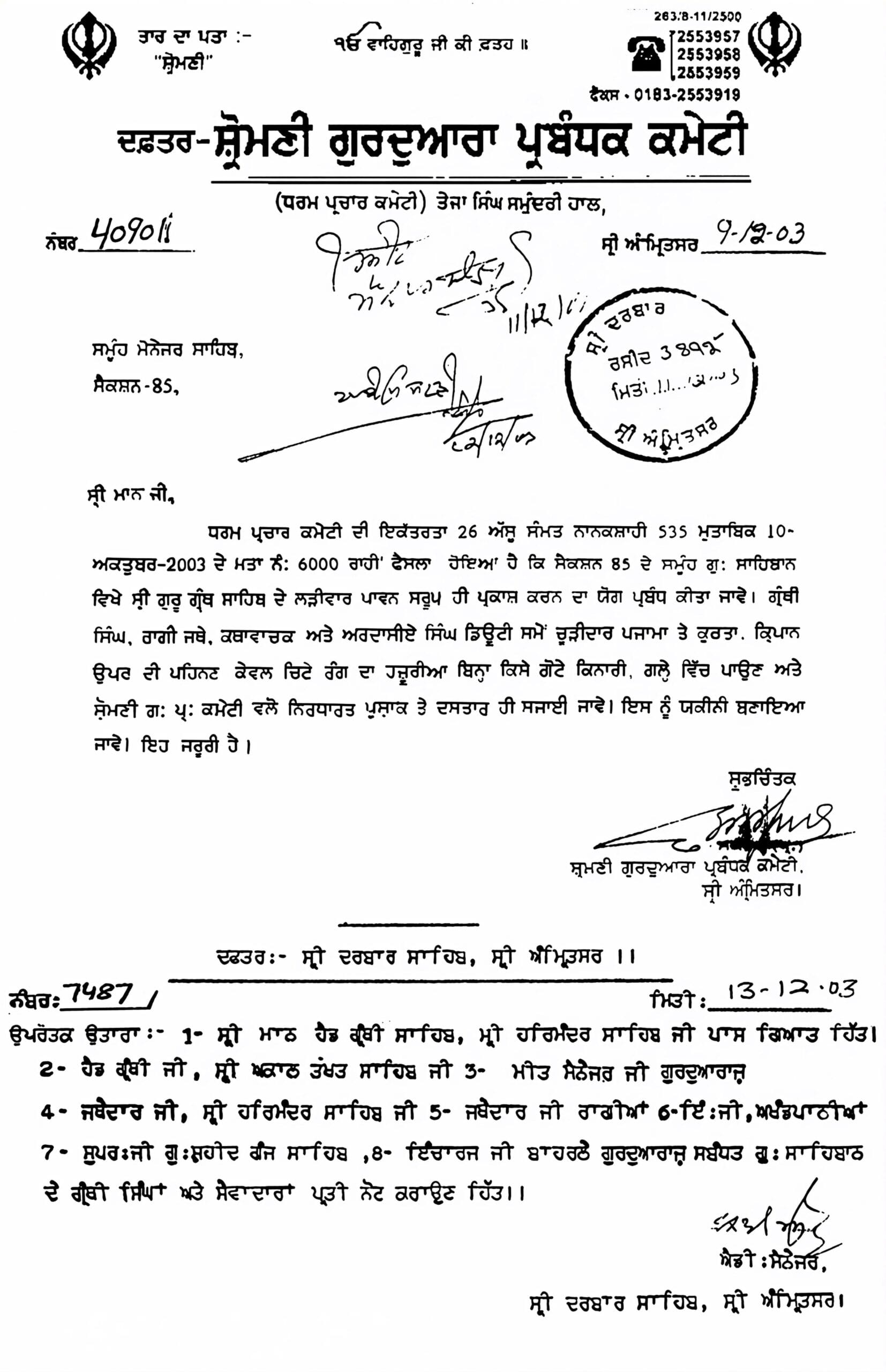
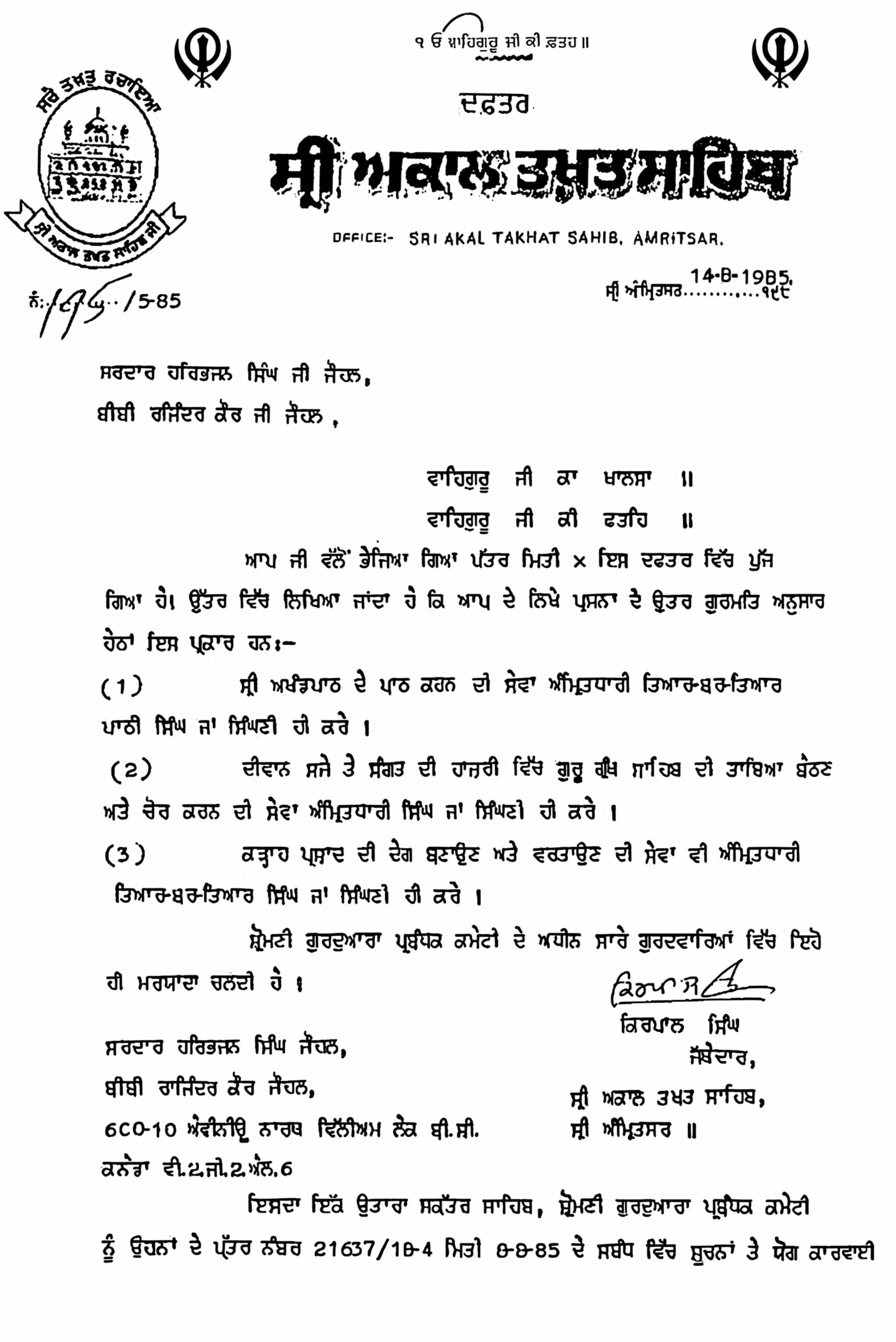
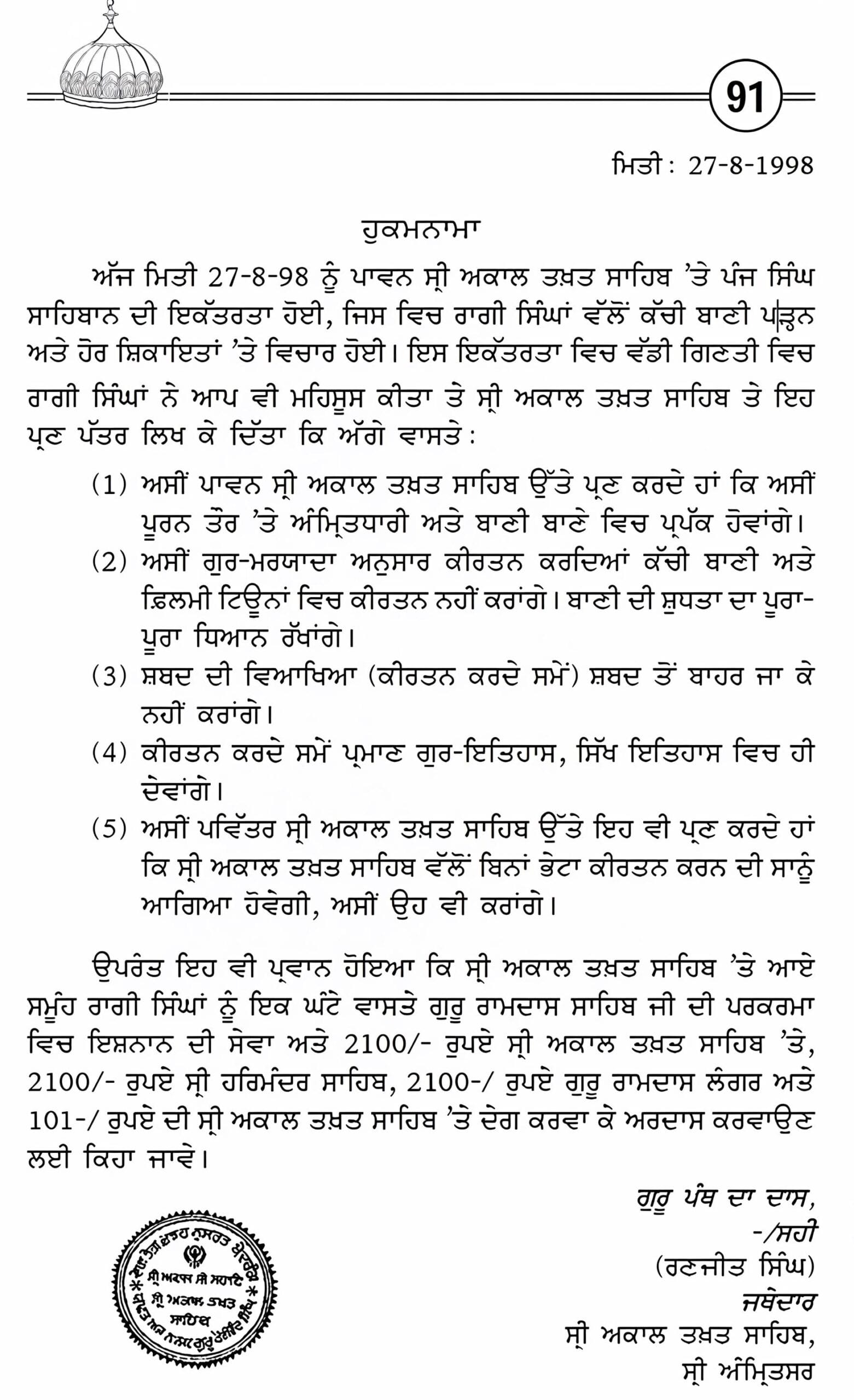
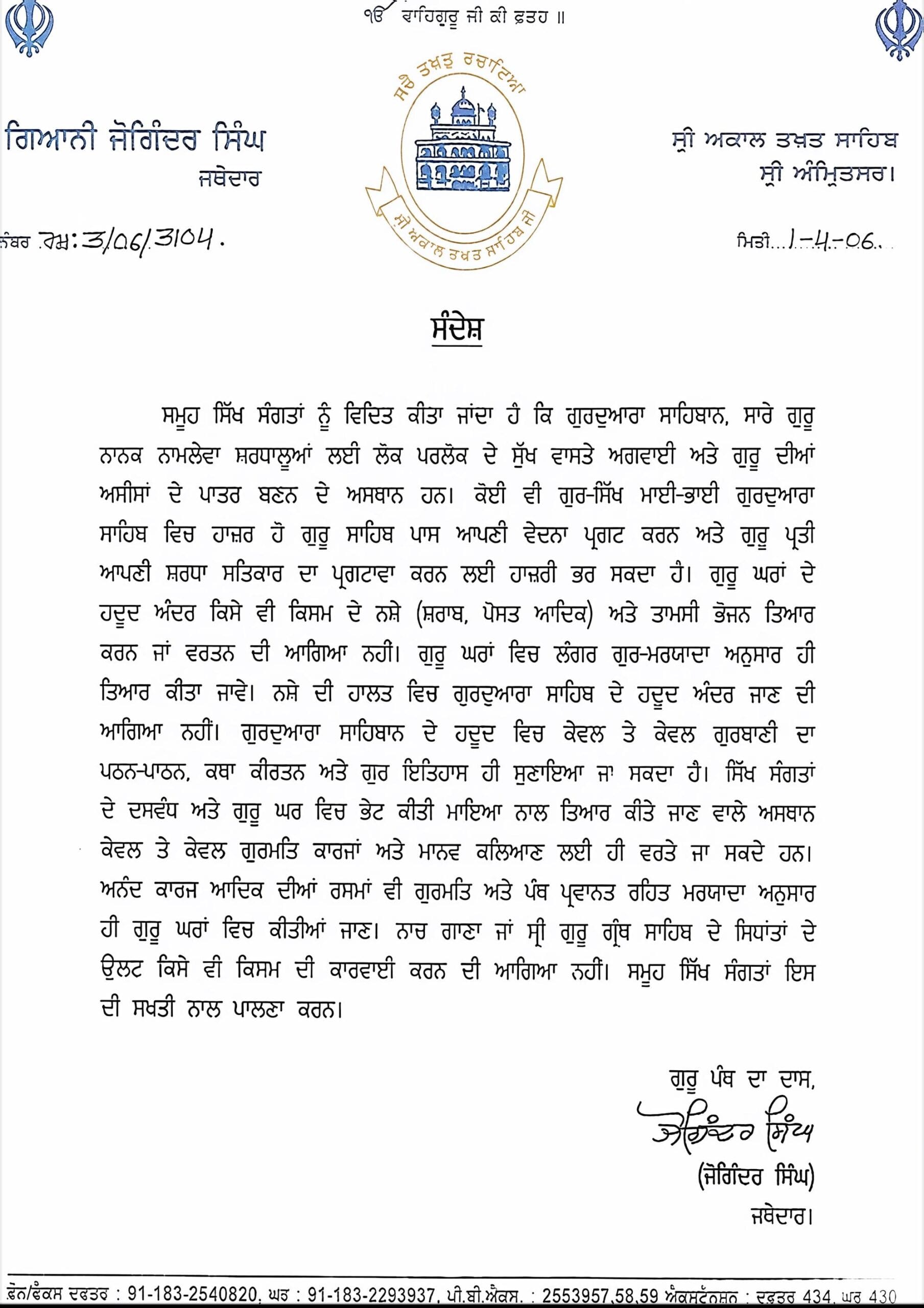
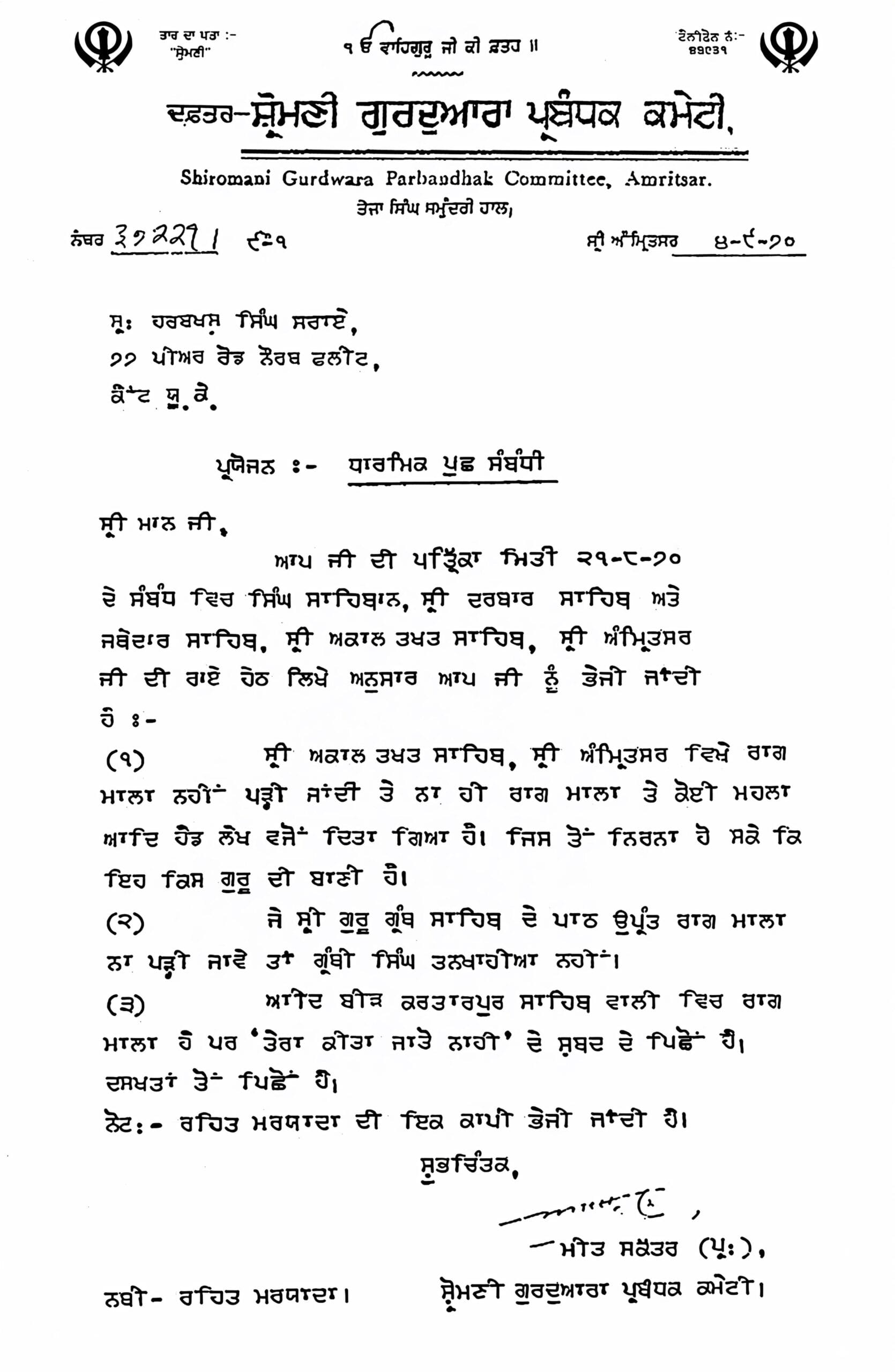
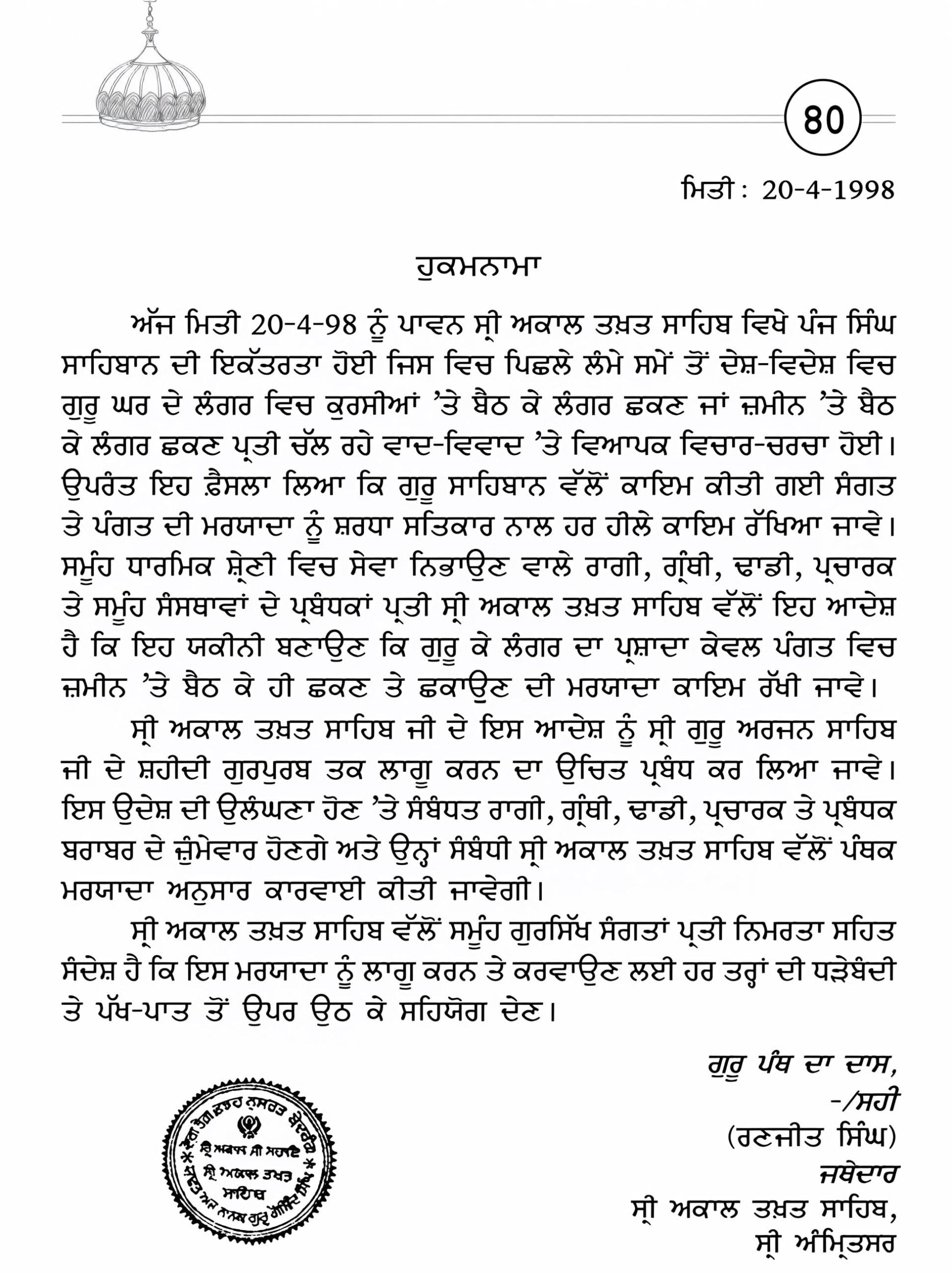
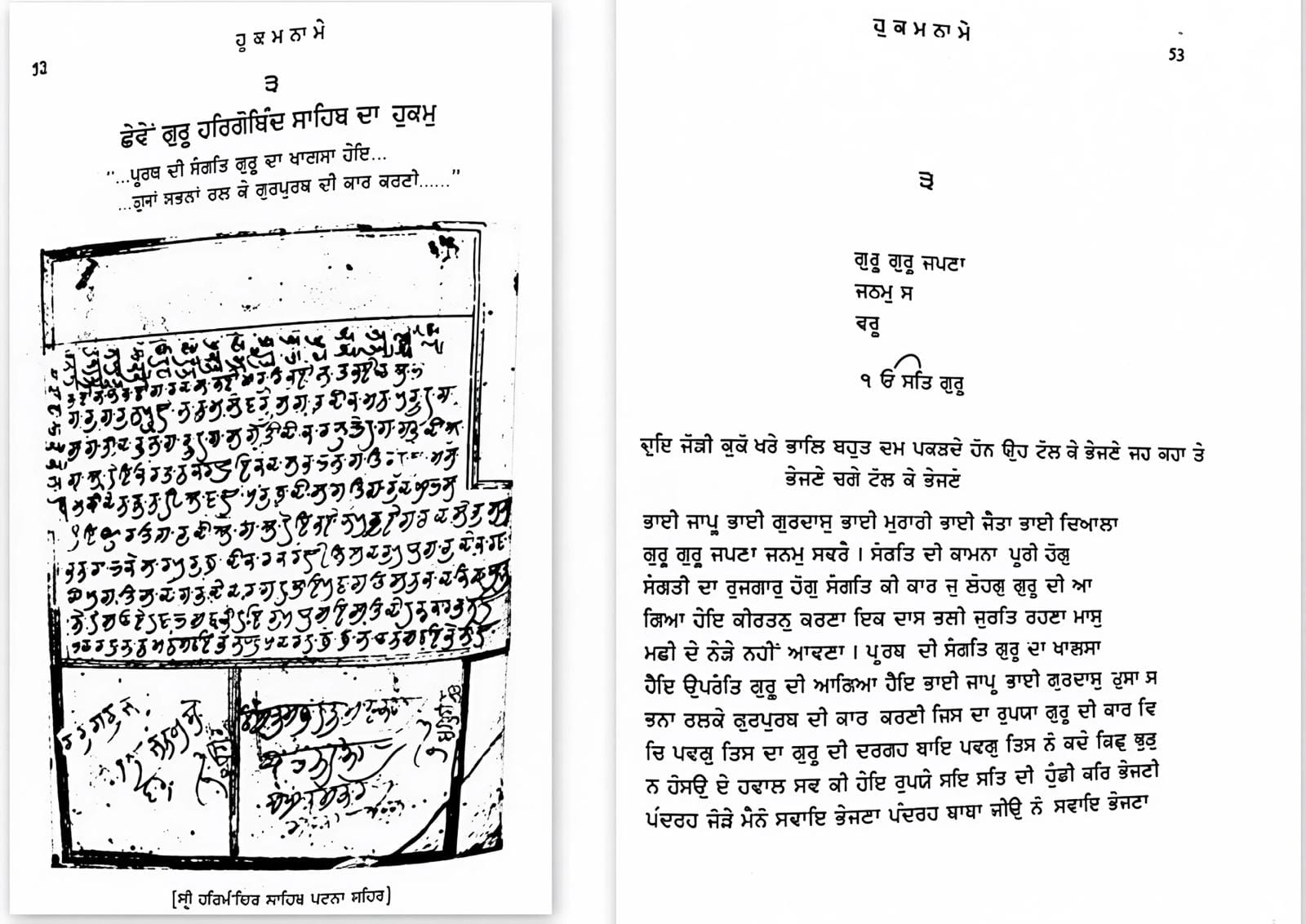
Hukamnama from Guru Hargobind Sahib Ji about not consuming meat or fish
This hukamnama instructs Sikhs not to consume meat or fish, stating that one should not come near meat or fish as per the edict.