
When Sikhs search the internet to understand whether meat consumption is permitted in Sikhi, they often encounter a confident‑sounding claim:
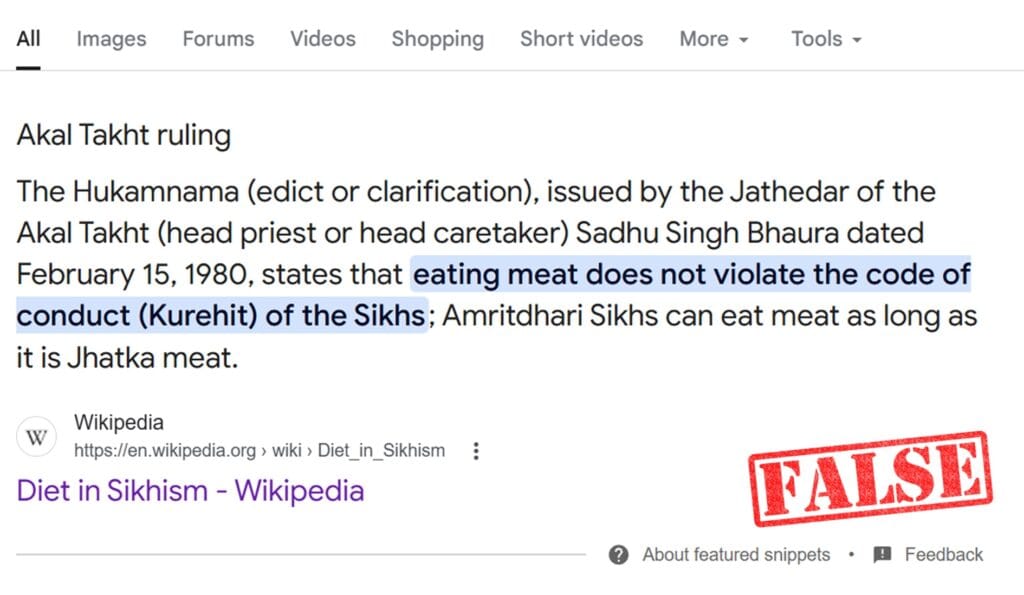
This statement appears across blogs, forums, social media posts, and even on Wikipedia. Because it is repeated so frequently, many assume it must be grounded in Panthic authority. However, a review of primary sources shows that no such Hukamnama exists.
This article outlines how the claim originated, how it spread, and what the official records actually state.
The earliest traceable reference to this alleged Hukamnama appears not in any Panthic archive, but in The Sikh Review, a long‑running English‑language monthly magazine founded in 1953 by the Sikh Cultural Centre in Kolkata (formerly Calcutta), India. Its 1992 publication, Volume 40, p. 16, asserted:
And according to the Hukamnama of Jathedar Sadhu Singh Bhaura of the Akal Takht, dated February 15, 1980 eating of “jhatka”, animal slaughtered with one stroke of kirpan (sword), is not against the code of conduct (kurehit) for the Sikhs.
No evidence, citation, or reproduction of the document accompanied the claim. Although respected for its longevity, The Sikh Review is not an official Sikh governing body, and its content reflects the views of individual contributors.
This is the earliest known source of the claim.
The claim resurfaced nearly a decade later when it was repeated word‑for‑word by Dharam Singh, Punjabi University
Perspectives on Sikhism (2001), p. 89.
Again, the statement was presented without any reference to official Sikh records. This academic repetition gave the claim an appearance of legitimacy, despite the absence of primary evidence.
By 2011 (and possibly earlier), the claim appeared on Sikhs.org, in an article by Sandeep Singh Brar.
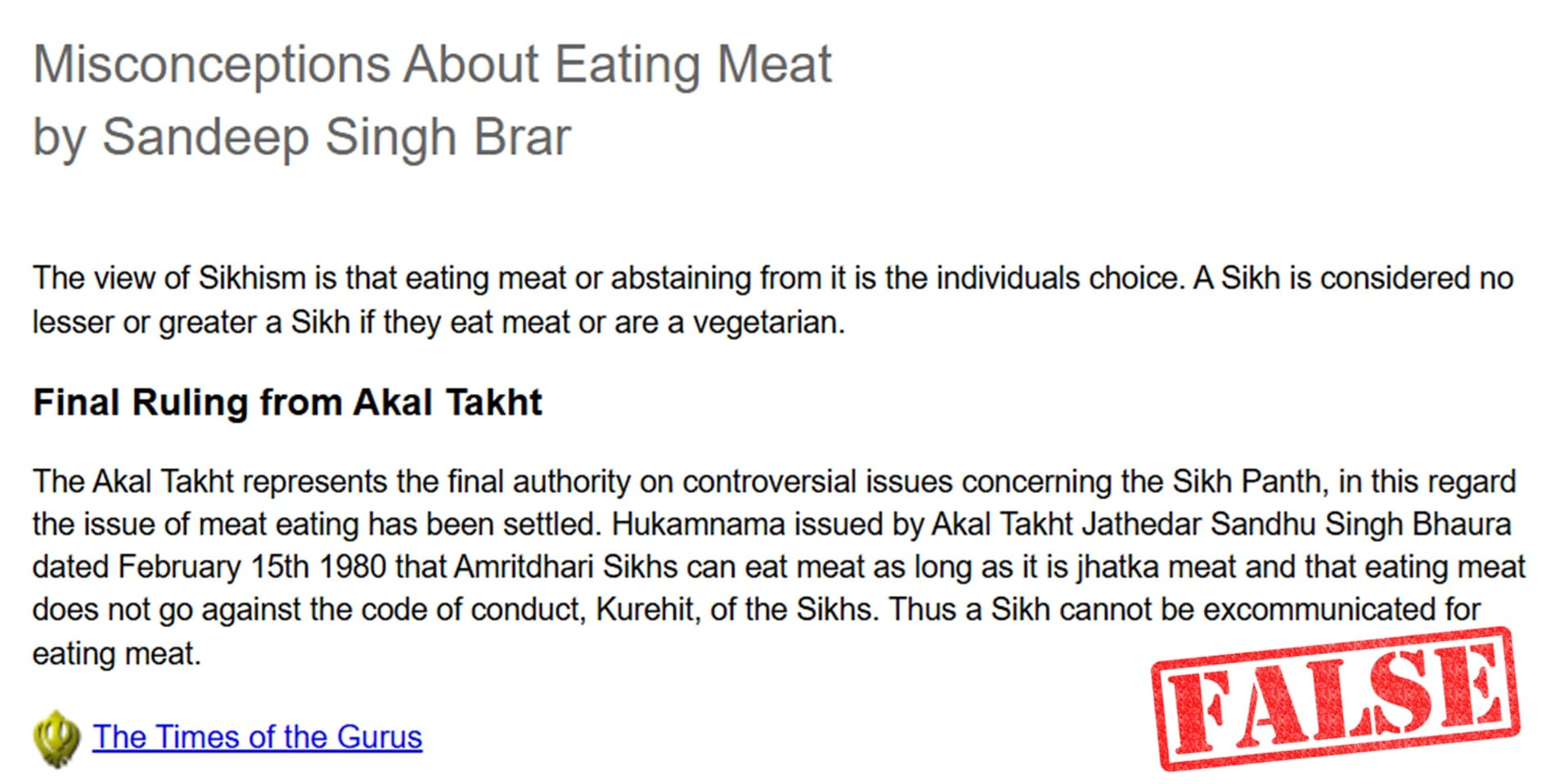
Because Sikhs.org is an older, highly indexed website, search engines began ranking the page prominently. From there, the claim spread widely:
Through repetition alone, the claim became accepted by many as factual.
All official Hukamnamas (edicts), Aadesh (directives), and Sandesh (memorandums) issued by Akal Takht Sahib are archived by the Shiromani Gurdwara Parbandhak Committee (SGPC), the elected body responsible for managing major Sikh gurdwaras (places of worship) in Punjab, India.
In June 2003, Roop Singh of the SGPC published a compilation of all Hukamnamas, Adesh, and Sandesh till date from the 1887 to 1999. This compilation is publicly available on the official SGPC website amongst others.
A complete review confirms:
In short, the claim has no primary source and does not appear anywhere in the official record.
| Claim | Status | Notes |
|---|---|---|
| Akal Takht issued a Hukamnama on 15 Feb 1980 permitting jhatka meat | False | Not found in any SGPC or Akal Takht record |
| First appearance of claim | 1992 | The Sikh Review, Vol. 40 |
| Academic repetition | 2001 | Perspectives on Sikhism, p. 89 |
| Online spread | 2011 (or earlier) | Sikhs.org article |
| Verified SGPC record | None | Confirmed via Roop Singh’s compilation |
This issue extends beyond the topic of meat. It highlights a broader concern:
Akal Takht Sahib’s authority rests on documented Hukamnamas, not on magazine statements or internet circulation.
For a community that values accuracy and Panthic unity, it is essential to distinguish between verified historical records and unsubstantiated claims.
The alleged “1980 meat Hukamnama” is a clear example of how misinformation can enter Sikh discourse through repetition rather than evidence. By tracing its origins and checking the official SGPC records, it becomes evident that no such Hukamnama was ever issued and the claim is baseless. Therefore, it should not be used as a reference in regards with the Sikh Rehat or Panthic positions.
A responsible approach to Sikh history and Rehat requires grounding our understanding in authentic, verifiable sources. This clarification aims to support that effort.