
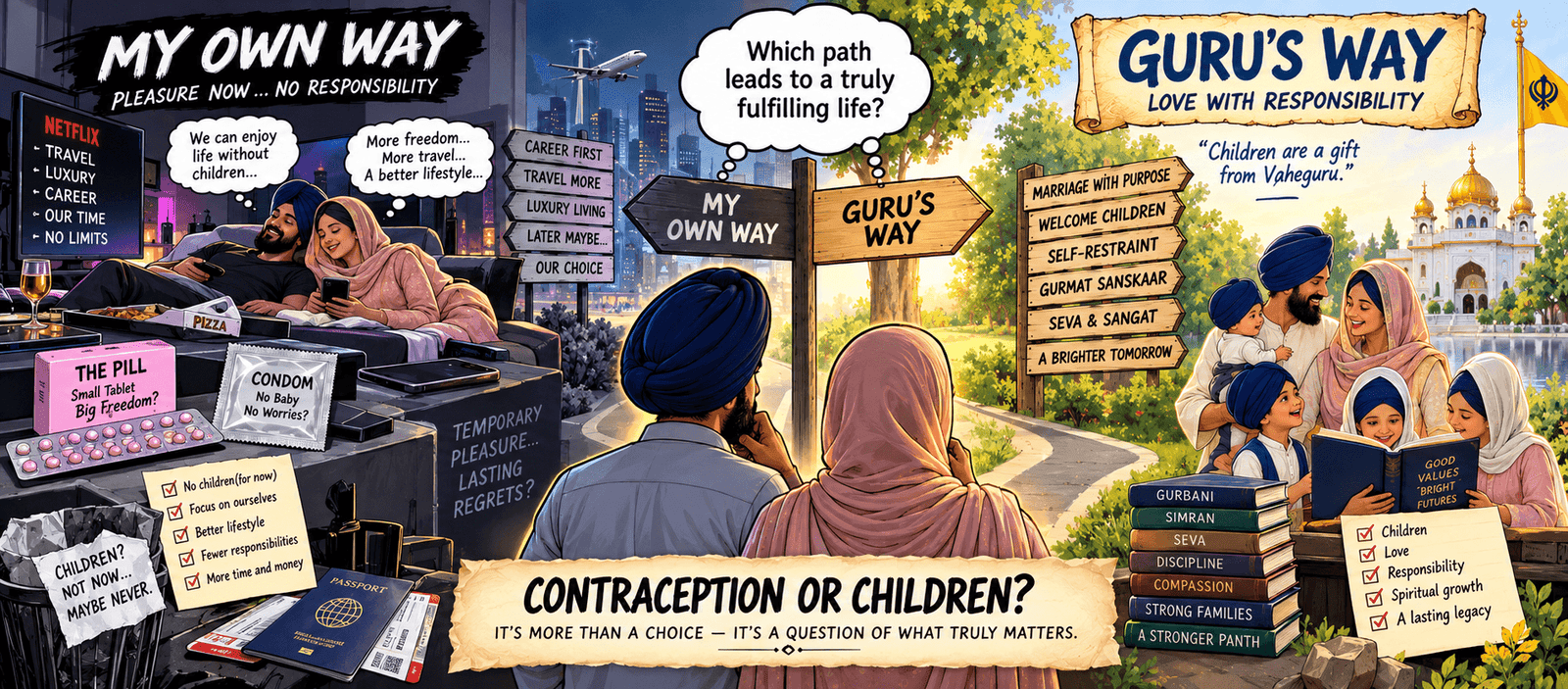
Modern society generally treats sexual activity and having children as two separate choices. A married couple may continue having sexual relations while deliberately preventing conception, and this is usually regarded as morally neutral.
Traditional Gurmat — the Guru’s way of thinking and living — begins from a different understanding. Sikhi places sexual relations within Gristi Jeevan (married householder life), where intimacy, responsibility and the possibility of children belong together.
The traditional Sikh position is therefore straightforward: a Gursikh should not deliberately use contraception to prevent conception. If husband and wife choose to have sexual relations, they should accept the possibility of children. If there is a genuine reason why conception should presently be avoided, they should practise self-restraint.
Sri Guru Granth Sahib Ji does not name modern contraceptive methods. The position instead follows from wider Gurmat principles: mastery of Kaam (lust or uncontrolled sexual desire), Sehaj (spiritual balance), responsible married life, acceptance of children, and living within Hukam (the Divine Order or Will).
Sikhi does not teach that sex is sinful. The Gurus established the path of Gristi Jeevan: a Sikh may marry, raise a family, work and live spiritually within society. Sexual intimacy therefore has a legitimate place between husband and wife.
But marriage does not mean that every sexual desire must be satisfied. Kaam remains one of the five major inner vices. The Sikh seeks to govern desire rather than be governed by it.
Sri Guru Granth Sahib Ji warns:
ਬਹੁ ਸਾਦਹੁ ਦੂਖੁ ਪਰਾਪਤਿ ਹੋਵੈ ॥ ਭੋਗਹੁ ਰੋਗ ਸੁ ਅੰਤਿ ਵਿਗੋਵੈ ॥
ਹਰਖਹੁ ਸੋਗੁ ਨ ਮਿਟਈ ਕਬਹੂ ਵਿਣੁ ਭਾਣੇ ਭਰਮਾਇਦਾ ॥੭॥“For one’s excessive indulgences, one receives only pain; from their enjoyments, they contract diseases, and in the end, they waste away. Worldly pleasures can never erase pain; without accepting the Lord’s Will, one wanders lost and confused. ||7||”
— Sri Guru Granth Sahib Ji, Ang 1034
The Sikh ideal is Sehaj: desires exist, but they do not rule us. This raises a question often overlooked in discussions about contraception: if there is a genuine reason why conception should not occur, why must sexual activity continue?
Within traditional Sikh family life, sexual union is naturally connected with procreation. This does not mean that every occasion of marital intimacy must produce a child. Conception naturally does not occur every time, and marital intimacy can also express affection, closeness and unity between husband and wife.
The important distinction is between naturally not conceiving and deliberately preventing conception. An infertile couple, an older couple, or a couple who simply do not conceive have done nothing deliberately to prevent conception. Contraception introduces an intentional intervention for that specific purpose.
Therefore, saying, “Neither couple has produced a child, so what is the difference?” misses the point. Morality involves intention and action as well as outcome. Naturally failing to conceive is not the same as deliberately preventing a potentially fertile sexual union from resulting in conception.
Suppose husband and wife genuinely believe that they should not presently have another child. Modern thinking usually moves immediately to the question, “Which contraception should they use?”
But this assumes that sexual activity itself must continue.
Gurmat provides another answer: self-restraint.
If there is a sufficient reason to avoid the possibility of a child, there can also be a sufficient reason to abstain from the act through which a child may naturally be conceived. The choice is not simply between contraception and continually having children.
Bhagat Kabir Ji describes an exceptionally disciplined person:
ਕਾਜੀ ਸੋ ਜੁ ਕਾਇਆ ਬੀਚਾਰੈ ॥ ਕਾਇਆ ਕੀ ਅਗਨਿ ਬ੍ਰਹਮੁ ਪਰਜਾਰੈ ॥
ਸੁਪਨੈ ਬਿੰਦੁ ਨ ਦੇਈ ਝਰਨਾ ॥ ਤਿਸੁ ਕਾਜੀ ਕਉ ਜਰਾ ਨ ਮਰਨਾ ॥੨॥“He alone is the true Qazi who reflects upon the human body, and through the fire of the body illuminates the Divine within. Even in a dream he does not allow his bind [semen/sexual essence] to be discharged; such a Qazi has no fear of old age or death. ||2||”
— Bhagat Kabir Ji, Sri Guru Granth Sahib Ji, Ang 1160
This passage is not discussing modern contraception. Its relevance is the spiritual ideal of mastery over sexual impulse rather than treating sexual release as an unavoidable necessity.
If a person can say “yes” to a desire but cannot say “no”, that is not complete freedom. Self-restraint is not anti-sex; it is mastery over Kaam.
No. Rejecting contraception does not mean maximising pregnancies. A couple with two children is not spiritually inferior to a couple with eight, and couples who naturally have few or no children are not spiritually deficient.
The principle is simpler: if husband and wife choose sexual relations, they accept the possibility of conception; if they genuinely need to avoid that possibility, they practise restraint.
Children should not be regarded as unwanted side effects of sexual activity. They are blessings entrusted by Vaheguru, carrying serious responsibilities. Sikh parents have a duty not only to provide materially and emotionally for their children, but to give them Gurmat Sanskaar — spiritual formation through Gurbani, Naam, Seva, Sangat and disciplined Sikh living.
This positive attitude towards larger Sikh families has also repeatedly been expressed by the leadership of Sri Akal Takht Sahib. In 2014, the then Jathedar Giani Gurbachan Singh encouraged Sikh couples to have four children rather than adopt the prevailing two-child ideal; in 2015 he again advocated at least three or four children. In July 2026, officiating Jathedar Giani Kuldeep Singh Gargaj similarly appealed for every Sikh family to have at least three children, presenting the issue as a matter of collective Panthic responsibility.
These statements do not mean that every Sikh couple is religiously required to have an exact number of children. Rather, they demonstrate an important traditional Sikh outlook: having several children should not automatically be regarded as undesirable, and responsible family life should not be equated with deliberately minimising the number of children.
The responsibility is not merely to have children, but to raise them well. A Sikh household can become a small Sangat, raising future generations with strong Gurmat Sanskaar and contributing towards the Chardi Kala of the Panth.
Financial responsibility matters. Sikhs should work honestly, provide for their dependants and make responsible decisions. Trust in Vaheguru is not an excuse for neglect. At the same time, genuine inability to provide necessities is different from simply being unwilling to sacrifice a preferred standard of living.
Sri Guru Granth Sahib Ji reminds the anxious mind:
ਕਾਹੇ ਰੇ ਮਨ ਚਿਤਵਹਿ ਉਦਮੁ ਜਾ ਆਹਰਿ ਹਰਿ ਜੀਉ ਪਰਿਆ ॥
“Why, O mind, do you worry and plan, when the Dear Lord Himself is concerned with your sustenance?”
— Sri Guru Granth Sahib Ji, Ang 10
Likewise, serious medical circumstances deserve compassion and proper medical advice. Medicines that affect fertility may sometimes be required to treat genuine medical conditions; treating illness where fertility is incidentally affected is different from deliberately using contraception for the purpose of preventing conception.
If pregnancy itself would pose a serious danger to a woman’s life or health, there is clearly a genuine reason to avoid pregnancy. But from the traditional Sikh perspective, a genuine reason to avoid pregnancy is also a genuine reason to abstain from the act that may cause pregnancy.
Changing the method does not change the underlying issue. A contraceptive pill may suppress ovulation, a condom creates a physical barrier, and other methods work in different ways. When they are deliberately being used for contraception, however, the relevant intention remains the same: sexual relations are retained while conception is deliberately prevented.
The traditional Sikh objection therefore does not depend upon proving that contraception is medically harmful. Imagine a contraceptive that was completely harmless, reversible and 100 per cent effective. The fundamental Gurmat question would remain:
Why is conception being deliberately prevented while the sexual act is retained?
The issue is ultimately about Kaam, self-restraint, responsibility and Hukam, rather than which contraceptive technology is safest.
Sexual intimacy within marriage can certainly express affection, tenderness and closeness. But sexual intercourse is not the only expression of marital love. Love is also loyalty, patience, companionship, sacrifice, care and Seva.
Sometimes love itself requires restraint. If husband and wife have a genuine reason to avoid conception, choosing to abstain together need not diminish their love. It may demonstrate that their relationship is based upon something deeper than the satisfaction of sexual desire.
Similarly, replacing intercourse with masturbation or other deliberately non-procreative sexual acts merely to obtain sexual release does not resolve the underlying issue. If the response to restraint is simply to find another means of satisfying Kaam, the desire has not been mastered; only its method of gratification has changed.
The traditional Sikh position can therefore be summarised simply. Sexual relations have their proper place within marriage, but marriage does not remove the Sikh duty to control Kaam. Sexual union is naturally connected with the possibility of children. Naturally failing to conceive is different from deliberately preventing conception, and children should be received as blessings and responsibilities rather than unwanted consequences.
Rejecting contraception does not mean that Sikhs must produce the maximum possible number of children. It means that sexual activity remains connected with responsibility.
If husband and wife choose sexual relations, they accept the possibility of children. If there is a genuine reason why they should avoid conception, they practise self-restraint rather than contraception.
The disagreement ultimately concerns two different understandings of freedom. Modern contraceptive thinking can define freedom as being able to satisfy sexual desire while controlling its reproductive consequences. Gurmat offers a more demanding understanding: freedom includes the ability to master desire itself.
Technology may alter hormones, create barriers or prevent conception in increasingly effective ways. But none of this answers the central spiritual question:
If the possibility of a child is unacceptable, why must the sexual desire be acted upon?
A Gursikh has another answer: I can exercise restraint.
The traditional Sikh position is therefore not anti-sex, anti-marriage or a demand to produce as many children as biologically possible. It places sexuality within Gristi Jeevan, where intimacy remains joined to responsibility and Kaam remains subject to the Guru’s discipline.
Where husband and wife choose sexual relations, they accept the possibility of children. Where there is a genuine reason to avoid conception, they practise restraint.