
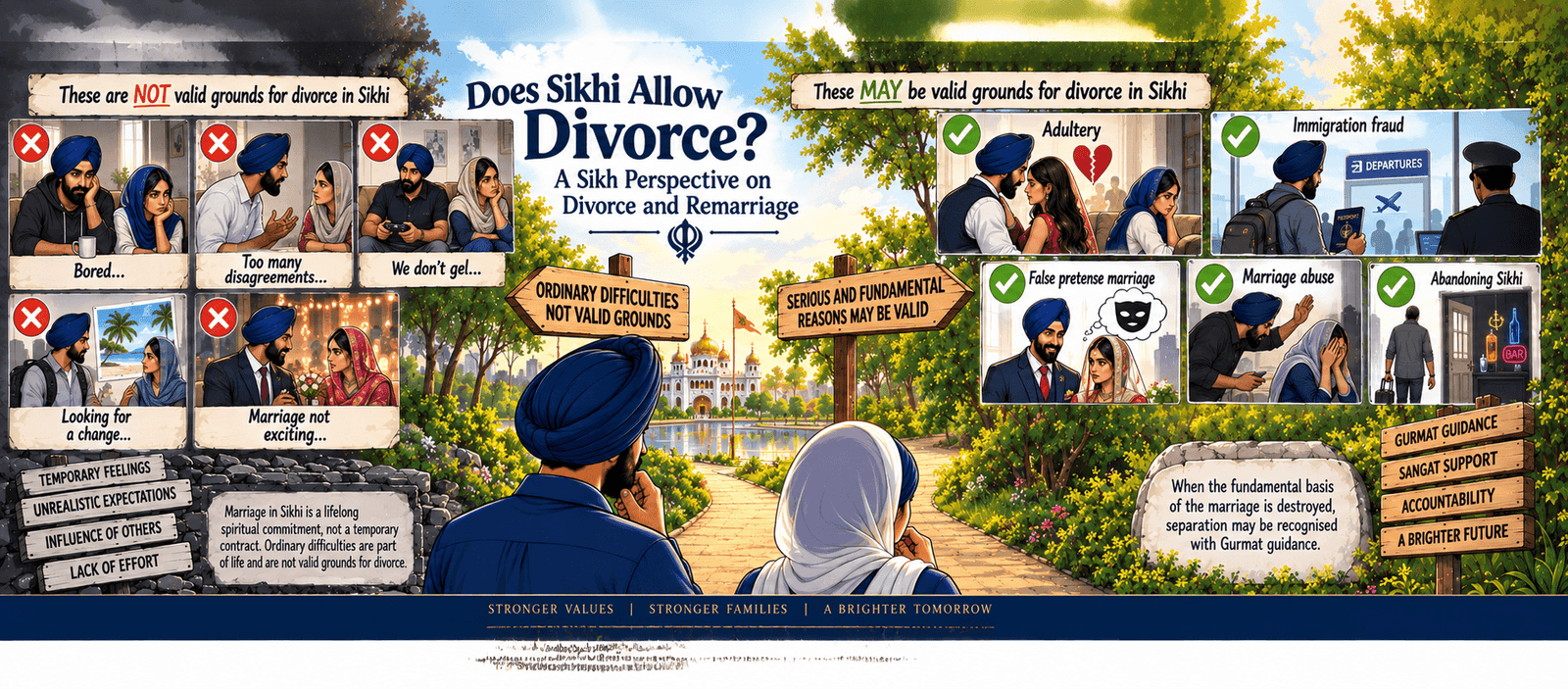
What does Sikhi say about divorce? Can a Sikh get divorced and remarry? Drawing upon Gurbani, the Sikh Rehat Maryada and research by Sikh educator and author Bhai Manvir Singh (UK), this article explores marriage breakdown, separation and remarriage from a Gurmat perspective.
Sikhi teaches that Anand Kaaraj is intended to be a lifelong spiritual union, not a temporary contract. There is no standard Sikh religious divorce ceremony or routine procedure for dissolving an Anand Kaaraj, and ordinary disagreements are not grounds for casually abandoning a marriage.
However, exceptional circumstances can arise in which the foundations of the marital commitment have been fundamentally destroyed and reconciliation is genuinely no longer possible. The Laavaaⁿ, being Gurbani, do not become void; rather, the marital relationship and commitment made before Guru Sahib may, in exceptional circumstances, be recognised as having been broken. Such cases should be approached through Gurmat-centred guidance and accountability rather than simply individual choice.
Where a marriage is legally registered, the necessary civil divorce must also be completed before remarriage.
This article draws particularly upon the research of Bhai Manvir Singh (UK) in The Sikh Rehat Maryada (Sikh Code of Conduct): With Supporting Proofs and Explanations, pp. 337–340, alongside Gurbani, the Sikh Rehat Maryada, and the Gurmat discourse of Bhai Manjit Singh (Toronto).
The starting point is that marriage is intended for life.
Anand Kaaraj is not simply a social contract between two people. Husband and wife make a sacred commitment in the presence of Sri Guru Granth Sahib Ji and begin a shared spiritual journey.
Gurbani describes the bond formed between man and woman:
ਭੰਡਿ ਜੰਮੀਐ ਭੰਡਿ ਨਿੰਮੀਐ ਭੰਡਿ ਮੰਗਣੁ ਵੀਆਹੁ ॥
ਭੰਡਹੁ ਹੋਵੈ ਦੋਸਤੀ ਭੰਡਹੁ ਚਲੈ ਰਾਹੁ ॥
ਭੰਡੁ ਮੁਆ ਭੰਡੁ ਭਾਲੀਐ ਭੰਡਿ ਹੋਵੈ ਬੰਧਾਨੁ ॥
“From woman, man is born; within woman, man is conceived; to woman he is engaged and married. Woman becomes his friend; through woman, the future generations come. When the woman he married dies, he seeks another woman to remarry; to woman he is bound…”
— Sri Guru Granth Sahib Ji, Ang 473
Marriage therefore involves companionship, responsibility and commitment, but the Sikh ideal goes considerably deeper than simply remaining legally married.
Husband and wife should progress spiritually together and strive towards the ideal expressed as:
ਏਕ ਜੋਤਿ ਦੁਇ ਮੂਰਤੀ — Ek Jot Due Moortee
“One light in two bodies.”
Their deepest unity is therefore not merely physical, financial or social. It is spiritual.
Bhai Manjit Singh (Toronto), in his Gurmat discourse Sikhi Vich Talaaq Ate Dooje Viah (“Divorce and Remarriage in Sikhi”), similarly describes the husband-wife relationship as the closest and most sacred relationship that people establish during their lives. The very expression “life partner”, he explains, indicates that this relationship is intended to endure throughout life.
Interestingly, Gurbani uses the concepts of Sanjog — union — and Vijog — separation.
Spiritually, these can describe union with and separation from Vaheguru. In worldly usage, they can also describe union and separation within human relationships.
Gurbani says:
ਸੰਜੋਗੁ ਵਿਜੋਗੁ ਕਰਤੈ ਲਿਖਿ ਪਾਏ ਕਿਰਤੁ ਨ ਚਲੈ ਚਲਾਹਾ ਹੇ ॥੮॥
“Both union and separation are written by the Creator. Whatever has been written by destiny cannot be erased.”
— Sri Guru Granth Sahib Ji, Ang 1058
The Sikh position should therefore not be oversimplified into claiming that separation is something Gurbani cannot even conceive of.
The Sikh ideal remains lifelong union. Yet Sikhi also deals realistically with human weakness, ego, wrongdoing and the consequences of people’s actions.
Many marital problems do not begin with extraordinary circumstances. They develop gradually.
Bhai Manjit Singh identifies lack of tolerance, uncontrolled anger, lack of humility and an unwillingness to compromise as causes that can slowly create bitterness between husband and wife. Small disagreements can become major conflicts when neither person is prepared to step back.
He also warns against interference from relatives, friends or acquaintances who create divisions between husband and wife through gossip and criticism.
Differences between two people are inevitable. The problem arises when every disagreement becomes a battle to be won.
From a Gurmat perspective, marriage therefore requires patience, humility, forgiveness, honesty, self-control and a willingness to examine one’s own faults.
The first response should normally be reconciliation rather than separation.
Minor arguments, personality differences, misunderstandings and the ordinary pressures of married life should not become excuses for abandoning the commitment made during Anand Kaaraj.
Where serious difficulties arise, guidance can be sought from mature Gursikhs, respected members of the Sangat, or, where appropriate, Panj Singhs or the Panj Pyaare.
Both husband and wife should also examine whether they themselves are living according to Gurmat.
Gurbani says:
ਭਗਤਾ ਤੈ ਸੈਸਾਰੀਆ ਜੋੜੁ ਕਦੇ ਨ ਆਇਆ ॥
“The devotee and the worldly-minded person can never truly unite.”
— Sri Guru Granth Sahib Ji, Ang 145
If one spouse genuinely attempts to centre their life upon the Guru while the other becomes dominated by ego or conduct fundamentally opposed to Gurmat, the spiritual unity intended within marriage becomes increasingly difficult.
Gurbani also says:
ਏਹ ਕੁਚਜੀ ਕੁਲਖਣੀ ਪਰਹਰਿ ਛੋਡੀ ਭਤਾਰਿ ॥
“The one of bad conduct and low character is abandoned by their beloved.”
— Sri Guru Granth Sahib Ji, Ang 516
In its spiritual context, this refers to the relationship between the soul and the Divine Husband. Nevertheless, the principle highlights the seriousness Gurbani attaches to character and conduct.
Merely possessing the outward status of being married cannot create genuine unity when the character and conduct necessary to sustain that relationship have disappeared.
Ordinary disagreements are not sufficient grounds for casually breaking an Anand Kaaraj.
This is one of the clearest points made by Bhai Manjit Singh (Toronto).
He distinguishes ordinary marital conflict from circumstances involving serious moral or religious breakdown. Differences of opinion and arguments over relatively small matters do not justify abandoning the relationship.
As he explains:
“Differences between yourselves, or arguing over small matters, are not reasons for which this relationship can be broken, because the foundation of this relationship was established in the presence of Guru Sahib.”
The couple made their commitment before Guru Sahib with the intention of maintaining the relationship throughout life.
A Gursikh should therefore not enter Anand Kaaraj viewing divorce as an easy exit if married life becomes difficult.
Here an important distinction needs to be made.
There is no standard Sikh religious divorce ceremony or prescribed procedure for dissolving an Anand Kaaraj. The Laavaaⁿ themselves are Gurbani and therefore do not become invalid or void. However, this does not mean that the marital commitment solemnised through the Anand Kaaraj and Ardaas can never be recognised as having been broken. Where one spouse fundamentally violates or abandons the Gurmat foundations upon which that commitment was made, exceptional circumstances may arise in which the marital relationship itself can be recognised as having ended.
Divorce (talaaq) is fundamentally a matter of civil law. A court determines whether two people remain legally married. Gurmat, however, asks a different question:
Have circumstances arisen that genuinely justify recognising the breakdown of the sacred marital relationship?
This distinction is important. A civil court can declare that the legal marriage has ended, but it cannot determine the religious question of whether the sacred commitment made before Guru Sahib has been legitimately broken. Conversely, where one spouse has fundamentally violated that commitment, the other spouse should not automatically be regarded as religiously bound forever simply because Sikhi has no formal divorce ritual.
These two questions overlap, but they are not identical.
Bhai Manjit Singh explains that modern marriages are generally registered with the state. A court can therefore legally dissolve the marriage and regard both individuals as legally free to marry again.
But obtaining a legal document does not by itself answer whether abandoning the Anand Kaaraj commitment was consistent with Gurmat.
Therefore, saying “there is no religious divorce ceremony in Sikhi” is not the same as saying “a Sikh can never separate, obtain a civil divorce or remarry.”
Sikhi distinguishes ordinary marital difficulties from exceptional circumstances in which the foundations of the marital commitment itself have been fundamentally violated. The important question is not simply whether a husband and wife wish to separate, but whether something sufficiently serious has occurred for the marital relationship solemnised before Guru Sahib to be recognised as genuinely broken.
In his discourse, Bhai Manjit Singh identifies circumstances in which the previous marital relationship may be regarded as having ended, including:
He explains:
“Because of certain exceptional reasons or serious offences, this relationship may be accepted as having broken down, and permission may be given.”
His discourse makes clear that he is speaking about serious circumstances rather than ordinary disagreements.
This should not be turned into a convenient checklist for escaping an unwanted marriage. The principle is that something exceptionally serious has occurred which has destroyed the foundations upon which the marital relationship was established. The Laavaaⁿ have not become void; rather, the marital commitment made through Anand Kaaraj and Ardaas has been fundamentally violated. In such exceptional circumstances, the relationship may be recognised as having been broken.
Nor should such a decision simply depend upon one person’s emotions or preferences.
Bhai Manjit Singh explains:
“According to the Maryada and the principles of Sikhi, approval should be sought from the Sangat or Panch, the advice of Gursikhs should be taken, and only then should the next step be taken.”
The emphasis is upon seriousness, accountability and Gurmat-centred guidance, rather than treating divorce merely as an individual lifestyle choice.
It is significant that Sikh religious literature and traditional Rehat-namas do not establish a routine religious procedure for permanently dissolving an Anand Kaaraj. The Sikh Rehat Maryada likewise prescribes no Sikh divorce ceremony.
Bhai Manvir Singh (UK) argues that this absence should be understood in the context of the Sikh view of marriage as a lifelong commitment. A routine religious procedure for ending an Anand Kaaraj could risk normalising marital dissolution as another readily available option whenever difficulties arose. Instead, permanent separation should remain an exceptional matter requiring consideration of the individual circumstances.
This does not mean that an innocent spouse must remain indefinitely bound where the other person has fundamentally destroyed the Gurmat basis of the marriage. The Laavaaⁿ, being Gurbani, do not become void. Rather, it is the marital commitment solemnised through the Anand Kaaraj and Ardaas that may have been fundamentally violated by one party. In exceptional circumstances, the marital relationship may therefore be recognised as having been broken.
This is consistent with the guidance given by Bhai Manjit Singh (Toronto). He explains that where one spouse abandons Sikhi or commits grave offences that are socially unacceptable and fundamentally contrary to Sikh principles, the relationship may be accepted as having broken down. Even then, the matter should not simply be decided according to individual preference: approval should be sought from the Sangat or Panch, the advice of Gursikhs should be taken, and only then should the next step be taken.
The first aim should therefore be reconciliation where reconciliation remains genuinely possible. Bhai Manjit Singh specifically distinguishes exceptional circumstances from ordinary disagreements and arguments over small matters, which he says are not sufficient reasons for breaking the relationship because its foundation was established in Guru Sahib’s presence with a commitment to maintain it for life.
Where exceptional circumstances have made reconciliation genuinely impossible, however, the marital commitment may be recognised as having been broken and permanent separation may be accepted, with appropriate Gurmat-centred guidance.
In this way, Sikhi does not normalise divorce, while also not leaving one spouse permanently bound to another person’s fundamental violation of the marital commitment.
The Sikh ideal of lifelong marriage should never be used to excuse or conceal abuse, violence or serious wrongdoing.
Marriage does not give either spouse permission to harm, terrorise, exploit or endanger the other.
Someone facing abuse may need to remove themselves from danger and seek appropriate safeguarding, professional, police or legal assistance. Immediate safety should not be postponed while attempts are made at informal reconciliation.
This is fundamentally different from abandoning a marriage because of ordinary disagreements.
The Sangat also has a responsibility to uphold Dharam. Protecting the outward appearance of a marriage cannot take priority over protecting someone from serious wrongdoing.
Reconciliation is a virtue where reconciliation is genuinely possible. It should not become a mechanism for returning someone to danger.
A particularly important statement in the Sikh Rehat Maryada says:
ਆਮ ਹਾਲਤਾਂ ਵਿਚ ਸਿੱਖ ਨੂੰ ਇਕ ਇਸਤਰੀ ਦੇ ਹੁੰਦਿਆਂ ਦੂਜਾ ਵਿਆਹ ਨਹੀਂ ਕਰਨਾ ਚਾਹੀਏ।
“Under normal circumstances, a Sikh should not marry another while their spouse is living.”
The words “under normal circumstances” are significant.
As discussed in the research of Bhai Manvir Singh (UK), this qualification was added to the statement in the 1945 edition of the Sikh Rehat Maryada.
If absolutely no exceptional circumstances could ever permit remarriage while the former spouse remained alive, the qualification “under normal circumstances” would be difficult to explain. Rather, it establishes the general rule — a Sikh does not marry another while their spouse is living under normal circumstances — while leaving room for exceptional cases in which the previous marital relationship has genuinely broken down to be considered individually through Gurmat-centred guidance.
The Sikh Rehat Maryada also explicitly provides for remarriage:
ਪੁਨਰ ਵਿਆਹ ਦੀ ਵੀ ਇਹੋ ਰੀਤ ਹੈ, ਜੋ ‘ਆਨੰਦ’ ਲਈ ਉਤੇ ਦੱਸੀ ਹੈ।
“Remarriage may be solemnised in the same manner as the Anand marriage.”
Therefore, remarriage itself is not prohibited in Sikhi. The real question is whether the previous marriage has legitimately ended.
Yes, remarriage can be permissible where the previous marital relationship has genuinely and legitimately ended.
However, civil divorce and Gurmat recognition of marital breakdown should not be confused. A civil divorce establishes that the marriage has legally ended; it does not by itself determine whether abandoning the sacred commitment made before Guru Sahib was justified according to Gurmat.
If a couple abandons their marriage merely because of comparatively minor disagreements, obtaining a civil divorce does not retrospectively make that decision consistent with Gurmat.
Bhai Manjit Singh argues that where no legitimate exceptional reason exists, simply obtaining a government divorce does not automatically make a subsequent Anand Kaaraj religiously acceptable.
Where the first relationship has genuinely ended under exceptional circumstances, however, remarriage may be permissible.
The distinction can be summarised simply:
Civil divorce determines legal status. Gurmat determines religious and moral accountability.
Yes, if the first marriage is legally recognised.
On 1 March 2005, Giani Joginder Singh Vedanti Ji, then Jathedar of Sri Akal Takht Sahib, publicly stated that a Sikh should not remarry without first obtaining a legal divorce, and that failing to do so would violate the Sikh Rehat Maryada.
This also has an obvious practical purpose. Attempting another marriage while the first remains legally intact can create serious legal, financial, inheritance and family complications.
Where a marriage has legitimately and permanently ended, religious accountability should therefore be addressed and the necessary civil divorce completed before remarriage.
An interesting contemporary example appears in the 2022 Panth Khalsa Nitnem Gutka Sahib, published by Sri Misal Shaheedan Tarna Dal, Baba Bakala Sahib, under the leadership of the late Jathedar Baba Gajjan Singh Ji.
Its additional Rehat Maryada, point 45, describes ending a marriage as Manmat — contrary to the Guru’s teachings — but then addresses circumstances where reconciliation has become impossible.
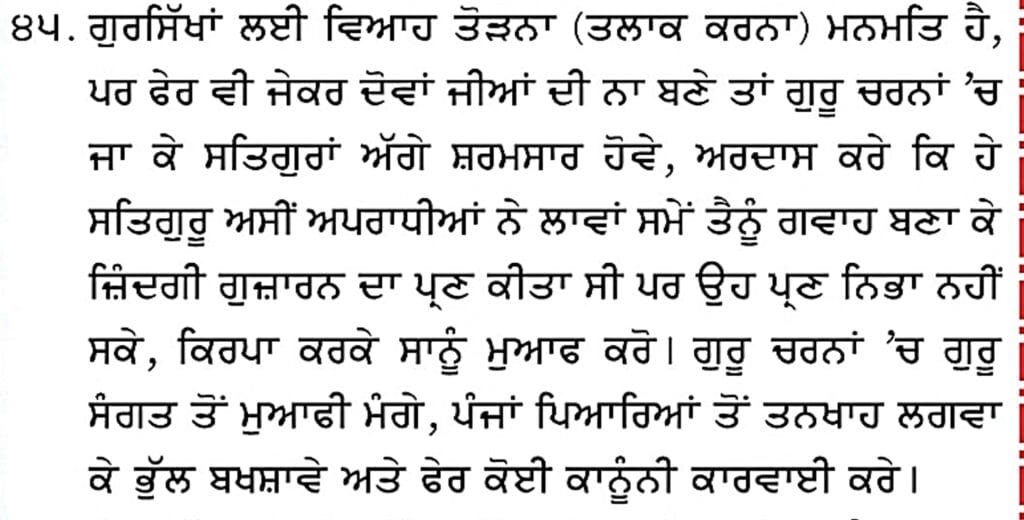
It states, in translation:
“For Sikhs, ending a marriage (divorce) is Manmat (contrary to the Guru’s teachings). However, if reconciliation is no longer possible, the couple should, with humility and remorse, present themselves before Guru Sahib and offer an Ardaas, seeking forgiveness for failing to uphold their vow of lifelong union. They should seek forgiveness from the Guru-Sangat in the presence of Sri Guru Granth Sahib Ji, accept a Tankhah as determined by the Panj Pyaare, and thereafter proceed with the necessary legal steps for civil divorce.”
This provides an example of how an irretrievably broken marriage may be dealt with without creating a Sikh “divorce ceremony” that reverses the Laavaaⁿ. Instead, the failure of the marital commitment is acknowledged before Guru Sahib through Ardaas, accountability and Tankhah, after which the necessary civil divorce can proceed.
It does not celebrate divorce or make it convenient. But neither does it pretend that irreparable marital breakdown can never occur.
Instead, it approaches the breakdown with spiritual seriousness, humility and accountability.
Perhaps the most important Sikh response to divorce begins long before a marriage breaks down — indeed, before the marriage even takes place.
The qualities necessary for a successful marriage cannot suddenly be acquired on the wedding day.
Young Sikhs need to develop honesty, responsibility, humility, patience, self-control, compassion, forgiveness, sexual integrity and spiritual steadfastness from an early age.
People also need to approach choosing a spouse realistically.
Physical attraction, wealth, profession, family status and an elaborate wedding cannot compensate for major differences in character, values and spiritual direction.
A couple hoping to live as “one light in two bodies” needs more than attraction. They need a shared direction towards the Guru.
Families and friends also have a responsibility to strengthen marriages rather than unnecessarily interfere in them. Bhai Manjit Singh concludes by warning Sikhs not to become the cause of someone else’s marriage breaking down, but instead to offer guidance rooted in Gurmat.
The Sikh position can be summarised as follows:
Marriage is lifelong in intention. Anand Kaaraj is a sacred spiritual commitment made in the presence of Sri Guru Granth Sahib Ji.
Reconciliation should normally be sought. Ordinary disagreements, personality differences and minor conflicts should not become excuses for casually abandoning a marriage.
There is no standard Sikh religious divorce ceremony or routine procedure for dissolving an Anand Kaaraj. The Laavaaⁿ, being Gurbani, do not become void. However, in exceptional circumstances the marital commitment made before Guru Sahib may be recognised as having been fundamentally broken. Legal divorce itself remains a civil process.
Exceptionally serious circumstances can destroy the foundations of the marital commitment. Where reconciliation is genuinely impossible, the situation should be considered through Gurmat, accountability and the guidance of mature Gursikhs, the Sangat, or, where appropriate, the Panj Pyaare.
Remarriage can be permissible. The Sikh Rehat Maryada itself provides for remarriage, but this does not mean every civil divorce automatically makes another Anand Kaaraj appropriate.
A legally married Sikh should obtain a legal divorce before remarrying.
Ultimately, Sikhi regards marriage as neither casually disposable nor something whose outward appearance must be artificially preserved regardless of grave circumstances.
The guiding principles are Gurmat, truth, responsibility, justice, humility and spiritual integrity.
Sources and Further Reading
Bhai Manvir Singh (UK), The Sikh Rehat Maryada (Sikh Code of Conduct): With Supporting Proofs and Explanations, pp. 337–340.
Bhai Manjit Singh (Toronto), Sikhi Vich Talaaq Ate Dooje Viah (“Divorce and Remarriage in Sikhi”), Sikhi Sikhia Gur Veechar. The discourse examines the lifelong nature of Sikh marriage, causes of marital breakdown, exceptional circumstances, civil divorce and remarriage.
Sikh Rehat Maryada, Shiromani Gurdwara Parbandhak Committee.
Panth Khalsa Nitnem Gutka Sahib, Sri Misal Shaheedan Tarna Dal, Baba Bakala Sahib (2022), point 45, p. 15.
Sri Guru Granth Sahib Ji: Angs 145, 473, 516 and 1058.