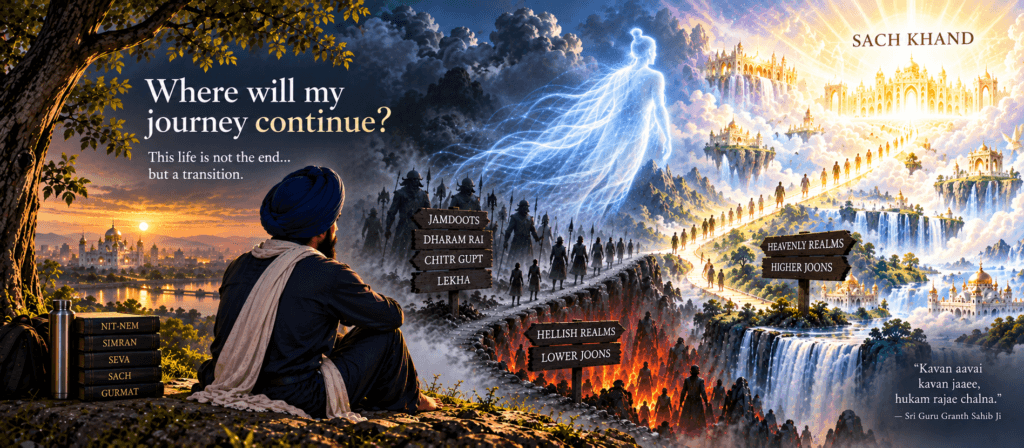
Death presents a question that no human being can ultimately avoid. We can observe what happens to the physical body: breathing stops, the heart ceases to function, the senses no longer respond and, in time, the body returns to the material elements from which it was formed. Yet this describes only the death of the body. It does not answer the deeper question of what happens to the conscious being who lived through that body.
Does the individual cease to exist? What, if anything, continues beyond physical death? Gurbani speaks of karam (actions and their consequences), Jamdoots (messengers associated with death and Divine justice), Dharam Rai (the Righteous Judge), Chitr Gupt, lekha (the account of one’s actions), the Dargah (Divine Court), Heaven and Hell, bhoot and pret, and repeated existence through different joons (forms or states of embodied existence). At the same time, Gurbani teaches that the spiritually liberated Gurmukh is not subject to this ordinary post-death process in the same manner as the spiritually bound jeev.
The Sikh understanding of death is therefore neither annihilation nor a simple division of humanity into two permanent destinations after death. Physical death forms one stage within a much greater spiritual journey. The unliberated jeev remains within aavaa-gavan — coming and going through birth and death — until the bondage that produces repeated embodiment is finally overcome through the Guru and Vaheguru’s Grace.
Bhai Sahib Bhai Randhir Singh Ji explored these questions extensively in Unditthi Duniya (“The Unseen World”). The work examines life beyond physical death, the Divine Court, Dharam Rai, Heaven and Hell, Jamdoots, experiences at the approach of death, Chitr Gupt and transmigration. Significantly, Bhai Sahib’s method is to establish these realities through Gurbani and then use personal and Gursikh experiences to illuminate what Gurbani has already revealed. This provides an appropriate method for approaching the subject more generally: Gurbani remains the authority, while the explanations and experiences of recognised Panthic Gursikhs may deepen our understanding where they complement, rather than contradict, Gurbani.
A Sikh understanding of death requires some understanding of what a human being is. In ordinary speech, we often speak simply of a “body” and “soul”. Traditional Gursikh explanations provide a more developed framework, distinguishing the asthool sareer (gross physical body), sookham sareer (subtle or imperceptible body), jeev-aatma (individual conscious being) and Jot (Divine Light). These terms should not be imagined as four physical objects placed inside one another. Rather, they distinguish different dimensions of embodied existence.
The asthool sareer is the visible biological body of flesh, blood, bones, organs and physical senses. It develops for a particular incarnation, changes throughout life and eventually dies. It belongs to this embodiment; if the jeev subsequently takes another joon, the same physical body does not accompany it.
The sookham sareer refers to the subtle or imperceptible dimension associated in traditional Gursikh explanation with the continuing mann (mind), tendencies, baasnaa or vaashnaa (deep desires), and sanskaar (impressions formed through experience and action). Bhai Sahib Bhai Randhir Singh Ji addresses directly the question of how pleasure, suffering or any other experience could occur after the gross physical body has died. His explanation is that another imperceptible body accompanies the soul after physical death and remains capable of experience. He therefore distinguishes the departure of the jeev from the mere cessation of breath: according to his explanation, the soul departs accompanied by this subtle body and remains capable of experiencing the consequences of its condition and actions before further transmigration.
The jeev-aatma should not simply be identified with either of these bodies. The jeev is the conscious individual undergoing embodiment, action, death and repeated birth. The gross and subtle bodies may therefore be understood as different vehicles associated with the embodied jeev. Bhai Sahib made the continuity of the conscious being particularly clear in his discussion with Bhagat Singh: the destruction of flesh, blood and bones does not amount to the annihilation of the conscious individual.
The Jot requires a further distinction. It is not another subtle “body” hidden within the other bodies. Jot means Light and, in this context, points towards the Divine Light and the ultimate spiritual Origin of the jeev. Gurbani says:
ਮਨ ਤੂੰ ਜੋਤਿ ਸਰੂਪੁ ਹੈ ਆਪਣਾ ਮੂਲੁ ਪਛਾਣੁ ॥
“O mind, you are the embodiment of the Divine Light; recognise your Origin.”
— Sri Guru Granth Sahib Ji, Ang 441
The deepest Sikh teaching about human existence therefore goes considerably beyond the proposition that an invisible soul survives physical death. Guru Sahib calls the jeev to recognise its Mool — its true Origin. Through haumai (ego-centred consciousness), attachment and desire, the conditioned jeev experiences separation and remains caught within repeated embodiment. Liberation involves overcoming that condition, not merely surviving the death of a physical body.
At physical death, the asthool sareer reaches the end of its function. Gurbani describes the dissolution of physical existence:
ਪਵਨੈ ਮਹਿ ਪਵਨੁ ਸਮਾਇਆ ॥
ਜੋਤੀ ਮਹਿ ਜੋਤਿ ਰਲਿ ਜਾਇਆ ॥
ਮਾਟੀ ਮਾਟੀ ਹੋਈ ਏਕ ॥The air merges into air, the light blends into the Light, and the dust becomes one with dust.
Guru Sahib then asks:
ਕਉਨੁ ਮੂਆ ਰੇ ਕਉਨੁ ਮੂਆ ॥
“Who has died? O, who has died?”
and continues:
ਨਹ ਕੋ ਮੂਆ ਨ ਮਰਣੈ ਜੋਗੁ ॥
ਨਹ ਬਿਨਸੈ ਅਬਿਨਾਸੀ ਹੋਗੁ ॥The imperishable is not destroyed through the destruction of physical form.
The physical corpse is therefore not the conscious being continuing onwards. Once its function has ended, the gross body returns to the material creation. This is also why the Sikh practice of cremation does not harm the onward journey of the deceased: the former physical body is no longer the vehicle through which the jeev experiences existence.
Bhai Sahib Bhai Randhir Singh Ji makes the distinction particularly clearly. A corpse no longer experiences physical pleasure or pain, yet the death of the gross body does not imply that the jeev has ceased to exist. According to his explanation, the continuing conscious being remains associated with the imperceptible body through which post-physical experience is possible.
This distinction also prevents a common misunderstanding concerning Mukti. Physical death and spiritual liberation are not synonymous. If everyone automatically became liberated when the body died, Gurbani’s extensive teachings concerning aavaa-gavan, karam, Jam, Dharam Rai, different joons and liberation would lose their meaning. Death ends one physical embodiment; Mukti ends the bondage that makes repeated embodiment necessary.
The Sikh ideal is consequently not merely to die, but to attain Jeevan Mukti — liberation while still alive.
Guru Nanak Sahib Ji states in Japji Sahib:
ਕਰਿ ਕਰਿ ਕਰਣਾ ਲਿਖਿ ਲੈ ਜਾਹੁ ॥
ਆਪੇ ਬੀਜਿ ਆਪੇ ਹੀ ਖਾਹੁ ॥
ਨਾਨਕ ਹੁਕਮੀ ਆਵਹੁ ਜਾਹੁ ॥What we do accompanies us; we reap what we ourselves sow, and under Hukam beings continue coming and going.
Karam should not be understood as an impersonal cosmic mechanism operating independently of Vaheguru. Everything remains within Hukam, and kirpa — Divine Grace — is fundamental to liberation. Nevertheless, actions have consequences, and those consequences extend beyond their immediate external effects.
Our actions also shape our inner condition. Repeated anger strengthens anger; repeated indulgence in greed, lust and attachment deepens those tendencies. Haumai continually reinforces an ego-centred identity. Conversely, Naam, Gurbani, Seva, Sangat, truthful conduct and submission to the Guru cultivate another spiritual orientation.
This is where baasnaa becomes particularly significant. Gurbani explicitly connects continued wandering through different states of existence with deep desire and haumai:
ਪਸੁ ਪੰਖੀ ਭੂਤ ਅਰੁ ਪ੍ਰੇਤਾ ॥
ਬਹੁ ਬਿਧਿ ਜੋਨੀ ਫਿਰਤ ਅਨੇਤਾ ॥Beasts, birds, bhoot and pret wander through many kinds of joons.
ਮਨਿ ਤਨਿ ਬਾਸਨਾ ਬਹੁਤੁ ਬਿਸਥਾਰਾ ॥
ਅਹੰਮੇਵ ਮੂਠੋ ਬੇਚਾਰਾ ॥Their being is filled with extensive baasnaa; the unfortunate one remains deceived by haumai.
— Sri Guru Granth Sahib Ji, Ang 1005
Elsewhere Gurbani says:
ਕਿਰਤ ਕਮਾਣੇ ਦੁਖ ਸਹੁ ਪਰਾਣੀ ਅਨਿਕ ਜੋਨਿ ਭ੍ਰਮਾਇਆ ॥
The being experiences the consequences of its actions and wanders through numerous incarnations.
Traditional Gursikh explanation uses the sookham sareer to help explain this continuity. The old gross body may return to dust, but the unresolved spiritual condition of the bound jeev has not thereby been erased. Its karam, baasnaa, sanskaar, attachments and degree of haumai remain relevant to the onward journey.
This also explains why spiritual development is not meaningless if physical death occurs before liberation. The gross body changes; the spiritual journey has continuity.
When the allotted span of physical life has been completed, Gurbani describes the departure as unavoidable:
ਮੁਹਤੁ ਨ ਚਸਾ ਵਿਲੰਮੁ ਭਰੀਐ ਪਾਈਐ ॥
When one’s allotted measure is complete, not even an instant’s delay can be obtained.
For the spiritually bound jeev, Gurbani repeatedly speaks of Jam and Jamdoots. Bhagat Kabir Ji says:
ਅਮਲੁ ਸਿਰਾਨੋ ਲੇਖਾ ਦੇਨਾ ॥
ਆਏ ਕਠਿਨ ਦੂਤ ਜਮ ਲੇਨਾ ॥The allotted time has ended; the account must be given. The fearsome messengers of Jam have come to take the being.
The command follows:
ਚਲਹੁ ਸਿਤਾਬ ਦੀਬਾਨਿ ਬੁਲਾਇਆ ॥
“Come quickly! You have been summoned to the Court.”
Bhai Sahib Bhai Randhir Singh Ji makes an important distinction between physical death and Jam. If Jam were merely another word for physical death, Gurbani’s statements that Jam does not approach Naam-imbued devotees would imply that such devotees never physically die. They clearly do. Bhai Sahib therefore understands physical death as the ending of the gross body, while Jam refers to an unseen authority or messenger connected with the onward journey of the spiritually bound jeev.
This distinction allows Gurbani’s language to be understood coherently. Death concerns the termination of the present physical embodiment; Jam concerns the post-physical condition of the bound jeev.
Bhai Sahib Bhai Randhir Singh Ji supplements his Gurbani-based discussion with experiences that he identifies as first-hand testimony. These accounts should not be treated as the source of Sikh doctrine; their significance lies in the way they complement what Gurbani already describes.
One of the clearest examples concerns Bhai Sahib’s cousin Tek Singh. As Tek Singh approached death, he reportedly became deeply distressed by terrifying Yamas which those around him could not see. Bhai Sahib records that when he approached while absorbed in Naam and Sukhmani Sahib, Tek Singh became peaceful and said that the frightening beings had withdrawn. When Bhai Sahib left, the distress returned; when Gurbani recitation resumed, relief again followed.
Towards the end of Tek Singh’s life, members of the family collectively recited Japji Sahib. Bhai Sahib records that Tek Singh’s distressed breathing became normal, his tears stopped, and he stated that the frightening beings were no longer visible. He then died peacefully. Bhai Sahib explicitly presents the event as something he personally witnessed.
He relates the experience to Gurbani:
ਗੁਰ ਕਾ ਬਚਨੁ ਸਦਾ ਅਬਿਨਾਸੀ ॥
ਗੁਰ ਕੈ ਬਚਨਿ ਕਟੀ ਜਮ ਫਾਸੀ ॥“The Guru’s Word is eternally imperishable; through the Guru’s Word, the noose of Jam is cut.”
A second account concerns Kehar Singh, who likewise reported a terrifying unseen presence near death. Bhai Sahib records that following Sukhmani Sahib recitation and Ardaas, Kehar Singh remained peaceful until his death and the being he had previously described did not return. Again, Bhai Sahib identifies himself as a first-hand witness.
Such accounts have a legitimate but carefully defined place within a Sikh treatment of death. Gurbani establishes the theological principle; the experience of a recognised Gursikh may provide testimony consistent with that principle. Personal experience, however respected its source, cannot be used to overturn Gurbani or manufacture a doctrine contrary to it.
The onward journey described in Gurbani involves accountability. One particularly significant verse states:
ਧਰਮ ਰਾਇ ਹੈ ਹਰਿ ਕਾ ਕੀਆ ਹਰਿ ਜਨ ਸੇਵਕ ਨੇੜਿ ਨ ਆਵੈ ॥
“Dharam Rai exists and is a creation of Vaheguru, but he does not come near Vaheguru’s devoted servant.”
— Sri Guru Granth Sahib Ji, Ang 555
The construction ਧਰਮ ਰਾਇ ਹੈ — Dharam Rai hai is significant: Dharam Rai exists. Yet the same line immediately establishes his position: ਹਰਿ ਕਾ ਕੀਆ — har kaa keeaa, he is created by Vaheguru. Dharam Rai is therefore neither an independent deity nor a rival power standing alongside Vaheguru. He is himself within creation and subordinate to Vaheguru’s Hukam.
For the ordinary spiritually bound jeev, Gurbani repeatedly speaks of an account. Japji Sahib says:
ਕਰਮੀ ਕਰਮੀ ਹੋਇ ਵੀਚਾਰੁ ॥
ਸਚਾ ਆਪਿ ਸਚਾ ਦਰਬਾਰੁ ॥According to deeds, consideration takes place; Vaheguru is True and True is the Divine Court.
Gurbani also says:
ਗਾਵਹਿ ਚਿਤੁ ਗੁਪਤੁ ਲਿਖਿ ਜਾਣਹਿ ਲਿਖਿ ਲਿਖਿ ਧਰਮੁ ਵੀਚਾਰੇ ॥
Chitr and Gupt know what is recorded, while Dharam considers the account.
Bhai Sahib takes these references seriously as descriptions of an unseen system of accountability. He draws particular attention to Gurbani concerning actions committed secretly, including wrongdoing concealed behind closed doors, and the impossibility of hiding them when the account is called for.
The language of lekha does not imply that an Omniscient Vaheguru requires paperwork to discover what human beings have done. Its spiritual force lies in the certainty of accountability. A person may successfully conceal an action from family, society or a human court, but nothing is ultimately concealed from Vaheguru.
The teaching therefore has an immediate ethical significance: the unseen account after death is directly connected with how one lives while alive.
Gurbani does not teach that every person necessarily experiences the same post-death process. The distinction between the spiritually bound manmukh and the Naam-imbued Gurmukh is fundamental.
Japji Sahib says:
ਮੰਨੈ ਜਮ ਕੈ ਸਾਥਿ ਨ ਜਾਇ ॥
One established in true acceptance does not go with Jam.
Elsewhere Gurbani says:
ਕਹਾ ਕਰੈ ਬਪੁਰਾ ਜਮੁ ਡਰਪੈ ਗੁਰਮੁਖਿ ਰਿਦੈ ਮੁਰਾਰੀ ॥
“What can the helpless Jam do? Vaheguru abides within the Gurmukh’s heart.”
The verse from Ang 555 adds that Dharam Rai, although real and created by Vaheguru, does not come near Vaheguru’s devoted servant.
Bhai Sahib also draws attention to another striking Gurbani statement:
ਚਿਤ੍ਰ ਗੁਪਤ ਕਾ ਕਾਗਦੁ ਫਾਰਿਆ ਜਮਦੂਤਾ ਕਛੂ ਨ ਚਲੀ ॥
The account associated with Chitr Gupt is torn up and the Jamdoots have no power over the devotee. Bhai Sahib interprets this as freedom from the ordinary jurisdiction of Jam and the accounting associated with transmigration.
This considerably deepens the Sikh understanding of salvation. The aim of Sikhi is not merely to accumulate sufficient merit to obtain a favourable judgement from Dharam Rai. Through the Guru, Naam and Divine Grace, the jeev can become free from the bondage that makes the ordinary karmic account and repeated transmigration necessary.
Gurbani presents creation as vastly greater than the physical world immediately accessible to human beings. Guru Nanak Sahib Ji says:
ਪਾਤਾਲਾ ਪਾਤਾਲ ਲਖ ਆਗਾਸਾ ਆਗਾਸ ॥
“Worlds beneath worlds, and countless worlds above.”
Within this wider creation, Gurbani speaks of surag (Heaven) and narak (Hell). Bhai Sahib explicitly rejects an interpretation in which Heaven and Hell refer only to pleasant and painful psychological experiences during earthly life. His treatment in Unditthi Duniya understands them as realities within the unseen creation and supports this conclusion through numerous Gurbani passages.
Yet neither Heaven nor Hell represents the final Sikh objective. Gurbani describes beings experiencing both while still remaining within repeated coming and going. Bhai Sahib accordingly explains that meritorious karam may produce heavenly consequences and sinful karam painful ones, but neither by itself destroys the underlying bondage of haumai.
Bhagat Kabir Ji expresses the higher spiritual position:
ਕਬੀਰ ਸੁਰਗ ਨਰਕ ਤੇ ਮੈ ਰਹਿਓ ਸਤਿਗੁਰ ਕੇ ਪਰਸਾਦਿ ॥
Through the Grace of the Satguru, I remain beyond concern for Heaven and Hell.
Bhai Sahib makes a useful distinction here. The Gurmukh’s lack of interest in Heaven and fear of Hell should not be confused with denying their existence. The devotee seeks union with Vaheguru rather than heavenly reward.
The Sikh objective is consequently greater than obtaining a pleasant afterlife. It is liberation from the entire system of compulsory coming and going.
The variety of existence described by Gurbani also extends beyond ordinary human and animal embodiment. Gurbani explicitly refers to bhoot and pret.
On Ang 276:
ਕਈ ਕੋਟਿ ਭੂਤ ਪ੍ਰੇਤ ਸੂਕਰ ਮ੍ਰਿਗਾਚ ॥
There are countless bhoot, pret, pigs and wild animals.
On Ang 1005:
ਪਸੁ ਪੰਖੀ ਭੂਤ ਅਰੁ ਪ੍ਰੇਤਾ ॥
ਬਹੁ ਬਿਧਿ ਜੋਨੀ ਫਿਰਤ ਅਨੇਤਾ ॥Beasts, birds, bhoot and pret wander through many kinds of joons.
Ang 1224 is particularly explicit:
ਪਸੁ ਪ੍ਰੇਤ ਉਸਟ ਗਰਧਭ ਅਨਿਕ ਜੋਨੀ ਲੇਟ ॥
The being is consigned to numerous joons — beasts, pret, camels and donkeys.
These passages make it difficult to reduce bhoot and pret simply to later Punjabi folklore. Gurbani includes such states within the variety of conditions through which the bound jeev may pass. Unditthi Duniya likewise includes accounts concerning departed spirits and their liberation.
At the same time, the pret condition should not be regarded as necessarily permanent. Gurbani says on Ang 274:
ਪਸੁ ਪ੍ਰੇਤ ਮੁਗਧ ਪਾਥਰ ਕਉ ਤਾਰੈ ॥
Even beasts, pret, the spiritually ignorant and stone-hearted can be carried across.
A pret therefore remains a jeev within Vaheguru’s creation and Hukam, not a power existing independently of Divine authority.
Acknowledging such states does not require Sikhs to accept every claim made about ghosts or paranormal phenomena. Gurbani’s references to bhoot and pret do not automatically validate claims concerning haunted objects, séances, every alleged possession, or spirits permanently inhabiting particular houses. A serious Sikh approach should neither deny what Gurbani affirms nor extend it into claims for which Gurbani and reliable Gursikh tradition provide no basis.
The existence of bhoot and pret does not establish that every unusual or violent death produces such a state.
There is no clear Gurbani basis for declaring that every person killed in an accident, murdered, or otherwise dying unexpectedly must become a wandering spirit. A murder victim is not spiritually culpable merely because another person caused their death, nor does an accidental death place the jeev outside Vaheguru’s Hukam.
Suicide involves the additional moral significance of one’s own action and spiritual condition, but here too it would be unjustified to manufacture a universal rule that everyone who dies by suicide must remain on Earth until the date on which they were supposedly “intended” to die.
Gurbani establishes Divine Justice, karam and the existence of different post-physical states. It does not give us authority to assign a particular state automatically to every person based solely upon the outward circumstances of death. The complete lekha and inner condition of the jeev are known to Vaheguru in a way that is not available to human observers.
Similar caution is necessary regarding the widespread belief that a deceased person remains around their home or family for exactly thirteen days.
Gurbani does not establish a universal thirteen-day period during which every departed jeev remains beside its former body or relatives. Indeed, passages concerning the Divine summons describe the bound jeev being called onwards when its allotted physical life has ended. Bhai Sahib interprets such passages as referring to an actual post-death journey rather than a prolonged attachment to the corpse.
This does not require the opposite conclusion that rebirth must always be instantaneous. Unditthi Duniya discusses intervening experiences and an onward journey before subsequent rebirth. What cannot be established is a single earthly timetable applicable to every jeev.
Nor should we assume without evidence that time in unseen realms is experienced in precisely the same manner as time through our present physical senses. Gurbani gives us the stages relevant to our spiritual preparation without providing a conversion table between earthly hours and other states of existence.
The distinction between the physical and subtle bodies becomes particularly useful when considering rebirth.
When one incarnation ends, the former asthool sareer is left behind. If another embodiment follows, the same gross body is not reconstructed and carried forward. A new physical body develops according to the new joon.
According to Bhai Sahib’s explanation, the continuing jeev remains associated after death with its imperceptible body and can experience consequences before undergoing further transmigration. Traditional Gursikh explanation associates this continuing subtle condition with the mann, baasnaa and sanskaar of the bound jeev.
The broad progression may therefore be understood as the ending of one gross physical embodiment, the continuation of the bound jeev in its subtle condition, post-death accountability and consequences according to Hukam, and, where liberation has not occurred, further embodiment in another joon. This is an explanatory outline rather than a claim that every jeev experiences every intermediate stage in an identical way.
This also clarifies personal identity across incarnations. The jeev-aatma is not permanently male or female, Punjabi or European, human or animal. Such characteristics belong to particular physical embodiments. The same bound jeev may pass through very different joons.
For the same reason, the continuity of sanskaar should not be turned into speculative reconstruction of previous lives. A present personality trait does not allow us confidently to determine someone’s former sex, species or circumstances. Gurbani teaches continuity and transmigration; it does not encourage us to convert guesses about previous incarnations into spiritual knowledge.
Traditional Sikh teaching speaks of chauraasee lakh joon — 8.4 million forms or conditions of embodied existence. Gurbani repeatedly describes the jeev wandering through different joons before receiving the precious opportunity of human birth.
The spiritual purpose of this teaching is not primarily to invite a biological calculation of modern species. It is to awaken the human being to the exceptional value of manukh janam — human life.
In this state we possess the opportunity consciously to seek Guru Sahib, understand Gurbani, practise Naam, transform our conduct and attain liberation. The seriousness of death therefore arises not only because physical life ends, but because an extraordinarily valuable spiritual opportunity can be lost.
Animals too are jeevs within Vaheguru’s Hukam. “Human”, “bird”, “dog” and other species describe particular embodiments rather than the permanent identity of the jeev. When an animal’s gross body dies, the physical form ends, while the unliberated jeev remains within the wider process of coming and going. Gurbani does not, however, provide detailed mechanics for the transition of every species, and there is little spiritual value in inventing them.
Near-death experiences and reports of previous-life memories can provide interesting secondary evidence, but they require careful treatment.
Bhai Sahib records incidents during the 1903 plague in which people who appeared to have died subsequently revived and described experiences involving Dharam Rai, Jamdoots and Chitr Gupt. One account concerns a woman named Jeeuni, who revived before cremation and reportedly described being taken in error for another person of the same name; Bhai Sahib records that the other Jeeuni died at the time of the first woman’s revival.
Such accounts are striking where they resemble realities already described by Gurbani, just as reports of children apparently remembering previous families or locations can be of interest when considering transmigration. Yet an NDE is not necessarily identical with completed, irreversible death. Someone who returns to ordinary bodily life has not completed the entire post-death journey.
The appropriate evidential order therefore remains important. Gurbani establishes Sikh doctrine; recognised Gursikh explanation and experience can illuminate it; other human testimony may provide corroboration. None of these secondary sources can override Gurbani.
A serious treatment of the Sikh afterlife should be equally willing to affirm what Gurbani teaches and to acknowledge where Guru Sahib has not supplied detailed information.
In fact, Gurbani tells us a considerable amount. Physical death does not simply annihilate the jeev. Karam has consequences. Haumai and baasnaa bind. There is aavaa-gavan through different joons. Gurbani speaks of bhoot and pret, Heaven and Hell, Jamdoots, Dharam Rai, Chitr Gupt, lekha and the Dargah. It also distinguishes the spiritual position of the Naam-imbued devotee from that of the ordinary bound jeev.
What Gurbani does not provide is a minute-by-minute itinerary of the unseen world. We are not given the dimensions of the sookham sareer, a physical description of every Jamdoot, an exact earthly duration for every stage between death and rebirth, or a complete organisational chart of the unseen creation.
Japji Sahib itself provides an important principle:
ਕਚ ਪਕਾਈ ਓਥੈ ਪਾਇ ॥
ਨਾਨਕ ਗਇਆ ਜਾਪੈ ਜਾਇ ॥“There, the spiritually unripe and ripe are distinguished.
O Nanak, on going there, it becomes known.”
The final words are especially significant: ਨਾਨਕ ਗਇਆ ਜਾਪੈ ਜਾਇ — “O Nanak, on going there, it becomes known.”
Some realities are therefore known fully by reaching them. This does not imply that Guru Sahib has inadequately explained the afterlife. Rather, Guru Sahib has revealed what is relevant to the spiritual purpose of our present life. Information which would merely satisfy curiosity, without helping us overcome haumai or attain liberation, need not be given in exhaustive detail.
This provides an important boundary for Sikh discussion of the paranormal. Recognised Panthic Gursikhs such as Bhai Sahib Bhai Randhir Singh Ji, Giani Sant Singh Maskeen Ji, Giani Pinderpal Singh Ji and others can illuminate Gurbani through their explanations and experiences. Where those accounts complement Gurbani, they are valuable. Where any account were to contradict Gurbani, Gurbani would remain the measure. Where neither Gurbani nor reliable Panthic understanding provides an answer, there is no difficulty in saying that the detail is unknown.
The Sikh teaching concerning death ultimately leads beyond death.
Mukti is not merely survival after physical death. The unliberated jeev survives physical death and yet remains bound. Nor is Mukti simply entry into Heaven, since heavenly existence can itself remain within the consequences of karam and subsequent coming and going.
Mukti is liberation from the bondage of haumai and aavaa-gavan itself.
Even more significantly, Sikhi teaches Jeevan Mukti: liberation while still physically alive. The human being is not instructed to remain spiritually asleep throughout life and hope that death will produce enlightenment afterwards. Through Guru Sahib, Naam, Gurbani, Rehat, Sangat, Seva and ultimately Vaheguru’s kirpa, the spiritual condition of the jeev is transformed here.
This is why Gurbani says:
ਮੰਨੈ ਜਮ ਕੈ ਸਾਥਿ ਨ ਜਾਇ ॥
One established in true acceptance does not go with Jam.
And:
ਕਹਾ ਕਰੈ ਬਪੁਰਾ ਜਮੁ ਡਰਪੈ ਗੁਰਮੁਖਿ ਰਿਦੈ ਮੁਰਾਰੀ ॥
“What can the helpless Jam do? Vaheguru abides within the Gurmukh’s heart.”
Likewise:
ਧਰਮ ਰਾਇ ਹੈ ਹਰਿ ਕਾ ਕੀਆ ਹਰਿ ਜਨ ਸੇਵਕ ਨੇੜਿ ਨ ਆਵੈ ॥
“Dharam Rai exists and is a creation of Vaheguru, but he does not come near Vaheguru’s devoted servant.”
— Sri Guru Granth Sahib Ji, Ang 555
And Gurbani describes the account itself losing its binding force:
ਚਿਤ੍ਰ ਗੁਪਤ ਕਾ ਕਾਗਦੁ ਫਾਰਿਆ ਜਮਦੂਤਾ ਕਛੂ ਨ ਚਲੀ ॥
Bhai Sahib understands this as freedom from the ordinary jurisdiction of Jam, Chitr Gupt and transmigration.
Elsewhere Gurbani says:
ਲੇਖਾ ਪੜੀਐ ਹਰਿ ਨਾਮੁ ਫਿਰਿ ਲੇਖੁ ਨ ਹੋਈ ॥
Through Vaheguru’s Naam, one reaches the state where there is no further account.
The purpose of Gurbani’s references to Jamdoots, Dharam Rai, the lekha, Hell and transmigration is therefore not to cultivate fascination with the unseen world. Their purpose is ethical and spiritual: they awaken the human being to accountability and, more importantly, reveal the possibility of becoming free from the bondage that makes such accounting necessary.
The Sikh understanding of death can therefore be brought together coherently. The asthool sareer is a temporary physical vehicle which ends and returns to the material creation. The bound jeev is not annihilated with it. According to recognised Gursikh explanation, the jeev continues in association with its sookham or imperceptible condition, while the karam, baasnaa, sanskaar and haumai which characterise its unresolved spiritual state remain consequential.
For the ordinary bound jeev, Gurbani describes post-physical accountability through Jamdoots, Dharam Rai, Chitr Gupt, lekha and the Dargah. Heaven and Hell exist within a creation far greater than the world presently visible to us, but neither represents the ultimate Sikh destination. Gurbani also includes bhoot and pret amongst possible conditions of existence. Where liberation has not occurred, the jeev remains within transmigration and may receive another joon, with a new gross physical body appropriate to that embodiment.
The Jot, however, is not another mortal body moving through this sequence. It points towards the Divine Light and the true spiritual Origin which Guru Sahib calls us to recognise. The ultimate problem is therefore not physical mortality but haumai — the condition in which the jeev remains separated from the recognition of its Divine Origin and consequently caught within coming and going.
For the Naam-imbued Gurmukh, Gurbani describes a fundamentally different spiritual position. Jam does not exercise the same authority; Dharam Rai does not come near Vaheguru’s devoted servant; the binding account is rendered powerless. The Sikh objective is therefore not merely to secure a better next incarnation or a more pleasant afterlife, but to attain freedom from compulsory birth and death altogether.
Guru Sahib has revealed enough about the unseen journey for us to understand its seriousness without giving us every detail of its mechanics. Where further knowledge is unnecessary for our present spiritual task, the words of Japji Sahib provide an appropriate conclusion:
ਨਾਨਕ ਗਇਆ ਜਾਪੈ ਜਾਇ ॥
“O Nanak, on going there, it becomes known.”
The central question raised by death is consequently not whether we can satisfy every curiosity about the world beyond physical existence. It is whether we are using the human life we possess now for the purpose for which it was given.
Everything with which we presently identify — possessions, status, physical appearance and eventually the physical body itself — will be left behind. What remains spiritually consequential is what we have become.
Sikhi therefore does more than explain what may happen after physical death. It teaches the human being how to live so that the cycle of death and rebirth itself may finally be transcended.
We’re here to help. Whether you’re curious about Gurbani, Sikh history, Rehat Maryada or anything else, ask freely. Your questions will be received with respect and answered with care.
Ask Question