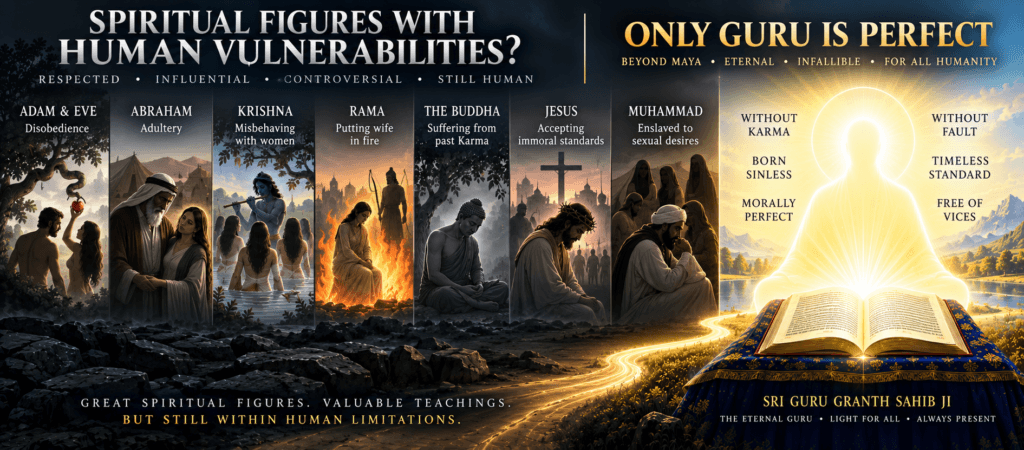
Throughout history, human beings have followed patriarchs, prophets, messengers, enlightened teachers, avatars and personalities believed to be divine. Their followers may regard them as exceptionally holy, chosen by God, protected by God, incarnations of deity or uniquely enlightened.
Sikhi makes a fundamentally different claim about Guru Nanak Dev Ji.
Guru Nanak Dev Ji was not an imperfect human being who gradually became holy. Guru Sahib was not a sinner selected by Vaheguru to deliver a Divine message. Nor was Guru Nanak Dev Ji a spiritual seeker who struggled through Maya, eventually achieved enlightenment and then became Guru.
The Sikh claim is much greater: Vaheguru (God) as the One and only Divine Guru, Himself manifested through Guru-Jot (Divine Light) and Guru-Shabad (Divine Word) as the physical manifestation of Guru Nanak Dev Ji. The same Guru-Jot continued through all Ten Guru-forms, and today the eternal Shabad Guru is present as Sri Guru Granth Sahib Ji.
Guru Nanak Dev Ji gives us perhaps the clearest starting point:
ਭੁਲਣ ਅੰਦਰਿ ਸਭੁ ਕੋ ਅਭੁਲੁ ਗੁਰੂ ਕਰਤਾਰੁ ॥
Bhullan andar sabh ko, abhul Guru Kartaar.
“Everyone is subject to error; the Guru and Creator are infallible.”— Sri Guru Granth Sahib Ji, Ang 61
The word abhul is fundamental. It does not merely mean that the Guru is wiser than ordinary people or makes fewer mistakes. Professor Sahib Singh explains abhul in relation to Maya: created beings can come under Maya’s influence and consequently take the wrong path, whereas the Guru-Creator does not come under Maya’s influence.
This establishes two fundamentally different categories.
There are created beings who can become influenced by Maya and fall into error.
And there is the Satguru, who is abhul.
Guru Nanak Dev Ji makes the distinction even more explicit:
ਪ੍ਰਥਮੇ ਬ੍ਰਹਮਾ ਕਾਲੈ ਘਰਿ ਆਇਆ ॥
“First, Brahma came under the power of Kaal.”ਆਗਿਆ ਨਹੀ ਲੀਨੀ ਭਰਮਿ ਭੁਲਾਇਆ ॥੧॥
“He did not accept the Divine Command and was led astray by delusion.”ਜੋ ਉਪਜੈ ਸੋ ਕਾਲਿ ਸੰਘਾਰਿਆ ॥
“Whatever comes into existence is overcome by Kaal.”ਮਾਇਆ ਮੋਹੇ ਦੇਵੀ ਸਭਿ ਦੇਵਾ ॥
“All celestial deities are caught in attachment to Maya.”ਕਾਲੁ ਨ ਛੋਡੈ ਬਿਨੁ ਗੁਰ ਕੀ ਸੇਵਾ ॥
“Without serving the Guru, they are not released from being subject to death cycle.”ਓਹੁ ਅਬਿਨਾਸੀ ਅਲਖ ਅਭੇਵਾ ॥੨॥
“That One is imperishable, unseen and beyond comprehension.”— Sri Guru Granth Sahib Ji, Ang 227
The expression devi-deva literally denotes female and male deities. “Celestial deities” communicates the sense more naturally in English without implying that Sikhi accepts independent Gods alongside Vaheguru.
The theological significance is profound. Being worshipped as divine does not make someone Satguru. Possessing supernatural powers does not establish moral perfection. Brahma can be deluded. Celestial deities can remain caught within Maya. They remain within Kaal and require the Guru.
The Guru, by contrast, is abhul.
Those caught within Maya require the Guru. The Satguru is the One who liberates them from it.
This gives Sikhs a coherent standard by which claims made about other religious personalities can be examined.
The question is not how many followers a person has, how many miracles are attributed to him, or whether his followers call him patriarch, prophet, messenger, enlightened one, avatar, Son of God or deity.
The deeper questions are these: Was this person always morally perfect? Was he completely beyond lust, anger, greed, possessive attachment and ego? Does his own religious literature describe disobedience, previous wrongdoing, Divine correction or morally difficult conduct? Must followers defend actions attributed to him by saying that they were normal or permissible within that particular historical society?
If so, Sikhi has no theological reason to place that personality in the same category as Satguru.
The biblical story begins with Adam and Eve living in Eden. Yet Genesis describes them disobeying God’s command concerning the forbidden tree. As a consequence, they are expelled from Eden, and cherubim guard the way to the tree of life.
“So the Lord God banished him from the Garden of Eden…”
— Genesis 3:23; see Genesis 3:1–24
Whatever theological interpretation Judaism or Christianity places upon the Fall, the narrative establishes an important distinction.
A being can begin in a condition of innocence and still fall.
That is not abhul.
The Sikh claim is not that Guru Nanak Dev Ji began innocent but possessed the possibility of subsequently rebelling against Vaheguru. Guru Sahib was beyond Maya from the beginning.
The comparison with Abraham is particularly significant because Judaism, Christianity and Islam all look back to Abraham as a foundational patriarch.
Genesis explicitly identifies Hagar as Sarah’s Egyptian slave. Sarah, distressed because she has no children, tells Abraham:
“Go, sleep with my slave…”
— Genesis 16:2
Abraham agrees. Genesis then says:
“He slept with Hagar, and she conceived.”
— Genesis 16:4
The narrative says that Sarah gave Hagar to Abraham “to be his wife”, reflecting an ancient social order in which a married man could take an enslaved woman as an additional wife or concubine. Yet Hagar remains a slave. After she becomes pregnant, serious conflict develops. Sarah tells Abraham:
“You are responsible for the wrong I am suffering.”
— Genesis 16:5
Abraham responds that Hagar remains under Sarah’s authority. Sarah then treats the pregnant Hagar harshly and Hagar flees. These details are stated directly in Genesis 16:1–6.
It is important to represent the Bible accurately. Sarah initially proposed the arrangement, and Genesis does not itself label Abraham’s conduct “adultery”. But that does not oblige Sikhs to accept the sexual morality of the society represented by Genesis.
From a Gurmat perspective, the underlying fact remains stark: a married Abraham had sex with an enslaved woman, impregnated her, and the resulting relationship produced suffering and serious conflict within his household.
Calling an enslaved woman an additional “wife” or “concubine” according to an ancient social convention does not make such conduct the eternal Sikh standard of marital fidelity.
The comparison with Guru Nanak Dev Ji is therefore not between two equivalent religious founders. Abraham is presented as a human patriarch living within the marriage, concubinage and slavery structures of his age.
Guru Nanak Dev Ji is Satguru — the manifestation of the perfect Divine Guru.
Hindu traditions make different theological claims about their avatars and deities. Their devotees often interpret apparently unusual actions through concepts such as Divine leela. Those interpretations deserve to be stated accurately, but Sikhi is not required to accept every deed attributed to an avatar as an eternal moral example.
The Bhagavata Purana provides a striking example.
Canto 10, Chapter 22 narrates unmarried gopis bathing in the Yamuna after leaving their garments on the bank. Krishna takes their clothes, climbs a tree and tells them to come out of the water to receive them. The girls eventually emerge while attempting to cover themselves. The text later describes them as having had their clothing stolen and having been deprived of their modesty.
Within the Vaishnava tradition, this episode receives a devotional interpretation concerning surrender and the gopis’ love for Krishna. That interpretation should not be concealed when explaining the source.
But a Sikh need not accept that theological interpretation as transforming the narrated conduct into the universal model of interaction between men and women.
The Gurmat criterion is not whether followers can interpret an action as leela.
The criterion is abhul Satguru.
Purāṇic traditions concerning Vishnu, Jalandhara and his wife Vrinda contain another morally difficult narrative. Versions of the story describe Vishnu assuming Jalandhara’s appearance and deceiving Vrinda, whose fidelity was connected with Jalandhara’s protection.
The exact details vary across Purāṇic recensions and later retellings, so a responsible article should cite the particular edition being used rather than pretend every version contains identical wording. The episode is associated with the Jalandhara-Vrinda narrative in the Śiva Purāṇa, Rudra Saṃhitā, Yuddha Kāṇḍa.
The larger Sikh point does not depend upon exaggerating the story. Gurbani has already supplied the theological principle:
ਮਾਇਆ ਮੋਹੇ ਦੇਵੀ ਸਭਿ ਦੇਵਾ ॥
“All celestial deities are caught in attachment to Maya.”
Supernatural or celestial status does not itself establish Satguruship.
The Ramayana traditions preserve difficult episodes concerning Rama’s treatment of Sita.
After Sita is recovered from Ravana, the narrative includes the public questioning of her purity and her ordeal by fire. The later Uttara Kāṇḍa narrates the pregnant Sita being sent away following criticism among Rama’s subjects.
These episodes have generated extensive Hindu theological interpretation. Some understand Rama as fulfilling the duties of a king; others emphasise that Rama knew Sita was pure; others understand the events symbolically or within the framework of Divine leela.
The Sikh argument need not dismiss those interpretations. The more fundamental question is why conduct attributed to a supposedly perfect avatar requires later interpreters to reconcile it with the moral intuition that an innocent and faithful wife should not have to prove her purity or suffer abandonment because of public suspicion.
The Sikh claim concerning Guru Nanak Dev Ji requires no equivalent separation between what the Guru taught and conduct attributed to the Guru that Sikhs subsequently have to morally defend.
The Guru is the standard.
Buddhism presents a different theological model.
The Pāli Buddhist tradition includes accounts connecting sufferings experienced in the Buddha’s final existence with actions in previous existences. The Apadāna material traditionally known in discussions of the Buddha’s previous karma attributes bodily afflictions to earlier deeds.
This should be understood according to Buddhist concepts of karma and rebirth rather than inaccurately described using an Abrahamic concept of “sin”.
Nevertheless, the distinction from Satguru remains important.
A being who progresses through previous existences and ultimately attains enlightenment is not the same theological claim as the Divine Guru who was never spiritually unenlightened.
Guru Nanak Dev Ji did not possess a morally imperfect past that had to be overcome.
Guru Sahib did not accumulate spiritual knowledge until he qualified to become Guru.
Guru Nanak Dev Ji was Satguru from the beginning.
Christianity provides perhaps the closest direct comparison because Christians explicitly claim that Jesus was without sin. Hebrews 4:15 describes Jesus as tempted or tested as human beings are, yet “without sin”.
A serious Sikh comparison should acknowledge that claim.
The question, however, is not merely whether a religion declares its central personality sinless. It is whether the teachings and conduct attributed to that person constitute an unproblematic eternal moral standard.
Luke records Jesus saying:
“Do you think I came to bring peace on earth? No, I tell you, but division.”
— Luke 12:51
The passage continues by describing divisions between father and son, mother and daughter, and other members of a household (Luke 12:51–53).
Luke 14:26 contains even more striking language: a person who comes to Jesus without “hating” father, mother, wife, children, brothers and sisters cannot be his disciple.
Christian interpreters generally do not understand this as a command literally to despise one’s parents. It is commonly explained as Semitic hyperbole emphasising that commitment to Jesus must take precedence over every human relationship. That explanation should be acknowledged.
The New Testament also emerges from a slaveholding society without recording Jesus explicitly abolishing slavery. Jesus uses master-slave relationships within his parables, including imagery involving physical punishment in Luke 12:45–48. A parable containing slavery does not by itself prove approval of slavery, and that distinction matters.
Yet the comparative question remains: if someone is presented as God manifested amongst humanity and as the perfect moral example for all ages, what should perfect Divine morality look like when confronted with institutions such as human slavery?
The Sikh conception of Satguru does not depend upon saying that the Guru’s morality belonged to fifteenth-century Panjab but needs reinterpretation for the modern world.
The Guru embodies Sach, which transcends the age.
Islam presents Muhammad as the Messenger of Allah and an exemplary model. Classical Muslim theology also developed doctrines of prophetic protection, generally discussed under ʿismah, although Muslim theological schools have differed concerning its precise extent.
Yet Islamic primary sources themselves provide material that distinguishes the Islamic conception of prophethood from the Sikh conception of abhul Satguru.
The Qur’an tells Muhammad:
“ask forgiveness for your sin…”
— Qur’an 47:19
English translations differ: some render the Arabic dhanb as “sin”, others as “fault”, and Muslim theologians interpret such passages in ways consistent with prophetic ʿismah. Nevertheless, the underlying command to seek forgiveness is present in the Qur’anic text.
Qur’an 48:2 similarly speaks of Allah forgiving what preceded and followed of Muhammad’s dhanb. Qur’an 80:1–10 begins with the famous incident, “He frowned and turned away”, traditionally associated in Islamic commentary with Muhammad’s response when the blind man Ibn Umm Maktum approached him.
Whatever theological explanations Muslims give these passages, the model is distinguishable from:
ਅਭੁਲੁ ਗੁਰੂ ਕਰਤਾਰੁ ॥
“The Guru and Creator are infallible.”
Islamic literature also attributes to Muhammad conduct that today frequently requires historical defence.
The best-known example concerns Aisha. Sahih al-Bukhari records Aisha as saying that Muhammad married her when she was six years old and consummated the marriage when she was nine. The reference is Sahih al-Bukhari 5134, Book 67, Hadith 70.
Some contemporary Muslims question whether the traditional age can be historically reconciled with other chronological evidence. Others accept the canonical Hadith and defend the marriage according to social conditions and concepts of maturity in seventh-century Arabia.
But this brings us directly back to the Sikh test.
If conduct attributed to someone presented as humanity’s moral example has to be defended principally on the basis that it was acceptable within his historical society, that is a different claim from the Sikh doctrine of the timeless Satguru.
Guru Nanak Dev Ji’s morality does not have to be confined to the norms of fifteenth-century Panjab in order to remain defensible today.
None of these comparisons requires Sikhs to say that every other religious personality was wholly evil or that nothing valuable can be found within other traditions.
That is not the argument.
The argument is that religious greatness and Divine Guruship are not interchangeable categories.
One tradition may describe a patriarch with human failings and complicated relationships.
Another may describe a prophet who receives Divine correction.
Another may describe someone who progresses through previous existences before attaining enlightenment.
Another may describe an avatar whose morally difficult actions are explained as Divine leela.
Another may claim that a personality is God incarnate while interpreting difficult sayings through a particular historical or theological framework.
Sikhi makes a different claim.
The Satguru is the manifestation of the perfect Divine Guru-Jot and is therefore abhul.
This is perhaps the simplest way to understand the difference.
Some religious narratives describe innocence followed by a fall.
Some describe mistakes followed by Divine correction.
Some describe previous karma followed eventually by enlightenment.
Some contain conduct defended according to the social standards of a particular historical period.
Some explain morally difficult actions as leela, mystery or exceptional Divine permission.
Sikhi requires none of these explanations for Guru Nanak Dev Ji.
There was no sinful Guru Nanak who later became pure.
There was no unenlightened Guru Nanak who later became enlightened.
There was no lustful Guru Nanak who later conquered lust.
There was no greedy Guru Nanak who later renounced greed.
There was no ego-driven Guru Nanak who later conquered Haumai.
There was no morally compromised Guru Nanak who subsequently received Gurbani correcting his behaviour.
Guru from the beginning. Pure from the beginning. Perfect from the beginning. Beyond Maya from the beginning.
Why?
Because Guruship did not originate from the human ego of Nanak.
Its source was Divine.
The Sikh claim becomes even more remarkable because it extends beyond a single historical life.
The one Guru-Jot manifested successively through the Ten Guru-forms. Across approximately two centuries, circumstances changed dramatically while the moral source remained the same.
Guru Nanak Dev Ji demonstrates truthful living, humility, compassion and fearlessness. Guru Arjan Dev Ji demonstrates acceptance of Hukam while enduring torture. Guru Hargobind Sahib Ji demonstrates that spirituality does not require passivity before oppression. Guru Tegh Bahadur Sahib Ji sacrifices his life defending the freedom of people belonging to another faith. Guru Gobind Singh Ji gives his father, mother, four Sahibzaade and countless beloved Sikhs while refusing to abandon Dharam.
The Guru appears as householder, traveller, teacher, poet, community builder, martyr, sovereign and warrior. Yet Sikhs do not discover an immoral phase of Guruship that later generations must explain away.
The circumstances change.
The Guru-Jot does not.
This is where a common missionary objection fails to understand the nature of Gurbani.
Christian and Muslim missionaries sometimes search English translations of Sri Guru Granth Sahib Ji and isolate first-person expressions such as “I am sinful”, “I have no virtues” or “I am foolish”. They then treat these as autobiographical confessions by Guru Nanak Dev Ji.
But Sri Guru Granth Sahib Ji is not Guru Nanak Dev Ji’s autobiography.
Gurbani is Shabad Guru, revealed for humanity to sing, recite, contemplate and internalise.
Imagine if the Guru had instead given Sikhs hymns saying: “I am perfect. I possess every virtue. I have no faults. I am spiritually superior.”
Who would now sing those words?
We would.
Human beings still struggling with Kaam, Krodh, Lobh, Moh and Haumai would repeatedly proclaim their own perfection. Rather than destroying ego, such language could strengthen it.
Instead, the perfect Guru places the language of perfect nimrata (humility) upon the lips of imperfect disciples.
The decisive statement concerning the Guru himself remains:
ਭੁਲਣ ਅੰਦਰਿ ਸਭੁ ਕੋ ਅਭੁਲੁ ਗੁਰੂ ਕਰਤਾਰੁ ॥
“Everyone is subject to error; the Guru and Creator are infallible.”
The Guru does not need Gurbani to correct His immoral behaviour.
We need Gurbani to correct ours.
We can now return to the central question: Was Guru Nanak Dev Ji God?
The Sikh answer is yes — but it must be understood according to Gurmat, rather than importing another religion’s concept of incarnation.
The finite physical body was not the totality of Infinite Vaheguru. Vaheguru cannot be confined within a human organism. Nor was Guru Nanak Dev Ji a second God alongside Vaheguru.
There is only Ik Oann-Kaar.
The Sikh claim is that the Divine Guru-Jot manifested through Guru Nanak Dev Ji. The Guru-form appeared within history; the source of Guruship was not created within history.
Guru Nanak Dev Ji therefore did not have to find God before becoming Guru.
The Divine Guru came to reveal Vaheguru to us.
Guru Nanak Dev Ji says of the revealed Baani:
ਜੈਸੀ ਮੈ ਆਵੈ ਖਸਮ ਕੀ ਬਾਣੀ ਤੈਸੜਾ ਕਰੀ ਗਿਆਨੁ ਵੇ ਲਾਲੋ ॥
Jaisi mai aavai Khasam kee Baani, taisrra kari giaan ve Lalo.
“As the Divine Word of my Master comes to me, so I proclaim it, O Lalo.”— Sri Guru Granth Sahib Ji, Ang 722
Guru-Jot and Guru-Shabad manifest the same Divine Guruship.
If Guru Nanak Dev Ji were merely the human founder of a religion, Sikhs today could only look backwards towards a great teacher who died centuries ago.
But Guruship never depended upon one physical body.
The same Guru-Jot continued through all Ten Guru-forms. The Divine Shabad was revealed and preserved, and eternal Guruship was bestowed upon Sri Guru Granth Sahib Ji.
Therefore, the Sikh does not merely possess writings left behind by a deceased founder.
The Sikh has Guru today.
Sri Guru Granth Sahib Ji is not merely information about a Guru who existed in the past. Guru Sahib is the eternal Shabad Guru through whom Divine Wisdom continues to enlighten humanity.
The Sikh position can therefore be expressed simply.
History contains remarkable religious personalities. Some are called patriarchs. Some prophets. Some messengers. Some enlightened teachers. Some avatars. Some celestial deities. Some are claimed to be manifestations of God.
But titles do not establish perfection.
Gurbani gives us the criterion.
Created beings — even exalted celestial beings — may become caught within Maya:
ਮਾਇਆ ਮੋਹੇ ਦੇਵੀ ਸਭਿ ਦੇਵਾ ॥
“All celestial deities are caught in attachment to Maya.”
Those within Maya require the Guru:
ਕਾਲੁ ਨ ਛੋਡੈ ਬਿਨੁ ਗੁਰ ਕੀ ਸੇਵਾ ॥
“Without serving the Guru, Kaal does not release them.”
But the Guru is categorically distinguished from created fallibility:
ਭੁਲਣ ਅੰਦਰਿ ਸਭੁ ਕੋ ਅਭੁਲੁ ਗੁਰੂ ਕਰਤਾਰੁ ॥
“Everyone is subject to error; the Guru and Creator are infallible.”
This is the dividing line between created spiritual greatness and Divine Guruship.
Those affected by Maya require the Guru. The Satguru is beyond Maya. Therefore the Satguru cannot belong to the same category as the beings whom the Guru liberates.
Guru Nanak Dev Ji was not another imperfect human being attempting to reach the Perfect One.
The Perfect Divine Guru manifested as Guru Nanak Dev Ji to lead imperfect humanity towards Vaheguru.
That is why Sikhs do not have to defend Guru Sahib by saying, “It was acceptable in those days.”
Divine Truth does not become immoral when the century changes.
Kaam remains Kaam. Krodh remains Krodh. Lobh remains Lobh. Moh remains Moh. Haumai remains Haumai. Exploitation remains exploitation. Falsehood remains falsehood.
And Sach remains Sach.
Guru Nanak Dev Ji therefore did not merely teach humanity the moral standard.
The Guru perfectly embodied it.
Pure from the beginning. Perfect from the beginning. Never conquered by Maya. Never morally corrupted. Never requiring repentance for immoral conduct. Never requiring another Guru to enlighten Him. Never requiring Sikhs to lower the moral standard to defend His actions.
The Divine Guru-Jot manifested through all Ten Guru-forms, and the eternal Guru remains present today as Sri Guru Granth Sahib Ji.
Others may be revered as patriarchs, prophets, messengers, enlightened beings, avatars or celestial deities.
But in Gurmat, only Guru is Satguru — abhul, beyond Maya, the perfect and timeless spiritual and moral standard for all humanity.
ਭੁਲਣ ਅੰਦਰਿ ਸਭੁ ਕੋ ਅਭੁਲੁ ਗੁਰੂ ਕਰਤਾਰੁ ॥
Bhullan andar sabh ko, abhul Guru Kartaar.
“Everyone is subject to error; the Guru and Creator are infallible.”
— Sri Guru Granth Sahib Ji, Ang 61
We’re here to help. Whether you’re curious about Gurbani, Sikh history, Rehat Maryada or anything else, ask freely. Your questions will be received with respect and answered with care.
Ask Question