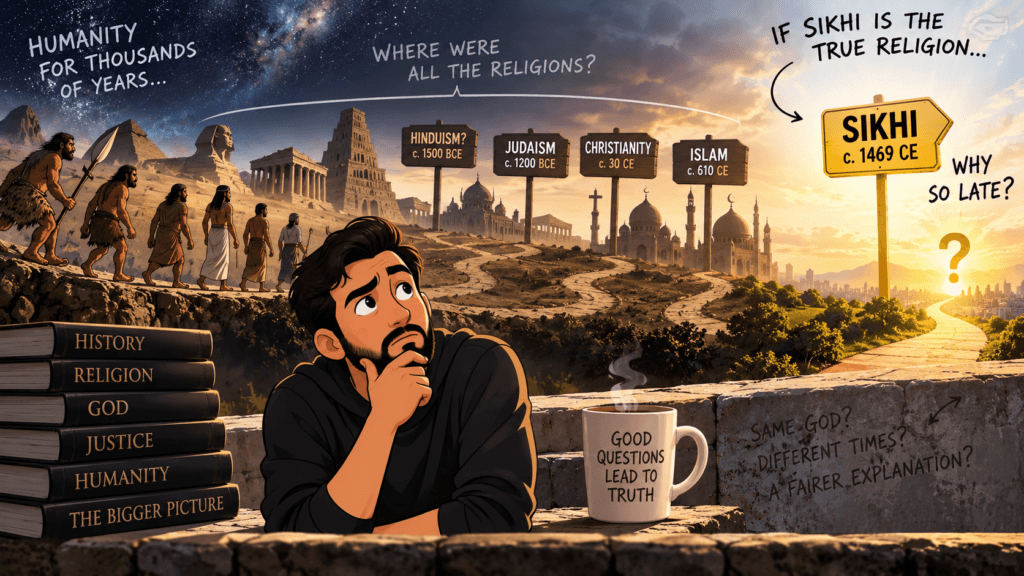
A common question asked about Sikhi is: if Sikhi is the true religion, why was it revealed through Guru Nanak Dev Ji only about 500 years ago? Human beings had existed for thousands of years before this, so what happened to all those people? If Sikhi is God’s true path, should it not have existed from the beginning of time?
The question sounds challenging, but it begins with an assumption that needs examining. Which organised religion actually existed at the beginning of time? Christianity did not. Islam did not. Nor did Sikhi exist as an organised human religion. Before human beings existed, there could be no churches, mosques, Gurdwaras (Sikh places of worship), scriptures in human languages or organised religious communities.
At the beginning, there was only God.
This is precisely where Sri Guru Granth Sahib Ji begins:
Aad Sach, Jugaad Sach. Hai Bhee Sach, Nanak Hosee Bhee Sach.
“True in the primal beginning, True throughout the ages. True now, O Nanak, and forever shall be True.”
Sikhs commonly use the name Vaheguru for God — the One eternal Divine Being who created and pervades everything. Sikhi does not claim that Vaheguru or Divine Truth came into existence when Guru Nanak Dev Ji was born in 1469. God is eternal. Naam — the Divine Name and living presence of God — is eternal. Hukam — the Divine Order within which all creation exists — is eternal.
What happened through Guru Nanak Dev Ji was revelation, not invention.
It is common to read that Guru Nanak Dev Ji “founded” Sikhi. This can be useful as historical shorthand, but it can also give the wrong impression. According to Sikhi, Guru Nanak Dev Ji did not sit down and construct a new philosophy or decide to establish a new religion from his own ideas. The Guru describes the source of his message:
Jaisee mai aavai Khasam kee Baanee, taisrraa karee giaan ve Laalo.
“As the Divine Word of my Master comes to me, so I proclaim it, O Lalo.”
(Sri Guru Granth Sahib Ji, Ang 722)
Gurbani — the revealed Divine Word contained within Sri Guru Granth Sahib Ji — is therefore understood as revelation from God. The Sikh claim is not that Divine Truth suddenly became true in the fifteenth century. Rather, the eternal Truth was revealed through Guru Nanak Dev Ji within human history.
This distinction answers one part of the question, but an important issue remains. If the complete path was revealed through Guru Nanak Dev Ji, what happened to the countless human beings who lived before him?
Sikhi does not teach that people who lived before Guru Nanak Dev Ji were abandoned by God or condemned simply because they were born too early. To understand why, we need to understand a fundamental Sikh teaching: one physical lifetime is not the entire existence of the soul.
Sikhi teaches that the soul passes through repeated births and deaths. Our actions have consequences — known as karam — and the soul continues its journey within Hukam, God’s Divine Order. Human birth is especially precious because it provides the opportunity to seek liberation and ultimately become united with God.
Sri Guru Granth Sahib Ji says:
Bheyee paraapat maanukh dehuree-aa. Gobind milan kee ih teree baree-aa.
“You have obtained this human body. This is your opportunity to meet the Lord.”
(Sri Guru Granth Sahib Ji, Ang 12)
Consider someone who lived 10,000 years ago. That person obviously could not have heard the teachings of Guru Nanak Dev Ji during that particular lifetime. According to Sikhi, however, the death of that person’s body did not necessarily mark the end of the soul’s existence. The soul remained within God’s Divine Order, experienced the consequences of its actions, and continued its spiritual journey through further births.
No soul was born “too early” for God.
This means that those who lived before Guru Nanak Dev Ji had not permanently missed the opportunity for liberation. Their spiritual journey continued, and as the soul progressed it could eventually receive, through Divine Grace, the opportunity to encounter the Guru and Naam.
Yes. Sikhi does not teach that everyone who lived before Guru Nanak Dev Ji was spiritually lost, or that nobody had any relationship with God before 1469. People could pray, remember God, practise compassion and self-discipline, perform good actions and make genuine spiritual progress.
Sri Guru Granth Sahib Ji itself contains the sacred compositions of several Bhagats — spiritually enlightened devotees of God — who lived before Guru Nanak Dev Ji. Their inclusion makes it clear that Sikhi does not claim that spiritual awareness suddenly became possible in the fifteenth century.
The Sikh claim is more specific. Through Guru Nanak Dev Ji, the complete path of Gurmat — literally, the Guru’s wisdom and way — and Naam was revealed to humanity, providing the way by which the soul can ultimately become free from repeated birth and death and attain complete union with God.
There is therefore a distinction between making spiritual progress and receiving the complete path to final liberation. Those who lived before Guru Nanak Dev Ji were not abandoned. They remained within God’s care, and the journey of their souls continued.
This understanding also addresses a difficulty that arises if we assume everyone has only one earthly lifetime in which to find the correct religion.
Consider two people. One is born into a devout religious household and is taught from childhood that its religion is true. Its scripture, prayers and beliefs surround that person from infancy. Another is born on the opposite side of the world into a completely different religion and is taught its beliefs with equal sincerity. Neither chose their parents, country, century or religious upbringing.
If eternal salvation depended upon identifying and accepting one particular religion within that single lifetime, the two people would clearly not have begun with the same opportunity. The difficulty becomes even greater when we consider someone who lived centuries before the supposedly necessary revelation had even occurred.
Sikhi does not make a soul’s ultimate destiny depend simply upon the historical accident of birthplace or century. The soul’s journey extends beyond one physical lifetime. Someone who has not yet encountered the Guru’s path has not necessarily lost that opportunity forever. Through Hukam, karam and Divine Grace, the soul continues its journey and can receive further opportunities for spiritual progress and liberation.
The same principle helps explain what happens to babies who die in the womb or shortly after birth. Such a child has had no meaningful opportunity to study religion, consciously worship God or choose between competing religious claims. Sikhi does not regard that brief physical existence as the beginning and end of the soul’s entire journey. The soul remains within God’s Divine Order and justice; physical death does not bring that journey to an arbitrary end.
Any revelation that enters human history must appear at some particular point in time. Simply moving that date further backwards does not solve the underlying question. If Christianity appeared around 2,000 years ago, we can ask what happened to people who lived 5,000 years ago. If Islam appeared around 1,400 years ago, we can ask what happened to those who lived before it. The same basic question can be asked of any religion whose revelation occurs within history.
Sikhi does not attempt to solve this by claiming that the organised Sikh religion physically existed from the beginning of humanity. Instead, it distinguishes between eternal Divine Truth and the historical revelation of that Truth.
Guru Nanak Dev Ji came into this world according to Hukam — God’s Divine Order and Will. Those who lived beforehand had not “missed their chance”, because their souls were not restricted to the one physical lifetime in which they happened to live before the Guru’s coming.
Their journey continued.
The original question therefore confuses the age of an organised religion with the age of the Truth it reveals. Sikhi does not claim that God began with Guru Nanak Dev Ji, that Naam began in 1469, or that nobody before Guru Nanak Dev Ji could know or remember God. It teaches that Vaheguru is eternal, that souls have existed within the Divine Order throughout human history, and that spiritual progress was possible before Guru Nanak Dev Ji.
At the time ordained by Vaheguru, Guru Nanak Dev Ji came into this world and revealed the complete path of Gurmat and Naam, through which the human soul can ultimately escape the cycle of repeated birth and death and attain union with God in Sach Khand — the highest spiritual realm and state of complete union with the Divine.
So the Sikh position is not:
“The Truth began 500 years ago.”
It is:
“The Truth is eternal. Guru Nanak Dev Ji revealed that eternal Truth to humanity at the time ordained by God.”
No soul was forgotten before Guru Nanak Dev Ji. No one was eternally disadvantaged because they happened to be born in the wrong century. Their lives and spiritual journeys remained within the justice and care of the same eternal God whom Sri Guru Granth Sahib Ji describes:
Aad Sach, Jugaad Sach. Hai Bhee Sach, Nanak Hosee Bhee Sach.
“True in the beginning. True throughout the ages. True now. Forever True.”
We’re here to help. Whether you’re curious about Gurbani, Sikh history, Rehat Maryada or anything else, ask freely. Your questions will be received with respect and answered with care.
Ask Question