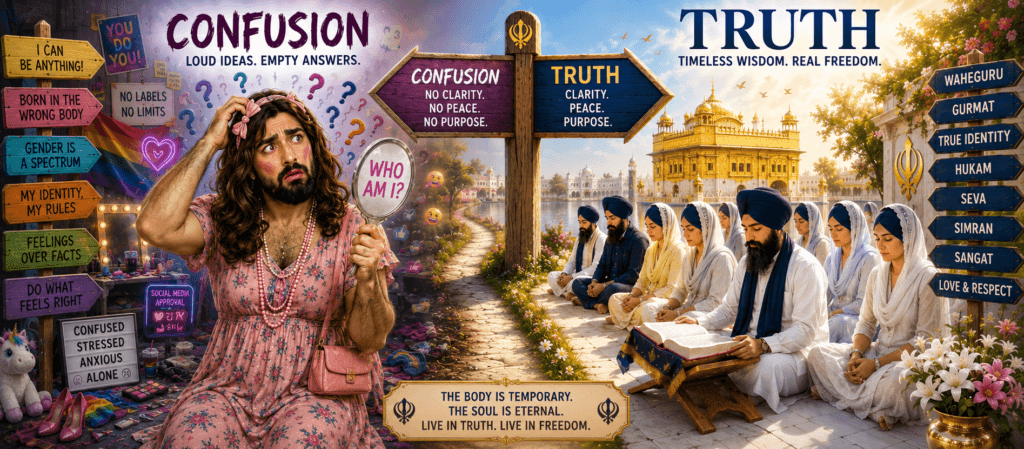
Questions about transgender identity have become increasingly prominent in modern society. A Sikh may hear that biological sex and gender are separate, that someone can be “born in the wrong body”, or that an internal sense of gender determines whether someone is male or female.
How should a Sikh understand these claims?
Transgender identity is often grouped together with homosexuality under the wider label “LGBTQ+”, but they are different questions. Homosexuality concerns sexual attraction and relationships. Transgender identity concerns the relationship between biological sex and a person’s internal sense of identity.
For a Sikh, the starting point is neither politics nor hostility towards anyone experiencing gender dysphoria. It is Gurmat (the Divine Wisdom and teachings of the Guru).
In Sikhi, the Guru is not merely a human teacher, prophet or philosopher. The Guru is Vaheguru Himself in the role of the eternal Divine Guide — the Divine Light, Voice and Wisdom that guides humanity towards Truth. Therefore, a Sikh seeks to understand the human person through the Guru, rather than changing the Guru’s teachings to fit changing ideas in society.
Modern discussions about gender identity often begin with the question, “What do I feel that I am?” Sikhi begins deeper: Who is the “I” experiencing that feeling?
Guru Sahib says:
ਮਨ ਤੂੰ ਜੋਤਿ ਸਰੂਪੁ ਹੈ ਆਪਣਾ ਮੂਲੁ ਪਛਾਣੁ ॥
“O mind, you are the embodiment of Divine Light; recognise your Origin.”
— Sri Guru Granth Sahib Ji, Ang 441
Our deepest identity is the Aatma (the spiritual self or soul). We are more than our physical appearance, nationality, occupation, desires or feelings. The Sikh spiritual journey is ultimately about recognising our Divine Origin and connecting with Vaheguru.
Yet being more than the body does not make the body unreal or self-defined. Gurbani says:
ਏਤੇ ਅਉਰਤ ਮਰਦਾ ਸਾਜੇ ਏ ਸਭ ਰੂਪ ਤੁਮੑਾਰੇ ॥
“(Creating humanity,) You created many women and many men; all of them being Your forms.”
— Sri Guru Granth Sahib Ji, Ang 1349
Gurbani presents the Divine pattern for embodied humanity as women and men — female and male. Notice where the act of creation lies: “You created many women and many men.” Biological sex is not presented as something an individual creates for themselves according to an internal feeling. It belongs to the Divine design of human embodiment.
This does not mean that the Aatma itself is male or female. The spiritual self transcends the physical body. But spiritual transcendence does not make physical distinctions imaginary. Gurbani can therefore affirm both truths simultaneously: women and men share the same Divine origin and spiritual worth, while male and female remain real distinctions within embodied human existence.
Spiritual equality does not require biological sameness.
Human bodies do not always develop according to the ordinary physical pattern. Some people are born with disabilities, genetic conditions or variations of sexual development. This does not require Sikhi to abandon the underlying Divine pattern of creation.
In Japji Sahib, Guru Nanak Dev Ji says:
ਕਰਮੀ ਆਵੈ ਕਪੜਾ ਨਦਰੀ ਮੋਖੁ ਦੁਆਰੁ ॥
“Through past karam (actions), the robe of the physical body is obtained; but through Divine Grace, the doorway of liberation is found.”
— Sri Guru Granth Sahib Ji, Ang 2
Karam refers to actions and their consequences across the spiritual journey of the jeev (individual living being). Sikhi therefore understands the particular physical body received in this birth within the much wider framework of karam and Hukam (Divine Order).
An analogy may help. The ordinary human bodily pattern includes two arms and two legs. A person may nevertheless be born with one arm. That person is no less human and no less spiritually valuable, but the variation does not establish that the human biological blueprint has no normal pattern.
A physical variation from a pattern does not create a new biological blueprint.
This is relevant to intersex conditions — uncommon variations in sex characteristics or sexual development. Intersex should not be confused with transgender identity, which concerns someone’s internal sense of gender. People with intersex conditions deserve the same dignity as everyone else, but the existence of atypical sexual development does not by itself make biological sex a matter of self-identification.
Significantly, Gurbani itself was not unaware of people whose sexual development differed from the ordinary male-female pattern. Bhagat Kabir Ji refers explicitly to a khusra (eunuch):
ਬਿੰਦੁ ਰਾਖਿ ਜੌ ਤਰੀਐ ਭਾਈ ॥
ਖੁਸਰੈ ਕਿਉ ਨ ਪਰਮ ਗਤਿ ਪਾਈ ॥੩॥“If someone could save himself by celibacy, why then haven’t eunuchs obtained the state of supreme dignity?”
— Sri Guru Granth Sahib Ji, Ang 324
The purpose of the verse is spiritual: Bhagat Kabir Ji is rejecting the idea that celibacy itself produces liberation. His argument works precisely because the khusra is recognised as having a physical sexual condition without that condition itself determining spiritual attainment. The conclusion of the Shabad is that liberation comes through the Divine Name, not through bodily condition.
Guru Arjan Dev Ji elsewhere also uses “kaa-purakh” — explained in traditional Punjabi interpretation as khusra/hijra — in an analogy involving a woman. Again, Gurbani acknowledges such people without constructing from their existence a new self-defined category of biological sex.
Bhai Gurdas Ji similarly lists khusre/hijre among numerous human physical conditions and variations. His wider point is not to demean any of them, but that every embodied human being remains subject to birth and death without the Perfect Guru. Physical condition does not determine spiritual worth or liberation.
This is important. Sikh scripture and tradition did not need modern society to inform them that human bodies can develop atypically. Such people were already known and mentioned. Their existence does not overturn the broader pattern in which Gurbani speaks of Vaheguru creating “many women and many men”.
Transgender identity raises a different question. Rather than an observable variation of physical development, it concerns a person’s internal experience of their gender in relation to their biological sex.
Someone experiencing gender dysphoria may feel a profound conflict between their internal sense of self and their body. That experience should not be mocked or dismissed. But an important distinction remains between the reality of a feeling and the interpretation of that feeling.
A feeling can be entirely sincere without every conclusion drawn from it necessarily being true.
A seventy-year-old may genuinely say, “Inside, I feel 25.” The feeling may accurately describe their internal experience, but it does not alter their biological age.
Likewise, if someone sincerely felt that they belonged to a different racial ancestry, the sincerity of the experience would not change their ancestry.
Age, ancestry and biological sex are different things, but the logical principle is the same: an internal experience does not automatically redefine an external biological reality.
This also exposes the difficulty with saying that “a woman is anyone who identifies as a woman”. What does “woman” mean in the phrase “identifies as a woman”? If the answer is again “someone who identifies as a woman”, the definition becomes circular.
If someone asked, “What is a doctor?” and the answer were “anyone who identifies as a doctor”, we still would not know what a doctor actually is.
Recognising this is not the same as denying someone’s feelings. It simply distinguishes two claims: “This is genuinely how I feel” and “therefore this feeling determines what I objectively am.”
Sikhi does not treat the mind as the final authority over reality. Guru Sahib says:
ਮਨਿ ਜੀਤੈ ਜਗੁ ਜੀਤੁ ॥
“Conquer the mind, and you conquer the world.”
— Sri Guru Granth Sahib Ji, Ang 6
The Sikh spiritual path involves bringing the mind under the guidance of the Guru. Human beings experience powerful desires, fears, attractions, anxieties and perceptions about themselves. Sikhi neither tells us to pretend these experiences do not exist nor assumes that every deeply felt experience must define reality.
This is the distinction between Gurmat and Manmat (following one’s own mind rather than the Guru).
There may also be more than one explanation for why someone’s internal sense of themselves conflicts with their present body.
Sikhi teaches reincarnation. The jeev has passed through previous births and bodily forms. Within this worldview, impressions or tendencies carried from previous births could potentially influence experiences in the present life. Someone who previously occupied a different bodily form could conceivably carry impressions associated with that existence. This is one possible Sikh explanation; we cannot know that it applies to any particular individual.
A simple analogy illustrates the point. Suppose someone genuinely remembered having different parents in a previous birth. Even if the memory were authentic, their present biological parents would not thereby become the “wrong parents”. A previous-life impression may help explain an internal experience without cancelling the reality of the present birth.
The same applies to embodiment. Even if an internal feeling were connected with a previous bodily existence, it would not mean that Vaheguru has mistakenly given the jeev the wrong present body.
Guru Nanak Dev Ji says:
ਹੁਕਮੀ ਹੋਵਨਿ ਆਕਾਰ ਹੁਕਮੁ ਨ ਕਹਿਆ ਜਾਈ ॥
“Through His Hukam, forms come into being.”ਹੁਕਮੈ ਅੰਦਰਿ ਸਭੁ ਕੋ ਬਾਹਰਿ ਹੁਕਮ ਨ ਕੋਇ ॥
“Everyone is within His Hukam; no one is outside His Hukam.”
— Sri Guru Granth Sahib Ji, Ang 1
Our present embodiment exists within Hukam, not outside it.
Not every feeling requires a previous-life explanation. Human beings also understand themselves using the concepts and language available around them.
This is especially relevant to children. A child’s understanding of themselves develops within family life, school, friendships, television, cartoons, films, the internet and social media. The ideas repeatedly presented to children can therefore influence the language and framework through which they interpret their experiences.
Consider a girl who dislikes dresses, prefers traditionally masculine interests and feels different from other girls. If she has repeatedly encountered the idea that such discomfort may mean she is really a boy, she may begin interpreting her personality through that framework.
But another explanation is much simpler: she may simply be a girl who does not conform to stereotypes about girls.
Similarly, a boy may be gentle, artistic, emotionally expressive and uninterested in stereotypically masculine activities. None of these qualities makes him female.
This does not mean that exposure to ideas about gender automatically causes gender dysphoria. It means that the concepts presented to us can influence how we interpret and label our feelings. Continually encouraging a child to ask whether they “feel like” a boy or girl may therefore turn ordinary differences in personality, interests or temperament into questions about their sex that they might otherwise never have entertained.
There is also a contradiction in using gender stereotypes to establish gender identity. If society’s expectations about what boys and girls should like are merely stereotypes, why should failing to conform to those stereotypes become evidence that someone is actually the opposite sex?
A girl does not have to become a boy in order to reject feminine stereotypes, and a boy does not have to become a girl in order to reject masculine ones.
Sikhi gives young people room to reject stereotypes without rejecting their bodies.
Some may argue that because Sikhi teaches that the Aatma transcends the physical body, biological sex should not matter.
Gurbani itself shows why that conclusion does not follow.
Gurbani frequently describes the jeev as the soul-bride and Vaheguru as the Husband Lord. This spiritual imagery applies to male and female Sikhs alike. A male Sikh does not become biologically female because Gurbani describes his spiritual relationship with Vaheguru through the imagery of a bride.
The metaphor concerns the relationship between the Aatma and Vaheguru, not a transformation of biological sex.
The same distinction appears when Gurbani describes marriage:
ਧਨ ਪਿਰੁ ਏਹਿ ਨ ਆਖੀਅਨਿ ਬਹਨਿ ਇਕਠੇ ਹੋਇ ॥
ਏਕ ਜੋਤਿ ਦੁਇ ਮੂਰਤੀ ਧਨ ਪਿਰੁ ਕਹੀਐ ਸੋਇ ॥੩॥“They are not called husband and wife merely because they sit together. They alone are called husband and wife who are one light in two bodies.”
— Sri Guru Granth Sahib Ji, Ang 788
The spiritual unity — “one light” — does not erase the embodied distinction. The same Gurbani calls them ਧਨ ਪਿਰੁ — wife and husband.
This brings us back to the principle established at the beginning: spiritual oneness does not mean biological sameness.
None of this gives a Sikh permission to ridicule, bully or mistreat someone who identifies as transgender. Someone experiencing gender dysphoria may be experiencing genuine distress and should be treated with compassion. A classmate, work colleague, neighbour or anyone else deserves human dignity.
But respect does not require agreement.
A Sikh can respect a Christian without accepting Christianity as Gurmat. A Sikh can respect an atheist without accepting atheism. Likewise, respecting someone who identifies as transgender does not require a Sikh to accept that an internal identity changes biological sex.
Gurbani provides the balance beautifully:
ਏਤੇ ਅਉਰਤ ਮਰਦਾ ਸਾਜੇ ਏ ਸਭ ਰੂਪ ਤੁਮੑਾਰੇ ॥
“(Creating humanity,) You created many women and many men; all of them being Your forms.”
— Sri Guru Granth Sahib Ji, Ang 1349
Every person has dignity and spiritual worth. At the same time, Gurbani presents embodied humanity as women and men, created by Vaheguru. Equality does not require the distinction to disappear.
The Sikh position is therefore neither “you are merely your body” nor “your body is whatever your mind says it is.” Our deepest identity is the Aatma, yet the body of this birth is real. The Divine pattern of embodied humanity is male and female; individual physical variations exist within karam and Hukam; and an internal feeling, however sincere, does not by itself redefine biological reality.
Ultimately, the question is one of authority. Does the mind determine reality for itself, or does the Divine Guru teach the mind how to understand itself?
Guru Sahib says:
ਮਨ ਤੂੰ ਜੋਤਿ ਸਰੂਪੁ ਹੈ ਆਪਣਾ ਮੂਲੁ ਪਛਾਣੁ ॥
“O mind, you are the embodiment of Divine Light; recognise your Origin.”
— Sri Guru Granth Sahib Ji, Ang 441
The Guru does not tell the mind to invent its identity. The Guru tells the mind to recognise its true Origin.
For a Sikh, compassion and Truth therefore belong together. We respect the dignity of every human being while allowing Gurmat, rather than changing social ideas or our own internal feelings, to guide our understanding of who we are.
We’re here to help. Whether you’re curious about Gurbani, Sikh history, Rehat Maryada or anything else, ask freely. Your questions will be received with respect and answered with care.
Ask Question